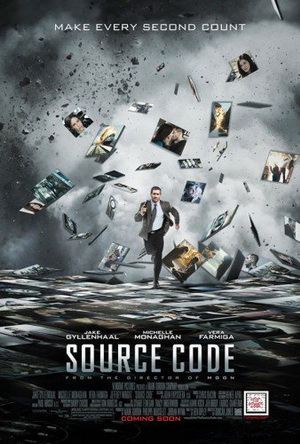
Source Code

I heard that this was a mindbender film so I embargoed myself out of reading anything about it. That means no reviews, no forum posts talking about it, nothing. That’s probably why I enjoyed the film as much as I did, given that:

  1. It has a terrible title which tells you nothing whatsoever about the subject of the film and, more importantly, is a misnomer given that the term “source code” in computer programming does not mean anything even vaguely resembling what they refer to in the film.
  2. The science involved is claptrap of the lowest order. How do you explain how a dead man’s mind can contain all the information in the universe? It’s quantum mechanics. Parabolic calculus. Just brilliant.

Continue reading Source Code

AI Challenge 2011 Results

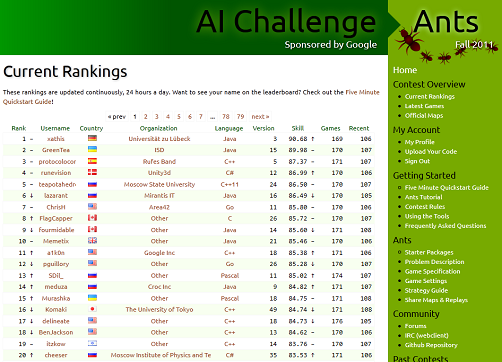
The 2011 AI Challenge is now over. I finished in 71st place. While that’s some way off of my 47th position in Planet Wars, considering the complexity of this year’s challenge and the fact that there was a total of 7,897 entrants this year, compared to less than 5,000 last year, I’m very glad to finish within the top 100 at all. In fact, if it weren’t for the fact that about a week before the closing date for submissions, a bunch of highly-ranked entrants publicly posted details of their combat strategy, allowing me to replicate some of it, I wouldn’t have been able to make it into the top 200 at all. As usual, this post will be about the results. I’ll write another post later about my bot in my games blog.

As with last year, once again this year’s contest was dominated by a single person. Bocsimacko who won Planet Wars last year didn’t submit an entry for Ants, but Xathis of Germany basically pulled off the same thing. For almost the entire duration of the contest, not only did Xathis keep the number one spot, he did it with the first version of his bot as well. Admittedly, it was possible only because he’d worked on his bot during the beta phase and most of his testing seems to have taken place on the TCP servers, but it’s an impressive feat nevertheless. We did have a bit of last minute tension as GreenTea of Ukraine supposedly took the number 1 spot for a couple of hours just before the finals ended, but Xathis retook the top spot just in the nick of time.

Continue reading AI Challenge 2011 Results

Recent Interesting Science Articles (Nov ’11)

I didn’t exactly forget to write one of these for November 2011. It’s just that between personal issues, my participation in the 2nd International Melaka Walkathon and most of all, spending lots of time on my entry for the AI Challenge 2011, I just never got around to it. Well, better late than never and here’s a whole bunch of articles to make up for the tardiness:

  • This is purely based on survey data, i.e. asking people what they believe rather than observing it in them, but this article reports how happiness is correlated with high ethical standards.
  • One of the most interesting events in November was how the Earth was almost destroyed by a passing asteroid. Of course, almost is a relative term and astronomers have long calculated that the asteroid, 2005 YU55 will miss our planet, coming no closer than about 320,000 kilometres. This article has all the details.
  • One of the basic assumptions in science is the laws of nature remain constant. This extensive blog post looks at one very intricate experiment that suggests that this may not necessarily be true. In particular, the experiment looks at the fine-structure constant, itself a combination of several constants including the electron charge, Planck’s constant, the speed of light and ? by studying the spectra of quasars. Their observations currently suggest that the fine structure constant appears to have been different in the distant. If this checks out, it could mean that the laws of physics themselves change over time.
  • This Freakonomics blog post covers the work of an economist who thought to ask: hey, with all those sex abuse scandals in the Catholic Church, I wonder what that means for their membership and donation numbers? It turns out that the scandals have indeed led to a drop in the number of people attending Catholic Church with commensurate gains elsewhere. In particular, it looks as if Baptist churches picked up most of the fleeing Catholics.
  • Can animals laugh? In particular, can animals laugh when they’re being tickled? This blog post covers the work of Jaak Panksepp who tickled rats to find out. It seems that rats make a chirping noise in the 50 kHz range under certain conditions and this researcher sought to prove that this response has an ancestral relationship to human laughter. They found out all sorts of things, for example, that the most playful rats tend to be the most ticklish, that tickle response rates drop after adolescence, that the tickle response tends to help with social bonding and that rats will even run mazes for the sake of being tickled.
  • Ever since quantum mechanics was invested, physicists have long argued over how it can be interpreted. Lately, most scientists prefer to treat it as a purely statistical tool, absolving them of the need to treat the results as something that exists physically. A recent preprint of a paper suggests that this interpretation is flawed and that the results of quantum mechanics do reflect intrinsic physical reality after all.


America’s ISA

Early this month, to little international outcry, the US Senate passed a bill that would make Malaysia’s controversial ISA look positively tame by comparison. The bill in question is the National Defense Authorization Act. Glenn Greenwald of Salon summarizes the most important provisions as follows:

(1) mandates that all accused Terrorists be indefinitely imprisoned by the military rather than in the civilian court system; it also unquestionably permits (but does not mandate) that even U.S. citizens on U.S. soil accused of Terrorism be held by the military rather than charged in the civilian court system (Sec. 1032);

(2) renews the 2001 Authorization to Use Military Force (AUMF) with more expansive language: to allow force (and military detention) against not only those who perpetrated the 9/11 attacks and countries which harbored them, but also anyone who “substantially supports” Al Qaeda, the Taliban or “associated forces” (Sec. 1031); and,

(3) imposes new restrictions on the U.S. Government’s ability to transfer detainees out of Guantanamo (Secs. 1033-35).

Continue reading America’s ISA

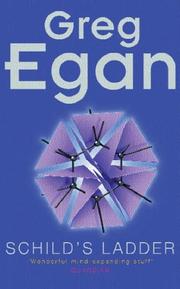
Schild’s Ladder

I’ve been cleaning up some of the old books I have scattered around my mother’s house. Some of these have been too damaged by poor storage conditions and need to be junked. Some others I’m too embarrassed to keep and will be donated. The rest needs to be packed up to be ready to be moved to Seremban. Greg Egan’s Schild’s Ladder is of course in that last category and while staying in Kuala Lumpur, I’ve found that my memory of it was poor enough to merit rereading the novel. Since I’ve never written about this particular book here as well, I thought I’d remedy that as well.

The Wikipedia entry for this novel calls it Greg Egan’s hardest SF book ever and considering that Egan is easily the hardest of the hard SF writers, this is a daunting statement indeed. This is because Schild’s Ladder begins with a fictional theory that unifies relativity with quantum mechanics, the so-called Sarumpaet rules of Quantum Graph Theory. In the far future universe of the novel, this has been the basic foundation of all physics for thousands of years even as humanity has spread out and diversified throughout the galaxy. Some of these descendents of humanity exist only as pure software constructs. The acorporeals as they are known  aren’t even raised in an analogue of 3D space, preferring more complex spaces due to the belief that this will unnecessarily restrain the flexibility of their developing minds.

Continue reading Schild’s Ladder