Interesting links

I’ve been remiss in updating lately, mostly because I’ve been embroiled in yet another personal programming project. So here are a few of the more interesting articles I’ve read recently to tide you over:

  • Probably due to the dysfunction exhibited by the U.S. government over the past year, libertarians have recently been abuzz about creating new countries of their own from scratch, Ayn Rand-style. The most impressive projects are the sea-steading ones of course that so eerily mimic the underwater city of Rapture from the BioShock games, but these are pipe dreams with not much chance of coming to fruition. Surprisingly, the most realistic of these initiatives is Honduras’ attempt to create a Hong Kong-style charter city which would be autonomous from the host country. Even Honduran police and the court system will not have authority in the designated zones as they will outsourced to the private sector and the courts of Mauritius respectively. The Economist has the details.
  • So Kim Jong Il died last month and the North Korea population promptly exploded into an orgy of mass grieving. This short article from MSNBC offers a few tantalizing glimpses of how this works in the hermit kingdom, which includes people being punished for not participating in organized mourning sessions or even not being seen to cry in a genuine manner.
  • By now everyone has heard of the cruise ship that sank off the coast of Italy and the idiot captain whose latest claim that he accidentally fell into the lifeboat and thus didn’t mean to intentionally abandon ship. But do you wonder what happens next to that ship? Do they let it sink? Do they try to refloat it? Well, this amazing feature from Wired covers an international team of experts who specialize in just this sort of thing, traveling all around to refloat capsized ships or just salvage what can be saved. They’re paid big bucks but their company earns money only if they succeed as their contracts are based on a percentage of the value recovered and as the article makes it painfully clear, theirs is a mortally dangerous job. The article is so good it could be made into a summer blockbuster, highly recommended.
  • Finally, on a more light-hearted note, I’m sure what with the Wikipedia blackout and all, everyone knows about SOPA and how it’s supposed to help with copyright violation, i.e. IP piracy. In a move that combines the futility of fighting against file sharing and the ridiculousness of organized religion, Sweden has officially recognized the Church of Kopimism as a religious organization. This church was founded in 2010 and upholds the right to file-share as a sacred tenet. Its religious symbols are CTRL+C and CTRL+V, i.e. copy-paste. PCMag has the story.
Recent Interesting Science Articles (Dec ’11)

I spent some time looking for cool stuff to share but only have a couple of articles for the last month of 2011, so here they are anyway:

  • The Economist has a simple story about how the usual practice of cutting off an infant’s umbilical cord immediately following birth may not be a good idea. The theory is that as long as the cord is still attached, blood continues to flow from the detached placenta to the infant. If the cord is cut too soon, not enough blood flows into the infant, causing anemia. Indeed, a study found that infants who had their umbilical cords cut after at least 3 minutes following birth had up to 45% more iron in their blood compared to those whose cords were cut within 10 seconds when they were 4 months old. As the article suggests, this may be what nature “intended” as other mammals tend to leave the cords attached for some time following birth.
  • The next article is the latest in a long line of findings in evolutionary psychology which show that human infants are born with an ingrained sense of morality. What makes this one different is that it also shows that infants’ sense of morality is capable of quickly growing more sophisticated as they grow older. Previous studies showed that infants like to reward actors in events that they perceive to be good, which usually means an actor that has been seen to be helping other actors in a scenario, such as retrieving an object for them or helping them climb across an obstacle etc. However, this time the researchers showed that at the age of about 8 months, the babies, when asked to reward an actor, would choose to reward a bad actor if they had previously seen this actor doing bad things to another antisocial actor as opposed to another actor who only did good things all the time. This means that they are rewarding an actor who they think is justly punishing someone bad.

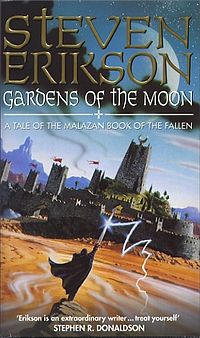
Gardens of the Moon

In my ongoing quest to read all of the major fantasy series (leaving aside obvious crap like David Eddings and Terry Goodkind stuff), I recently bought Steven Erikson’s Gardens of the Moon, the first book of his Malazan Book of the Fallen series. (As an aside, I’ve recently being buying books from the UK-based The Book Depository, which is noteworthy mainly for offering free shipping anywhere in the world, not to mention prices that beat any Malaysian retailers. The downside of course is that you need to wait for about a month to get your book. If anyone knows of any online store that can offer better deals for someone residing in Malaysia, do let me know.)

The Malazan books have quite a fanbase and, with all ten books in Erikson’s series now out, plus another four books by the co-creator of their shared world, Ian Cameron Esslemont, seem to be decently successful. Review-wise, however, the verdicts are all over the chart. The most enthusiastic fans rate Erikson’s work more highly even than G.R.R. Martin’s Song of Fire and Ice. Given that these include some very smart people from QT3, I’m not inclined to dismiss their opinions lightly. To the detractors however, his story is an incomprehensible mess, plagued by bland prose, cliched and boring characters and poor storytelling sense. After slogging through all 600+ pages of the first book, I’m sad to say that I have to include myself in the latter camp.

Continue reading Gardens of the Moon