Updated on 28th December 2014 to fix errors caused by a change in the CodeSkulptor library.
The latest Coursera class I’ve been taking is Introduction to Interactive Programming in Python, a long and unwieldy title. It was conducted by professors Joe Warren, Scott Rixner, John Greiner and Stephen Wong of Rice University and ended yesterday so, as usual, I thought I’d write a few words about it.
To tell the truth, I was misled by the title of the course. I thought it really was an introduction to writing interactive programs. Since all of the programs we worked on in the Algorithms class were non-interactive, I thought this would be a good new experience. It turns out that this course should really be labelled something like Introduction to Programming via Interactive Games in Python, which is even more of a mouthful but more aptly describes the content of the course.
Continue reading End of Introduction to Interactive Programming in Python class →
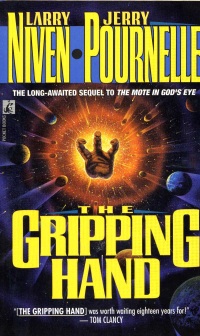
The Gripping Hand is the sequel to The Mote in God’s Eye. In some markets, it is also sold as The Moat around Murcheson’s Eye, which is a mouthful for a title but perhaps makes more sense. It was released in 1993, a full eighteen years after the first book was published. (George R.R. Martin fans might want to take note.) That’s almost as long as the time that has passed in-universe between the events of the two books.
The sequel centers around two characters from the first book. Kevin Renner who was navigator on board the INSS MacArthur during the mission to Mote Prime and Horace Bury, the trading magnate who initially saw the Moties as a tremendous money-making opportunity but later became terrified of them. The two are now agents of Navy Intelligence, with the responsibility of ferreting out rebel threats to the Empire while the Imperial Navy concentrates its resources on the Motie blockade.
Continue reading The Gripping Hand →
Majorly late with this one, I know. I’ve been in Kuala Lumpur for extended period lately. But better late than never and I’m determined to keep this blog alive if updates now are less frequent. So let’s get on with it.
- This first one is a bit trite and still a truth worth keeping in mind. It’s from the BPS Research Digest and talks about how people tend to think of their own names as being rarer, and therefore more special, than they really are. Also connected is the finding that people with genuinely rare names tend to be happier with their names, further confirming the observation like to be special. But I think people should be careful about going too far and end up choosing names that are just plain ridiculous.
- The next article from the website MNT and covers the subject of how people might be able to solve mathematical problems unconsciously. The study in questioned distracted the participants with another stimuli while an arithmetic equation or a verbal expression was displayed. The result, to no one’s surprise, is that the so-called unconscious stimuli primed participants to be more likely to respond with the correct answer. Personally I find this particular piece of research to be fairly dubious. The mathematically problem given as an example seems to simple that it should be solvable by reflex so it’s not clear to me what the news here is.
- Next up is a feature from The New Yorker which talks about the world’s grandest computer simulation of a brain. The initial target is to simulate the brain of a macaque monkey on a collection of ninety-six of the world’s fastest computers. It’s more of an overview of this area of research than this particular project since we have only the announcement and not much else to go on. Count me in as one of the skeptics on this one. I have a feeling that brain computation involves more than just neurons and ignoring the rest of the complex biochemistry going on is a mistake.
The unexamined life is a life not worth living