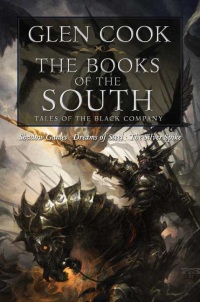
The Books of the South is an omnibus collection of the next three novels of the Black Company series, consisting of Shadow Games, Dreams of Steel and The Silver Spike. The former two novels cover the adventures of what remains of the Black Company, now led by Croaker, as they venture southwards in search of the mercenary company’s origins. The latter novel covers the splinter rebel band led by the White Rose and various free agents as well as the remains of the empire under new leadership as all factions squabble in the fallout of the huge battle against the Dominator.
Of the three books, The Silver Spike is perhaps the most satisfying as it at least brings the story of several key characters to a definitive close whereas the other two end on a “to be continued” note. Following the devastation of the epic Battle of the Barrowland depicted in The White Rose, the White Rose herself, Silent and a small group of survivors become embroiled in a conflict around the silver spike used to trap the essence of the Dominator. A band of rogues realize that the spike is immensely valuable and concoct a plan to steal it. Meanwhile, the remnants of the Lady’s Empire tries to restore order.
Continue reading The Books of the South →
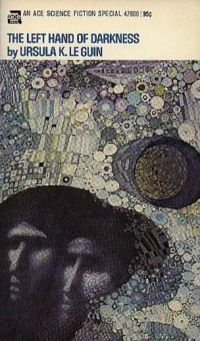
I’m still slowly working on reading the great classics of science-fiction that every fan of the genre should read at least once. I’ve been a fan of Ursula K. Le Guin’s Earthsea series ever since high school but I’ve read precious few of her more substantial Hainish Cycle novels. The Left Hand of Darknes, originally published in 1969, is perhaps the most well-known of these and was the big book that made Le Guin a great SF writer so it’s well past time that I got around to reading it.
I have read The Dispossessed, published in 1974 but judging from the events in the books apparently set thousands of years before The Left Hand of Darkness. There are obvious stylistic and thematic parallels between the two books. In each of the two books, two different societies that are rivals to each other are described. The reader takes the role of tourist to compare and remark upon the differences and similarities between the two rival societies. In The Dispossessed, the contrast is between the capitalist Urras and the anarcho-communist Anarres, obvious allusions to the United States and the Soviet Union.
Continue reading The Left Hand of Darkness →
Just four articles for the last month of December 2012 and one of them isn’t a science article at all but is a retrospective on the year with a perspective that I hope more people would share.
- The first one is on a subject that Hiew actually forwarded to me earlier in the month. It’s about how it may be possible to know whether or not the universe that we currently exist in is actually a simulation run on some unimaginably powerful computer. The idea is that if our universe is simulated using an evenly-spaced three-dimensional lattice then the structure of that lattice itself imposes fundamental limits on the energy levels that any particles within the system can possess. And according to the team behind the paper, our universe does indeed have this kind of cut off in the spectrum of high energy particles. Personally I’m leery about this approach because it makes unfounded assumptions about the structure of the simulation. For example, instead of a fixed, regularly-spaced lattice, one could easily imagine a flexible system which could be as dense or as sparse as required to track the particles that are present locally. In any case, for a look at a fictional scenario of this, check out the novella True Names by Benjamin Rosenbaum and Cory Doctorow.
- The next link is not an article but rather a letter written in response to an earlier article. The original thesis made two complementary claims: 1) that humanity as a species is becoming less intelligent over time due to the accumulation of mutations that have deleterious effects on intelligence and 2) that if this is so the question of why we managed to evolve intelligence at all in the first place is because modern society shelter humans from the full effects of natural selection. Hunter-gatherer societies it is claimed have greater use for intelligence while in our time even relatively stupid people may thrive and live long enough to procreate. This letter argues against these conclusions stating that mutations occur in individuals and not the entire population as a whole while intelligence is correlated with the number of surviving children in modern societies.
- Then we have this article from Smithsonian.com about why humans blink so frequently. As the article states, some blinking is obviously necessary to lubricate the eyeballs, but we seem to blink more often than necessary for these basic functions. It turns out that another reason for blinking is to temporarily shut out the world to give ourselves a moment for introspective thinking. In effect, our minds shift to an altered mental state more conducive to thought at the moment when we blink.
- Finally our non-science article is this optimistic retrospective of 2012 from The Spectator. One of my personal pet peeves is people being unreasonably pessimistic about the present and like to view the past through rose-tinted glasses. But as this article reminds us 2012 has really been the best year ever for humanity as a whole. Poverty has never been lower. On a global scale, inequality is down too. Far fewer people die from violence or disease. And despite doomsayers’ repeated proclamations of peak oil, we live in an age of energy abundance not scarcity. So here’s looking forward to 2013 being an even better year!
The unexamined life is a life not worth living