Avatar

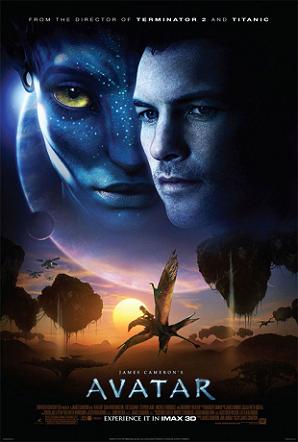
As usual when I write about films, spoilers abound so you might want to hold off on reading this until after you’ve watched it yourself. However, the plot is so cliche-ridden and so predictable that it’s pretty hard to spoil the film. It’s basically Dances with Wolves in space and all the pertinent plot points are clearly telegraphed from the first moment that you see the planet Pandora. Having only recently rewatched Aliens, I was also struck by how many themes and ideas were re-used. Over the top gung-ho soldier? Check. Greedy corporation exec who cares only about the bottom line? Check. Even the military vehicles and mechs look vaguely familiar.

The wonder of the film is that it all works, which says a lot about James Cameron’s directing skills. The film is genuinely breathtaking and spectacular, so much so that when you see it for the first time you simply know that this is something that you have never seen before. In that sense, it’s every bit as iconic and singular an experience as watching Star Wars or Jurassic Park for the very first time. It’s the same kind of once-in-a-lifetime experience that just blows you away.

It’s when you walk out of the cinema that all of the plot holes and flaws catch up with you. How do the human controllers connect with the avatar bodies? It must be magic because it seems to be unaffected by range or electromagnetic interference and the avatar bodies don’t seem to come with electronics. Why was the human ground force fooling around in the jungle for when the mission was to bomb the Tree of Souls? How ludicrous is it that no animals come to eat the avatar bodies when the human controllers are disconnected, especially after the film has established how hostile the jungle is? How come if the rocks float, the water still falls from it? And if they are made of the magical anti-gravity mineral, why don’t the humans just tow those away instead of trying to mine it from underground?

It’s common knowledge that Cameron wrote the original script for Avatar not long after he finished Titanic, so the script is still floating around the Internet. This website has a good comparison of the differences between the original scriptment and the film that ended up being made. It’s apparent that the original script was more subtle and less filled with cliches but a great deal more bloated. For example, in the original script the Na’vi that Jake falls in love with isn’t the first one that he meets, the research team is being helped by a Na’vi guide and Grace is secretly sleeping with him, there’s a previous human controller who fell in love with a Na’vi girl but she was killed by the military and he committed suicide etc. It all makes the Jake character less unique and less like a superhero who came out of nowhere to save the world.

For all these reasons, while watching Avatar once is practically mandatory, I doubt that the film stands up to repeated viewings. Even the technology will eventually look dated. But for now, it’s undoubtedly one of the most beautiful things ever put on film.


3D Printing

I first heard about 3D printing in The Economist a while back and it sounded promising but looked like one of those technologies that are always on the horizon but never quite arrive. Recently, someone on QT3 got a hold on a 3D printer and posted a Youtube video of it in operation. It really rammed home how far the technology has come already. Here’s the video he posted, which is just a simple demonstration of what it looks like in action:

Note that this thing isn’t really self-replicating yet. It can apparently print about half of the parts needed to make a new printer, but the metallic parts, motors and other electronic parts need to be purchased separately and attached to the ABS plastic parts that the printer creates. This is the same kind of plastic that Lego uses for its bricks, so it should be quite sturdy.

Naturally, as a boardgame player my first thought was how awesome this would be as a way to quickly create all sorts of pieces for games. This isn’t quite perfect yet because the printer’s resolution is too low, so it can’t do fine detail. Plus the way that the plastic is applied layer by layer makes it difficult or impossible to create pieces with significant “overhang”, as would be needed in for example, a theoretical humanoid figurine with arms that extend past the torso and the feet at the base of the figure. I hear that they’re working on this problem and thinking about ways to add a second print head that would print laterally in conjunction with the original printer head that works horizontally to alleviate this problem. Here’s an example of a different type of 3D printer making a pawn Chess piece:

Still, all this is pretty exciting stuff and it’s as close to the matter replication technology of Star Trek as I can imagine, something I never thought would happen within my lifetime. Hurray for science and technology!

The Storm Warriors

First off, don’t watch this. It’s terrible and you’d only be wasting your money. That said, I expected it before I went in and still dragged my wife into the cinema with me. This is because the original film The Storm Riders from 1998 is a huge guilty pleasure for me. This old review from LoveHKFilm.com (who still haven’t posted their review of the sequel yet!) put it best by calling it the Hong Kong version of Star Wars. As the reviewer Kozo noted, the original film, for all its cheap CGI effects, poor acting and hackneyed plot, successfully transported the viewer into a fantasy version of a mythical China that never actually existed but is clearly drawn from and inspired by Chinese themes and legends.

For my part, I immediately recognized The Storm Riders when I first watched it as the Chinese analogue of the many Western fantasy worlds I knew so much, Tolkien’s Middle Earth being the most iconic example. Of course, it wasn’t the only Chinese fantasy world. The version of China that Louis Cha’s novels are set in is unarguably more famous and celebrated, but it didn’t really feel fantastical enough for me. Come on, The Storm Riders even has a freaking dragon in it! Considering The Journey to the West as being fantasy is a bit unfair too. It would be like calling The Bible a fantasy novel.

Continue reading The Storm Warriors

Consensus in modern philosophy

For a website that started out with philosophy as its primary topic, I’ve been writing precious little on the subject. I suppose that this is because over the years I’ve become more and more set in my beliefs and ways so I’ve had no reason to want to read or write more on it. In any case, this tidbit is one of the most interesting things I’ve read in the field in many years. It’s a survey on modern philosophers’ views on a large number of controversies in philosophy, including various thought experiments and ethical dilemmas.

The surprising thing about this is that there appears to be a clear consensus in quite a few areas, which goes against the traditional complaint about philosophy being a talking shop where no one can ever agree with anyone else. Of course, one possible reason why there’s such a consensus is that most of the respondents are English speaking. According to the demographic breakdown given, out of the sample size of 3,226 respondents, 1,405 are Americans, 381 are British and 199 are Canadians. Of the non-English speaking countries, Germany is the highest with 115 respondents.

Continue reading Consensus in modern philosophy

Math is hard

193_reduced

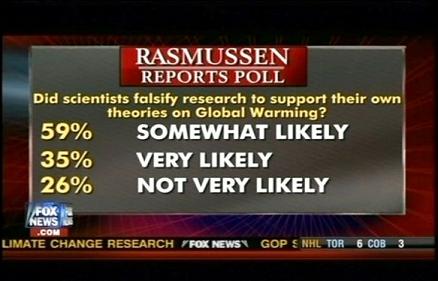
Or at least it seems to be for the notorious U.S.-based network Fox News. The first picture above is from a month ago and anyone even casually glancing at it should realize that something is wrong with that pie chart. Apparently Fox News didn’t just make a mistake in getting the graphics right, its news anchor Byron Harlan actually spoke these figures out loud as part of his news report.

foxpoll

This second graphic appeared only recently and again, it’s very obvious that the figures don’t add up. What’s worse is that the original statistics came from reputable polling agencies and their original figures certainly make sense but Fox News seems to have decided to interpret them more creatively. This post on Think Progress explains that fuzzy reasoning. Goofing up the occasional graphic is understandable, but when your news anchors repeat these mistakes on air, it smacks of a deliberate conspiracy, especially when well-educated, highly intelligent news anchors pretend to be dumb in order to better connect with an anti-intellectual audience.

The infamous BTN

The Biro Tata Negara (BTN) or in English, the National Civics Bureau, issue is something that almost everyone has always known about but rarely dared to speak out about. But once the cat’s out of the bag and the taboo of not talking about has been broken, there’s no shortage of people condemning it with their every breath. I guess I’m no different. In case there are any non-Malaysians reading this who have no idea what I’m talking about, it refers to a government agency run by the Prime Minister’s department that runs courses with the ostensible aim of promoting patriotism amongst Malaysians.

To that effect, it runs a series of courses for which attendance is obligatory for everyone wishing to qualify for a government job. However, many Malaysians have complained that the courses actually promote racism and seek to segregate the different ethnic groups that comprise the country’s citizens. The Malays in particular are consistently taught that they are special and hold a superior position with regards to the other ethnic groups while Chinese and Indian participants are taught that their Malaysian citizenship is not a right but rather a privilege for which they must be forever thankful to the Malays.

I’ve never attended one of these courses myself but I heard some very shocking anecdotes recounted by a friend of my wife about the course she was forced to take only a few years ago. This was part of a process that she had to go through to be hired as a public school teacher. I recall that the lecturer was described as being extremely provocative, to the point of shouting at participants even if that meant driving them into a rage or to tears. The Malay participants were constantly harangued with the question, “Are you Malaysians? Yes or no?” When they inevitably replied “Yes”, he would reply, “No, you are Bumiputera!”

This refers to the special classification assigned to ethnic groups recognized as being indigenous to the country, of which the Malays are by far the largest group, and hence accorded special privileges and rights under the national constitution. It goes without saying that this is resented not only by the ethnic groups not included under the bumiputera classification but also by more enlightened bumiputera who believe that such special privileges are a slur on their abilities.

Anyway the most interesting part about the experience that was related to me was towards the end of the course. One of the participants, a male Indian, was seen to be becoming more and more agitated as the lecturer spoke and looked like he was ready to start a fight then and there. The lecturer ignored him and just kept going. However, after he ended his talk, the lecturer took the time to take the Indian guy to one side to calm him down and told him not to take it too seriously and that he was just a guy doing his job. I honestly don’t know if that’s something to laugh or cry over.