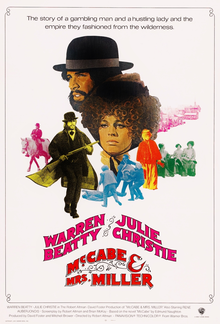
Watching Ennio was like a quick refresher on the Westerns of the 1960s so it’s fascinating to compare them to McCabe & Mrs. Miller. In making this, Robert Altman’s guiding principle seems to have been to identify the common tropes of the genre and do the exact opposite. This plays out so slowly and unremarkably that I was getting bored until I realized what it was trying to do. It’s not even gritty or anti-heroic. It’s that the characters are all cowards, there are no higher ideals and there is no glory whatsoever in violence. Its commitment to what I might call anti-Romanticism is total and that’s what makes it so unique and memorable.
Newcomer John McCabe attracts attention in the tiny town of Presbyterian Church as he sets up gambling games. The locals spread rumors about him once being a gunfighter but he insists that he is a businessman. He hires workers to build a brothel, buys whores from a pimp and is successful enough to establish himself in the town. Soon a British madam Constance Miller arrives offering to run his brothel for him in return for a 50%. Browbeaten by her dominant personality, he gives in and they eventually become the leading business owners in town. They also become romantic partners as McCabe comes to rely on her while she cares for him in her own way. But she insists that he pay her for sex like everyone else and maintains a careful distance. Eventually the town grows rich enough that they attract the attention of a large mining company. Two agents approach McCabe offering a substantial sum of money to buy out his holdings. He drunkenly refuses, secretly hoping that they will raise their offer. Mrs. Miller castigates him for being a fool as what the company cannot buy they will obtain through force.
Right from the get go, this looks and feels as different from the Westerns of only a few years ago. It’s set in the wintry climes and thick woods of Washington instead of a harsh desert. The cinematography uses soft lighting and the dialogue deemphasizes the main characters, elevating them only slightly above the babble of the crowd. What I found most interesting of all is that unlike traditional Westerns in which every man is armed as a matter of course, here visibly carrying a gun is a notable event. All eyes are drawn to the weapon as if it were a deliberate statement and are wary of the stranger wanting to start a fight. The little town then, named after its single church with a tall spire, then feels more like a real place that people live in rather than a just a stage for larger than life heroes and villains to confront one another in. All of them have heard the stories of famous gunslingers but when violence does, after a very long wait, break out, fights are won by shooting the opponent in the back. It gets boring because nothing much seems to happen and the film actively steer away from drama. The town grows richer and McCabe’s fortunes with it in the background without so much as a loud argument.
This verisimillitude though is its own kind of magic. The characters here are far more psychologically nuanced than any previous Western. At one point, McCabe has an extended scene in which he talks to himself as he doesn’t have the guts to reveal his real feelings to Mrs. Miller. He denies the rumors about being a gunfighter but it’s this reputation, unearned or not, that helps him establish himself. I don’t believe I’ve ever seen another instance similar to this one in which McCabe having realized that his life truly is in danger actually goes to the company to grovel for mercy. When the company makes it clear that they are done negotiating, he goes to a lawyer who puffs him up as the little man standing up to the big man. It’s astonishing. As for Mrs. Miller, we never get her backstory but we don’t need to. She has her vices and no doubt reasons of her own for never trusting in any man. Throughout it all, there’s no clear antagonist. The company’s boss never makes an appearance. Their agents’ main complaint after meeting McCabe is that the awful food in the small town might make them sick. This is a revisionist Western with a big capital R indeed.
It’s a film that is bold and utterly unique, a complete reinvention of what life on the frontier might have been truly like shorn of romantic pretensions. Yet it’s such a depressing vision that it’s hard to imagine anyone actually loving it. Both McCabe and Mrs. Miller are broken, ignoble and unlikable people. Nearly all of the women who goes to live in a place like that is either a prostitute or a mail-ordered bride. But we can also see how Presbyterian Church might one day grow into a town worth living in and a history of the West that deserves to be told.