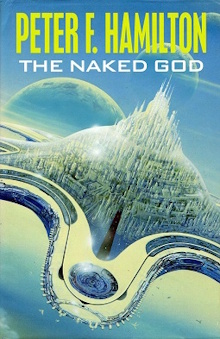
This trilogy is so long that it became a bit of a slog towards the end but I’ve finally reached the end. This is my least favorite of the three books as there are entire plotlines that I feel are ultimately pointless such as Louise and Genevieve’s adventures on Earth and the Skibbows’ vendetta against Kiera. On the other hand, there are also some spectacular setpieces. We get to visit the true homeworlds of the Kiint, and there are multiple first contact scenarios with alien civilizations both more and less advanced than humanity. As the title suggests, the crisis is resolved by a literal deus ex machina. That’s never great but it’s especially egregious here as one hero singlehandedly flips the table for everyone.
The last book ended with Tranquility coming under heavy attack. That is immediately resolved as the habitat reveals its secret ability to open its own wormhole and escapes to Jupiter. Jay Hilton however is evacuated by the Kiint to their true homeworlds in another galaxy. After reporting back to Trafalgar, Lady MacBeth is assigned another mission in conjuction with the voidhawk Oenone to investigate the Tyrathcan Sleeping God. To get there, the Lady MacBeth is given permission to fuel up with anti-matter and joins the Confederation Navy to first attack the anti-matter production base controlled by Al Capone. Meanwhile the campaign to liberate Mortonbridge finally begins with over a million Serjeants provided by the Edenists but bogs down as the possessed resist more intelligently than expected. On Earth, Louise Kavanagh is manipulated by the secretive cabal that actually runs the planet to locate and expose Quinn Dexter’s activities. After shifting out of the real universe to prevent a complete takeover by the possessed, the Valisk habitat finds itself trapped in a low-energy, high-entropy dimension populated by monstrous beings that feed on life energy.
The action continues unabated and I’m a little ashamed to say that my favorite sections here are the ones with Joshua Calvert. He may be the stereotypal hero of destiny but at least he gets to go around and get things done. Louise’s perspective finally gives us a look on what Earth is like in this era but she just doesn’t get to do much other than be overawed by everything around her. I detest how B7 continues to underestimate Dexter’s threat and their plan to use Louise is equally pointless. I didn’t reading about everything Valisk-related either but I suppose those scenes are needed to explain that escaping to another dimension is not a solution to the crisis. The Confederation looks stupid in this book in allowing their main base to be exposed to a straightforward suicide bombing and being unable to stop Al Capone’s forces infiltrating more worlds. There is a lot of exposition in this book, what happens to the possessed after Norfolk leaves the univerrse, what Kiint society is really like, etc. I generally enjoy world building but the pacing is off. Do we really want to read about Jay playing with her new alien friends on a paradise world when people are still dying and suffering horribly on the Confederation planets?
I’m especially irked that all these pages get in the way of the really cool stuff. At the beginning of the book, we’re all goggle-eyed at the post-scarcity society of the Kiint who are able to conjure up seemingly anything with their producer drones. But then we meet alien existences who have transcended all physical limits. Even better, Joshua’s journey to the Tyrathcan homeworld results in the crew making first contact with an entirely new alien civilization who have yet to develop faster-than-light travel. To these aliens, it is humanity who are god-like. This material is good enough to be its own book. In my last post, I speculated that the solution to the possession crisis must be some kind of metaphysical revelation. Unfortunately Hamilton seems to have been all tapped out on that front. We get an explanation that Father Horst Elwes’ exorcism in the first book was an irreproducible fluke. There’s some nonsense lesson about having faith in yourself but in the end the solution really is just technological deux ex machina. It turns out that when you can beg for help from a being that can create wormholes of any size and shift entire planets in and out of different dimensions, all of your problems just vanish. It’s an unsatisfying ending to the saga and renders all the efforts by everyone else instantly feel pointless.
The winding down at the end does at least provide closure, even bringing back characters you might have forgotten about from the first book. The series as a whole was a wild ride with plenty of good action set-pieces backed by the boldness of introducing possession by the dead into an otherwise hard sci-fi universe. Hamilton can write and he can juggle a huge cast of characters. But sometimes he seems to indulge in side-stories that are unnecessary, has poor sense of pacing and has old-fashioned ideas of what a space opera should be. Reading this wasn’t quite a waste of my time, as I considered it important to understand what else science-fiction writers have been doing in the 1990s but I cannot in good conscience recommend the trilogy to new readers.