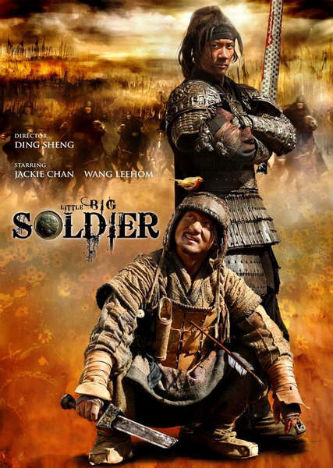
Little Big Soldier

Like so many Chinese families these days, we ended up going to the cinema on the very first day of Chinese New Year. Both my wife and I were unenthusiastic as we now have very low expectations of Chinese films, especially whenever Hong Kong celebrities are involved. But we went along anyway as it was a family outing. The idea was to try to watch one of the specifically Chinese New Year themed movies but due to the unavailability of tickets, we had to settle for Little Big Soldier. In retrospect, it was easily the best out of all the films that we could have watched that day.

Despite starring Jackie Chan and being set in the Warring States period in China, Little Big Soldier is neither a martial arts film nor a war film. Though it has elements of both, it is at heart a buddy film in which two characters bond with each other over the course of the story. American-born Wang Lee Hom is competent but otherwise unremarkable in his role as an honorable general of aristocratic stock even if his spoken Mandarin is still noticeably accented. Jackie Chan, however, turns in a surprisingly fresh and entertaining performance as a canny footsoldier who does whatever is necessary to survive, even if means taking cowardly measures and resorting to underhanded tactics.

It’s surprising because I usually find Chan to be insufferably annoying. He basically plays the exact same character in all of his movies with his physical comedy and acrobatics skills as the primary draw. But in Little Big Soldier, he plays against type and while there he still gets to be the comedy and acrobatics guy, both elements are carefully doled out in measured rations as opposed to the usual practice of doling gags out by the spadeful and hoping that some will stick. Thus restrained, his character feels sympathetic, down to earth and realistic.

Another thing that struck me is how genuine and honest this film felt. So many Chinese period films now go for the epic feel. They want to show vast armies and sweeping vistas. They want to tell stories on a huge scale about larger than life characters doing heroic stuff. Little Big Soldier by contrast has a small cast and a very focused and tight vision that feels at odds with the heavily commercialized fare we’re used to from most period films. As my wife and I discussed, the big budgets and big name cast of the epic films probably limit directors to more conventional storylines designed for maximum mainstream appeal so they end up being commercialized dreck that don’t stand out.

Finally, I note with interest that the director Ding Sheng is a virtual unknown with only two entries to his credit on IMDB. Of course, if this had been an epic action movie from the conventional mould, the studio would have gotten a big name director to do it, but it must still have been a brave choice. I also note that this film was conceived by Jackie Chan over 20 years ago and he originally cast himself in the role of the young general instead of the old soldier. Probably no one thought it would make money and indeed I don’t think this film has received much attention or earned much money. That’s a pretty sad indictment of the state of the Chinese film industry right there.

Links for further reading

I’m going to be busy at work in the run up to the Chinese New Year holidays and likely will not have any regular net access during that time while I’m away, so this is going to be the last post for at least a couple of weeks or so. In the meantime, if you’re starved of reading material, here are links to some interesting stuff I’ve read recently:

  • I’m not much of a fan of classical music, but it’s still sobering to learn that sales of just a few hundred units are currently sufficient to get an album on the Top Ten list by Billboard magazine. My wife, who is something of a fan, argues that this is countered by the fact that classical music recordings have a much longer shelf life than other works, but I think an upper limit of a few hundred sales is still rather pathetic. I fail to see how it’s economic to even produce these albums. Sales outside North America seem somewhat healthier however.
  • This is an older article that dates from August last year but I only recently came across it while reading one of the blogs by The Economist. As someone who’s married but has decided not to have children, I supposed I’m biased but it confirms a point I’ve been making for a long time now: having children is easily the most environmentally unfriendly things a person can do. It doesn’t matter how else you do right, like driving an electric, recycling regularly, use energy efficient light bulbs, etc. As soon as you have a child, your carbon impact takes off like a rocket.
  • Shanghai is cracking down on the wearing of pyjamas in public, apparently because it looks unseemly? What would they think about Malaysian-style singlets and short pants?
  • This review and summary of recently published biography of Ayn Rand, entitled Ayn Rand and the World She Made by Ann C. Heller, compares her to Stalin and argues that even though she rejected the Soviet Union and eagerly fled to the United States, there is still something profoundly Russian about her thoughts and views. It also relates an astonishing anecdote about how she treated her husband Frank O’ Connor who suffered from dementia in the last years of his life. Apparently Rand believed that he could snap out of it if only his willpower were strong enough and assigned him long, grueling lessons on how to think and remember and warned other people not to humor him but instead treat him as they would any other normally functioning person.
  • This essay by fantasy author Terry Pratchett who has been diagnosed with Alzheimer’s disease is very well-written and moving. It’s a plea for the authorities to allow people with incurable diseases to decide to die gracefully at the time and in the manner of their choice.

Recent Interesting Science Articles (January ’10)

Three articles of scientific import for the first month of the new year. The first one is about stem cells. Nothing really exciting except that it demonstrates, if in a rather grisly manner, how magically effective they work at staving off the effects of aging. The second one is about liquid diamond on the planets Uranus and Neptune. The last one is about a new theory on how human brains understand music and why we find it appealing.

Stem cells are old news by now but this article from Harvard Magazine describes a simple experiment that nonetheless successfully demonstrates the regenerative powers of stem cells in a very dramatic fashion. The experiment, led by Amy Wagers of Harvard University, surgically joined two mice so that their blood supply became shared. One of the animals was old. The other was young. The idea was that the blood from the young mouse would awaken the stem cells of the old mouse and enhance its regenerative abilities.

Continue reading Recent Interesting Science Articles (January ’10)