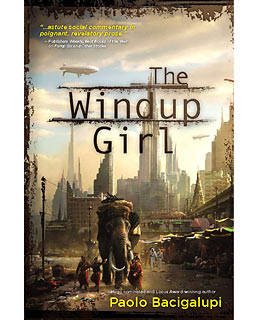
The Windup Girl

I picked up The Windup Girl by Paolo Bacigalupi solely on the strength of the blurb advertising it as having won both the Hugo and the Nebula for best novel. Not bad for a debut novel by a relatively unknown writer. It turned out to be a very pleasant surprise and I was particularly impressed by how deftly it portrays Southeast Asia. While I have misgivings about the plot and how events rush to an unsatisfying end, I still consider it to be one of the best novels I’ve read in recent years (not that I’ve been reading much admittedly).

Despite the title, the real star of the show here is arguably the city of Bangkok itself which is where the novel is set. In the 23rd century, the rising waters caused by global warming has destroyed many cities and even entire countries. With the world’s fossil fuels all but depleted, globalization as we now know it, is no more. The most powerful entities are the biotechnology companies who feed the world using their genehacked crops, maintaining their dominance by employing bio-engineered plagues to destroy natural food sources and even sending in private armies to topple governments when necessary.

Continue reading The Windup Girl

Tohoku earthquake and tsunami

That seems to be what the disaster is being officially called. Some of my own thoughts on the events, divided into a few categories:

Civil Order / Looting

Many commentators, particularly in Asia, have noted how civilized the Japanese have acted and how little looting there is. Most people cite it as evidence of their superior educational system and the way their culture frowns upon individualism. But that’s a shallow and general observation that doesn’t satisfy. What would be interesting are concrete examples of how the Japanese are taught differently and how their system is set up that delivers these results.

Continue reading Tohoku earthquake and tsunami

The disputed origins of Yoga

As much as I would like to write something about the ongoing events in Japan, events are developing too quickly to really write anything intelligent about it. The situation with their nuclear reactors could really go anywhere at the moment. Obviously, I hope that things go well. The Japanese sure could use a break.

Instead, here’s a link to an article disputing the Hindu origins of yoga. It has since evoked a great deal of controversy and ignited a significant debate over the issue. Considering how popular yoga is in Malaysia now and how it has stirred some debate over here as well as to whether or not it is a religious practice, I thought it would make for interesting reading.

Part of the article is a reaction against the “Take Back Yoga” campaign in the United States by the Hindu American Foundation who are upset that the modern practice of yoga is, more and more, shorn of its Hindu elements. In response, the author roughly makes the following points:

  1. Yoga, as it is popularly practiced and known throughout the world, is really just the physical component of yoga, hatha yoga. This style is extremely popular in India as well and has little spiritual or meditational content.
  2. This form of yoga is not really that old after all. The author claims that it was born in the late 19th or early 20th century as a form of exercise during the Hindu Renaissance that incorporated Western ideas of science, evolution, health and physical fitness.
  3. Effectively the techniques were drawn from drills, gymnastics and boidy-building techniques borrowed from Sweden, Denmark, England and the United States and then grafted together with the Yoga Sutras. In particular, the author traces the teachings to physical yoga to a school based at the Jaganmohan Palace of the Maharaja of Mysore in the early 20th century. In the 19080s, a Swedish yoga student found in the library of the Palace of Mysore a book entitled Sritattvanidhi that illustrates many of the techniques of modern yoga but also included rope techniques practiced by Indian wrestlers and traditional Indian gymnastics. It may also have drawn from exercises developed by a Dane and introduced to India by the British in the early 20th century. The palace at that time was certainly equipped with a Western-style gymnasium including wall ropes and props.
  4. Finally, the author claims that it is impossible to trace the ancient origins of most yoga sutras. Some yoga teachers claim that the sutras exist in some texts that now no longer exist. Others claim that a particular text contains some of these sutras yet other scholars cannot find them. One prominent yoga teacher claims that he traces his teachings to a text that dates from over a thousand years ago but now no longer exists. He knows of it because the ghost of an ancestor dictated it to him while he was in a trance.

Obviously, all of this is strongly disputed by opposing parties and the magazine even hosts a rebuttal by another author who fiercely disputes these conclusions.
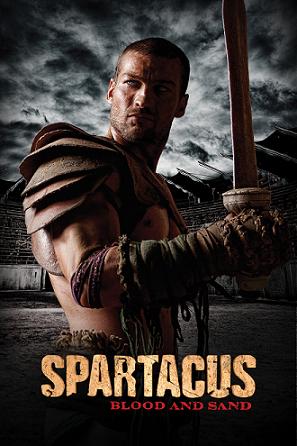
Spartacus: Blood & Sand

It seems that the new trend for television series is to have short seasons, averaging 12 to 13 episodes per season, rather than the normal 20 to 23. Since incidences of this trend correlates strongly with the quality of the series, this is something that I very much approve of. The latest example of this that both my wife and I enjoyed is Spartacus: Blood & Sand, and boy, has it been a wild ride.

As usual, I first read about the series on QT3. The initial buzz was quite poor however and after I learned that the people who worked on it were also some of the same people who were responsible for Xena: Warrior Princess and Hercules: The Legendary Journeys, I sort of lost interest. But then a weird thing happened. Usually shows get hyped up and then interest levels off after a while. Instead, Spartacus premiered as a bit of a damp squib, but then garnered more and more critical acclaim.

Continue reading Spartacus: Blood & Sand

Recent Interesting Science Articles (Feb’ 11)

Four articles this month and only two of them are the human nature stuff that I usually like to link to. One is an invention that I’d honestly wondered myself if it would work. The last one is not really a scientific article. Instead, it’s one person’s attempt to create art using technology and to illustrate a fundamental biological process at the same time. We’ll go with the human nature stuff first.

The first one comes from PsyDir and covers a question that many people are no doubt curious about: is there any link between genetics and religious fundamentalism? The paper in question took data from a national survey in the US to look for data about variations in religiosity between identical twins and non-identical twins. The paper also tried to sort out influences caused by the family environment that would be shared by siblings and the environment outside of the family.

Continue reading Recent Interesting Science Articles (Feb’ 11)