Quite a few of these articles this month, so here goes:
Cloning animals is nothing new these days but, still, there is something symbolic about cloning one from a single drop of blood, as this article from BBC News covers.
We all know that bats can navigate using ultrasound, but could prey make use of this fact as a defensive measure? This article from Popsci covers how hawk moths, found in the tropics, are able to respond to the ultrasounds emitted by bats hunting them by responding with ultrasound clicks of their own. It may be useful to just startle the moths or it could be part of an active jamming system to hamper the effectiveness of the bats’ echolocation abilities.
Nearly a quarter of a century after its inception, a study into the crack babies phenomenon of the 1980s has finally ended. The term refers to an epidemic of babies born to mothers who were addicted to cocaine and were exposed to the substance while in-utero. Apocryphal stories at the time talked of babies with shrunken heads, poor muscle tone and troubling behavioural symptoms. Twenty-three years later this study found that there was no difference in IQ between such babies and those of a control group with no prenatal cocaine exposure. They did find that both groups had IQ scores that were markedly lower than the national average and attribute it to the effects of poverty.
This next article is somewhat like the one above: conclusions that are “obvious” are not always correct. Pop quiz: which areas are safer to live in, for developed countries at least: urban areas or rural areas? As it turns out, this article from CNN explains how contrary to intuition, the risk of injury or death from violent crime and accidents are more than 20% higher in the countryside in the United States than in urban areas. We don’t know exactly why yet, but there are some educated guesses. In the US, rates of firearm ownership are higher in rural areas for example, and these residents tend to drive longer distances over more dangerous roads. Plus it’s easier and faster to get to a hospital in a city than in the countryside.
Finally here’s a just for fun article about a couple of physics points from the Pacific Rim film in a Scientific American blog: specifically how much force is there in a rocket-assisted punch delivered by a giant robotic fist and can a giant monster with a huge wingspan fly its way into space? It’s just the first in a series of two such articles with maybe more to come so be sure to look out for more too.
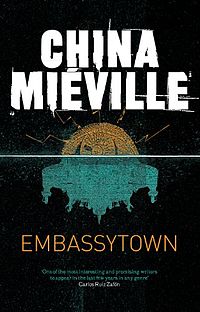
I’ve heard of China Miéville from his work in other genres but this is, I believe, his first science-fiction novel, and the first book of his that I’ve read. Embassytown received some very impressive reviews so I delved into it with plenty of anticipation and not a little bit of trepidation. As it turned out, the novel is less ambitious and more traditional than I expected so I needn’t have worried myself.
As its title implies, the book is about a city called Embassytown, the sole human settlement on the alien planet of Arieka. In the universe created by Miéville, humans traverse interstellar space by going through something called the immer, while hinting that some aliens, called exots, have wholly incompatible forms of FTL technology. It so happens that Arieka is located just about at the edge of explored space in the immer. This means that while Embassytown is formally a colony of a human empire known as Bremen, it is de facto semi-autonomous due to its remote location so visits from spacecraft crossing interstellar distances, called voidcraft, are both rare and the occasion for grand celebration.
Four articles this month, representing a fairly mixed bag of subjects. Here goes:
Let’s start with a very simple but effective technological innovation that applies only to countries that have four seasons. Tech-On! features a report about a new type of glass that would block sunlight in the summer while letting it through in the winter. It relies on the simple fact that sunlight in summer and winter have different incidence angles and the invention consists of nothing more sophisticated that joining two sheets of glass together. This alters the refractive qualities of the joined sheet of glass and the researchers tuned this precisely to have the desired effects. What I don’t quite understand is whether or not the glass needs to be precisely tuned to the latitude of the place where it will be installed because presumably the incidence angle of sunlight depends on the latitude of the location.
The next piece is not a science article but an extensive feature published in the New York Times about research on the outcomes to women and their babies who wanted abortions but were denied them. The key point is that the study manages to compare these women against similar women who wanted abortions and did get them. Not very surprisingly, the study found that these women have much poorer outcomes, with higher anxiety and depression levels, more likely to end up being poor and have poorer health. What is surprising is that despite these objectively poorer outcomes, most of these women still insisted that having that originally unwanted child was still the best thing that happened to them and significant numbers claimed years after the fact that they have never sought an abortion in the first place.
Then here’s an article from The Conversation about how cheetahs actually use their fabled speed. One uneducated guess about cheetahs might be that because of their reputation as the fastest land speed animal on Earth, you might expect them to hunt best of all on flat ground where they can show off their top speed. This turns out not to be true because cheetahs hunt more successfully in dense forested cover than on open ground. This is because the true advantage cheetahs have is not absolute top speed but fantastic acceleration rates and even better deceleration rates. This allows them to manoeuvre much more effectively than the prey they chase.
Bloomberg BusinessWeek has a very cool article about concrete, particularly the kind that the ancient Romans used. As we know from the copious amount of architectural works the ancient Romans left behind, they built a lot and a lot of it has lasted quite a long time. It turns out that ancient Roman concrete is significantly stronger than the modern variety we use today, commonly known as Portland cement. The precise formula for the kind the ancient Romans used was lost but researchers claim to have rediscovered by analysing their mineral content. By incorporating lyme and volcanic ash into their mixture, the Romans made more durable concrete than modern builders.
It’s only been a little over a year since the last installment of this series. Previous updates to this list were in 2007 and 2009. Part of the reason is that I’ve been watching many more films recently. I was still surprised by how long it took to get to the five films worthy enough to write one such installment but now all of the movies included were released within about the past two years which is more timely than what I’ve managed in the past. As usual the standard disclaimers apply and spoilers follow.
Four articles for the month of May 2013. One of them however is about a story in the realm of mathematics so arguably isn’t much of a science article at all.
Older computer users will probably remember the ELIZA chat bot written in the 1960s. It was created only as a early demonstration of natural language processing but many people took it seriously as a virtual psychotherapist. This article from the BBC talks about a real attempt at creating a virtual therapist to help real humans. As such it goes much farther than just printing text output onto a screen. It has an onscreen avatar which it can control, can verbalize its responses, can listen to patients’ voices and observer their body language and so forth.
So many claims of success at achieving cold fusion have been refuted over the years that many people now think it is impossible. This article from ExtremeTech covers the latest such claim and given the secrecy involved, it seems likely that it is just another scam. In this case however, a number of scientists from reputable European universities have been allowed to study the device, though they are still being kept in the dark about how exactly it works, and their preliminary, non-peer reviewed, finding is that it works as advertised. Given the potency of cold fusion as a power source, which would allow it to completely supplant our currently fossil-fuel based energy economy, this is something that deserves a lot of attention.
The next article from the so-called smart rifle. It comes with a color graphics display that allows the user to lock on to a target. The rifle then uses its own suite of sensors to determine when exactly to open fire, taking into account factors such as wind and distance, to ensure a hit. It even comes with Wi-Fi so the data for every shot can be shared online.
Finally here’s an extensive article describing the excitement in the mathematical community surrounding the release of a series of papers by a Japanese mathematician in August 2012. The mathematician in question Shinichi Mochizuki posted the papers onto the Internet claiming that it was a proof of the ABC Conjecture, a number theory problem that has important ramifications for mathematicians, and for all intents and purposes simply walked away, refusing all media interviews and requests to field questions. Other mathematicians of course delved eagerly into the papers, but there are 512 pages in total, and those were filled with new mathematical concepts and constructs that Mochizuki had seemingly invented himself. This meant that no other mathematician has so far been able to verify the correctness of his proof and so many months later the entire community is still waiting with bated breath to see if the proof is correct.
Part 2 of Princeton’s Algorithms course on the Coursera platform officially ended last week but I haven’t had time to write about it until today. I gushed about the first part of the course in a post last year and this is just the follow-up. It was originally meant to be offered at the end of 2012 (and the lecture videos have dates indicating that they were indeed filmed last year) but due to apparent problems with finalizing the exercises and assignments, the course was only opened at the end of March of this year. My thoughts:
I thought that Algorithms 1 was the best educational experience I’ve ever had and part 2 only goes on to confirm it. It is amazing in all respects. Based on discussions on the online forums with other students, it is my understanding that no other course available on the Coursera platform currently can match its wealth of teaching materials. It has lecture videos, PDF copies of the slides used in the lectures, extensive exercises, very interesting programming assignments, the code on the booksite provides a vast amount of examples to look at and its fiendish difficult interview questions will challenge you for weeks after the end of the course.
As to be expected part 2 is markedly more difficult than part 1. I’m pretty sure that the graph structures we learn in the first weeks of the course are more complex than anything else seen in part 1. I note that the official forums were pretty much devoid of dumb posts asking for help with elementary topics quite early on. There were some posts talking about the difficulty of the material early on and then everything was down to business. I surmise that the initial difficulty curve scared off plenty of people.
Part 2 only has four programming assignments whereas part 1 had five but they are all much trickier. Many students had high praises for the week 2 assignment which involved implementing the seam carving algorithm invented in 2007 and now used in many graphics editing software. It’s not just a toy program either since our own implementations can be used as elementary clients to perform seam carving on our own photos. I also liked the WordNet project which uses graphs to capture the relationships between words in the English language and is apparently used as part of the core of many programs that need to understand English, including IBM’s Watson computer. The other two projects were implementing the Burrows-Wheeler data compression algorithm and using graphs in an unconventional way to figure out whether or not teams have been effectively eliminated in baseball (or any other sports) leagues.
The latter stages of the course become increasingly theoretical. For example the professors provide an implementation of a linear programming solver but admit that it is only a toy solver and stress that serious users should look towards industrial-strength versions. This contrasts with previous work in the course in which the textbook implementations we study are suited for general use. The course ends with a discussion on reductions and a look at the classic P vs. NP problem in computer science.
The exercises used share the same format as part 1 of the course. The main purpose seems to determine if a student can manually trace how an algorithm works on pencil and paper. But the final exam in part 2 is a surprise in that it has a strong focus on the theoretical. Several students posted in the forums to note that the final exam feels like it wouldn’t be out of place in Tim Roughgarden’s Design and Analysis of Algorithms course. This is great of course since theoretical questions like this really test whether or not you understand the algorithms in question in a deep and intuitive way but tests like this are much harder for me.
While I could complete all of the assignments and exercises with a 100% score and I scored over 90% in the final exam, I feel that the difficulty of this course comes close to hitting my limits of what I can do. For example, for some algorithms, such as the fiendish Kosaraju-Sharir, while I can certainly follow the implementation and trace its results, I find that I can’t quite wrap my head around why it works and hence a deep, intuitive understanding of it. Similarly, for the data compression assignment, I can implement it and get it to work perfectly and why it works the way it does feels like magic to me.
So yeah, I greatly enjoyed the time and effort I spent on this course. My next Coursera course won’t be starting until mid-June or so which means I have some free time on hand until then.
Late this month due to an extended stay in Kuala Lumpur for the Malaysian general elections. Here are the three articles I’ve managed to glean from around the web in April.
This article from the Pacific Standard magazine covers a paper whose authors examined the obituaries of over 1,000 famous people published in The New York Times to determine if there are any patterns in them. They found that the famous people who died earliest were athletes, performers and non-performers who worked in creative fields. The famous people who died later were politicians, businessmen and military officers. The tentative conclusion is that people who work in sports and the performing arts incur psychological and physical costs that curtail their lifespan.
Here’s a link to a paper claiming that vervet monkeys were able to solve a multiplayer coordination “game” in which a captive monkey was trained to open a container holding a large amount of food, but only if the dominant monkeys of a wild troop stayed outside of an imaginary circle away from the food. The wild monkeys were able to infer the correct behavior by observing the trained monkey and receiving feedback from the trained monkey without the intervention of humans.
The Economist has an article talking about the tells that give players away when playing say a game of poker. Most people instinctively believe that the key to not giving away information about the hand you’re holding to other players is in keeping a straight face. As it turns out, experiments show that observers achieve a much higher success rate at correctly predicting the quality of a hand of cards held by another person not by looking at the player’s face but by looking at the player’s hands. This is sure to be a result that will revolutionize poker playing strategies.