Once again, more than two years have passed since I last time I wrote one of these posts. Check out the first of these from back in 2007 here and my update from 2009 here. All the usual caveats apply: favorite films are not best films and the date that this post is made has nothing to do with the release dates of the films featured herein. Always consider these lists to be an addendum to previous lists, not a replacement. And since everyone hates reading long prefaces, let’s get right down to it and just refer to the previous posts if you’re still confused.
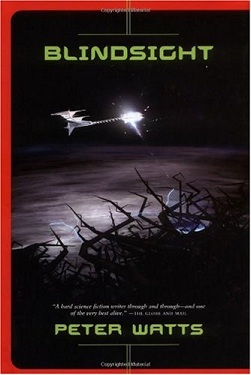
One of the QT3 and now Broken Forum regulars mentioned Peter Watts’ novel Blindsight in passing in the dualism / nature of consciousness thread I’d previously referenced. This was when the discussion turned to the subject of p-zombies and it turns out this novel has a thing or two to say on that particular topic. Since the book is available for free on the author’s website it was easy enough to check it out. It’s been such a riveting read that I’ve done little else save finish the book over the past few days. It was only after I’ve finished the book and looked up more info on the author that I realized he’s the same guy who briefly got famous on the Internet last year for being infected with necrotising fasciitis, complete with some very lurid photos on his blog.
Blindsight’s premise is a first contact scenario set in the near future. One day, over sixty-five thousand micro-satellites show up unannounced to presumably perform an exhaustive survey of Earth, destroying themselves in the process. Now if this were Star Trek, that would be the cue to break out the champagne bottles, sing kumbaya and welcome the aliens with open arms. But Watts comes from the Stephen Hawking school of extraterrestrial contact, not Gene Roddenberry. As a character in the novel states, technology exists only to tame nature and nature is basically everything that is not your own species. Therefore technology implies belligerence.
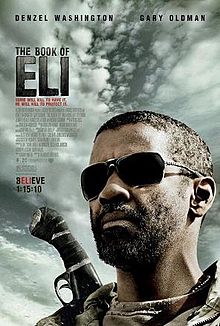
I was probably among the earliest to hear about this film if only because the story was written by Gary Whitta, a prominent QT3 member, and he posted about the project years before it made it onto the silver screen. It sounded like a standard Hollywood action movie, with some religious overtones that I usually dislike, so I didn’t make watching it a priority. So when I finally did watch it, I was pleasantly surprised by how much nuance it has and how intelligently it handles the religious theme.
For those who don’t know, Whitta was involved in founding the UK edition of PC Gamer magazine, so he has deep roots in videogaming way before he made it big in Hollywood. He’s also a big fan of Fallout 3 and as a gamer, I’m ticked by how it was an unmistakable source of inspiration for this film. There’s the obvious monochromatic look of the film for one thing and the concept of a heavily-armed lone wanderer walking across the post-apocalyptic landscape on a vital quest. At one point Eli is walking along an elevated highway and is nonplussed to see that it has shattered, a scene perfectly replicated from Fallout 3.
Since the QT3 community splintered, I find that I’ve been spending more time on the erstwhile refugee forum, Broken Forum, recently. While QT3 isn’t exactly dead, it does feel that Broken Forum has more interesting stuff now and the Politics & Religion subforum feels more pleasant and less pointlessly antagonistic. Anyway, the subject of mind/body dualism popped up the other day, I felt inspired to write some short posts in response. It’s been a while since I last participated in a philosophical discussion so I thought I’d clean up my posts and expand on them here.
I’m not going to go into a complete description of the topic. If you need to, Wikipedia offers a perfectly good summary of the basics. Or if you feel up to it, David Chalmers has a good overview of the entire topic, though he is of course probably the leading proponent of dualism in modern philosophy. Instead, I’m just going to examine two of the most interesting objections to physicalism I’ve seen in the thread. Neither of the objections are very strenuous. I guess physicalism and the scientific worldview are too well entrenched by now. So they’re more like niggling doubts rather than outright objections, but here we go anyway.
The first month of 2012 has been a good month for interesting reads of all kinds, not just science ones, but this series is all about the science, so here goes:
Scientific American reports on a clever experiment which attempts to shed light on how multicellular organisms evolved. These have always been a bit of a conundrum since indications are that the earliest such organisms were clusters of single cell creatures that somehow “decided” to stick together and work together for the common good. This is perplexing because while it makes sense for a single cell to snag resources for its own well-being, it’s a bit of leap from that to how the cells came to subsume their own self-interest in favor of that of the group as a whole. In this experiment, single-celled yeast were observed to achieve the earliest forms of multi-cellular organisms when selection pressure induced by the scientists encouraged them to cluster together and even develop a rudimentary version of division of labor.
The next article is from Malaysia’s very own The Star (actually just an article bought from Reuters, but whatever.) Researchers on Alzheimer’s disease have known for some time that people who actively exercise their brains through activities like reading and playing games seem to build up a sort of reserve of mental capacity. This allows their brains to function normally even after the destructive proteins that characterize the disease show up. However this new finding indicates that such activities do more than that. It appears that as long as these activities are started early on in life, they actually help to prevent the plaques from forming in the first place. The caveat is that starting brain-stimulating activities after Alzheimer’s has already been diagnosed does nothing so only a lifetime’s habit of being intellectually engaged appears to help.
The next two articles are somewhat related and they deal with open-mindedness, and what might or might not cause it. Discovery News highlights a finding that contravenes a commonly held belief, that as people age, they tend to become more conservative. This is based only on statistical data from surveys from 1972 to 2004, plus interviews, so it’s not exactly hard science. I think it makes sense with the key being that even if old people are conservative, their views become less extreme as they age and they learn to appreciate a greater range of other views from a lifetime of experience, even if they don’t agree with them.
The last article however is the controversial of all. Live Science cites research claiming that conservative beliefs are correlated with low intelligence. In particular, the correlation is between low levels of IQ measured as children and conservative beliefs held as adults when they grow up. As usual correlation doesn’t prove causation but the working theory is that it is more mentally draining to deal with people who are different from you and hence people with lower IQ gravitate towards beliefs and ideologies that stress conformity to tradition and resistance to everything that is new and different. These findings were buttressed by other studies that showed that people with lower cognitive abilities had less contact with people who did not share their race and were more likely to be prejudiced against homosexuals.
I’ve been remiss in updating lately, mostly because I’ve been embroiled in yet another personal programming project. So here are a few of the more interesting articles I’ve read recently to tide you over:
Probably due to the dysfunction exhibited by the U.S. government over the past year, libertarians have recently been abuzz about creating new countries of their own from scratch, Ayn Rand-style. The most impressive projects are the sea-steading ones of course that so eerily mimic the underwater city of Rapture from the BioShock games, but these are pipe dreams with not much chance of coming to fruition. Surprisingly, the most realistic of these initiatives is Honduras’ attempt to create a Hong Kong-style charter city which would be autonomous from the host country. Even Honduran police and the court system will not have authority in the designated zones as they will outsourced to the private sector and the courts of Mauritius respectively. The Economist has the details.
So Kim Jong Il died last month and the North Korea population promptly exploded into an orgy of mass grieving. This short article from MSNBC offers a few tantalizing glimpses of how this works in the hermit kingdom, which includes people being punished for not participating in organized mourning sessions or even not being seen to cry in a genuine manner.
By now everyone has heard of the cruise ship that sank off the coast of Italy and the idiot captain whose latest claim that he accidentally fell into the lifeboat and thus didn’t mean to intentionally abandon ship. But do you wonder what happens next to that ship? Do they let it sink? Do they try to refloat it? Well, this amazing feature from Wired covers an international team of experts who specialize in just this sort of thing, traveling all around to refloat capsized ships or just salvage what can be saved. They’re paid big bucks but their company earns money only if they succeed as their contracts are based on a percentage of the value recovered and as the article makes it painfully clear, theirs is a mortally dangerous job. The article is so good it could be made into a summer blockbuster, highly recommended.
Finally, on a more light-hearted note, I’m sure what with the Wikipedia blackout and all, everyone knows about SOPA and how it’s supposed to help with copyright violation, i.e. IP piracy. In a move that combines the futility of fighting against file sharing and the ridiculousness of organized religion, Sweden has officially recognized the Church of Kopimism as a religious organization. This church was founded in 2010 and upholds the right to file-share as a sacred tenet. Its religious symbols are CTRL+C and CTRL+V, i.e. copy-paste. PCMag has the story.
I spent some time looking for cool stuff to share but only have a couple of articles for the last month of 2011, so here they are anyway:
The Economist has a simple story about how the usual practice of cutting off an infant’s umbilical cord immediately following birth may not be a good idea. The theory is that as long as the cord is still attached, blood continues to flow from the detached placenta to the infant. If the cord is cut too soon, not enough blood flows into the infant, causing anemia. Indeed, a study found that infants who had their umbilical cords cut after at least 3 minutes following birth had up to 45% more iron in their blood compared to those whose cords were cut within 10 seconds when they were 4 months old. As the article suggests, this may be what nature “intended” as other mammals tend to leave the cords attached for some time following birth.
The next article is the latest in a long line of findings in evolutionary psychology which show that human infants are born with an ingrained sense of morality. What makes this one different is that it also shows that infants’ sense of morality is capable of quickly growing more sophisticated as they grow older. Previous studies showed that infants like to reward actors in events that they perceive to be good, which usually means an actor that has been seen to be helping other actors in a scenario, such as retrieving an object for them or helping them climb across an obstacle etc. However, this time the researchers showed that at the age of about 8 months, the babies, when asked to reward an actor, would choose to reward a bad actor if they had previously seen this actor doing bad things to another antisocial actor as opposed to another actor who only did good things all the time. This means that they are rewarding an actor who they think is justly punishing someone bad.