Zerg Zombies

Starcraft(2)_reduced

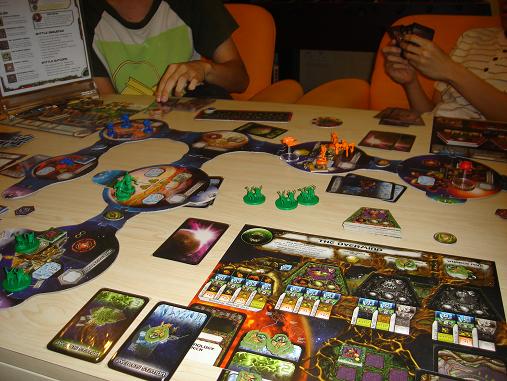
The title is what you get when I try to combine a post about the Starcraft boardgame with a game about zombies. Last week’s in-fashion game at CarcaSean was Starcraft which some of the hardcore regulars played multiple times over the course of the week. I only managed to play once which admittedly isn’t enough to form a good opinion of such a complex game. As its title implies, it’s a boardgame based on Blizzard’s popular video game. As in the original PC version, all three races are represented in the game and there are two rival factions for each race, so that up to two players can choose the same race. Lore-wise, everything is fairly faithful. The two rival factions for the Zerg for example are the Queen of Blades and the Overmind who as any Starcraft fan should know, have little love for one another.

The board for this game is actually made up of interlocking tiles representing star systems that each player takes turns to lay down, which is reminiscent of Twilight Imperium 3. Each system is subdivided into separate areas, each of which offer different resources or conquest points for the player occupying them. The resources, minerals and Vespene gas as in the original game, is spent to purchase technology, build bases and upgrade them and of course build new units. Naturally, the higher tier units can only be purchased once you own the appropriate production building.

Continue reading Zerg Zombies

Saudi Arabia seeks compensation for reduced oil consumption

In a move so outlandish that one would expect to see it only in an Onion article, Saudi Arabia has demanded that if the rest of the world reduces oil consumption due to efforts to combat global warming, it and other oil producing countries should be compensated for the corresponding loss of revenue. That’s about as heinous as drug pushers telling government authorities that they should be compensated if addiction treatment programmes successfully reduce their customer numbers.

While this is the first time I’ve heard of it, it appears that this has been the position of the Saudis ever since the first global climate talks in Rio de Janeiro in 1992. This time however they’re claiming that this is a “make or break” position for them, meaning that other countries must agree to pay compensation for reduced oil consumption or they’re going to walk out of any talks. Of course, Saudi Arabia and other oil producing countries need to diversify away from an economy that’s almost a hundred percent dependent on oil sales, but it’s not clear to me at all why other countries need to pay up to help them achieve that.

The wealth that the oil producing nations have earned from their black gold is already the stuff of legend, so what have they been spending it on if not preparing for a day when oil is no longer king? Furthermore, it’s not as if the oil is an infinite resource. In fact, if anti-global warming initiatives fail to reduce oil consumption, their oil would just be depleted all that much faster. Do they expect the world to compensate them for the loss of that oil then? It’s like asking their customers to pay for the same product twice.

World’s best boardgame!

Puerto Rico (2)_reduced

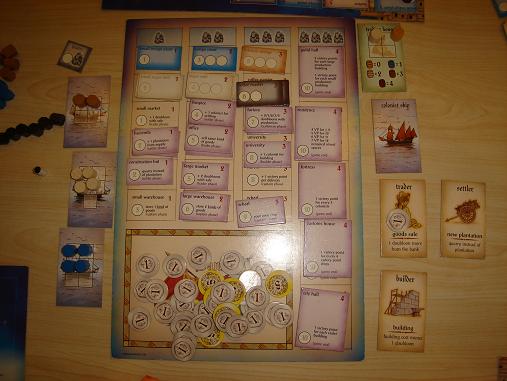
Or it was until recently on the BoardGameGeek rankings anyway. Agricola is currently our favourite boardgame, but since it only recently displaced Puerto Rico from the number one spot which it had previously held for quite a while, I’ve been itching to try the older game. Sean was kind enough to teach to us and join in even though he’s played it plenty of times already. His copy of the game certainly has the wear and tear to show it!

Since we’ve already played Twilight Imperium 3 and Citadels, we’re already familiar with the central mechanic of choosing roles, so we found it to be a fairly easy game to learn. Basically there are a number of roles which gives both the player who chooses the role as well as all other players in the game a specific action. The active player does get a small bonus for choosing the role. Every round that a role doesn’t get picked, money gets added onto it and whoever later picks that role gets it as a bonus.

Continue reading World’s best boardgame!

A Game: Colonization

Colonization 2009-10-04 23-36-11-43_reduced

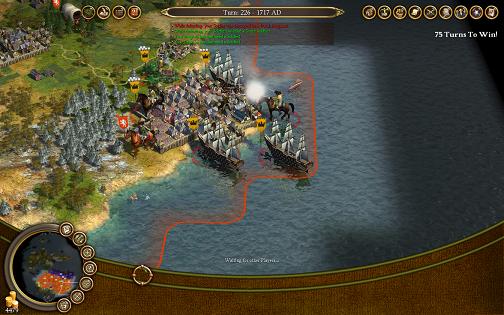
For a game that now claims membership of the Civilization family, Colonization lacks the breadth, depth, variety and sheer richness of its more famous cousins and is the poorer game for it. For one thing, it covers only a narrow slice of history, from 1492 to 1792 to be exact and despite its generic name, it covers only the colonization of the Americas. Folks who might have wanted a game that covers the colonization of Africa or Asia for example will have to walk away disappointed. For another thing, while there are many paths to prosperity, there is only one route to victory: successfully declaring independence from your mother nation and defeating their forces on the battlefield.

You start the game with a motley group of colonists out to make a new life in the New World. Unlike the Civilization games, you get a naval unit as part of your initial force, so you’re expected to spend some time exploring to find the best spot for your first settlement. Again, unlike Civilization, you’ll inevitably find that while the New World is indeed a vast land filled with riches, the best spots are already occupied by the native indians, so there is potential from conflict right from the beginning.

Continue reading A Game: Colonization

A better Risk

Struggle of Empires (2)_reduced

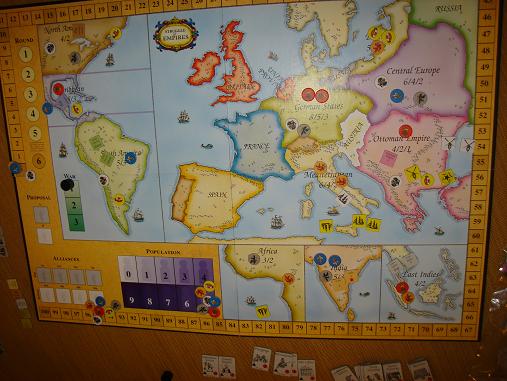
We made an extra visit to CarcaSean in the middle of the week for a session of Struggle of Empires. With six players in all, I do believe that it’s the biggest gaming group we’ve had yet. Our group was led again by Han who taught us the rules which took about half an hour out of our total playing time of four hours. This game’s basic gameplay reminds me a lot of Risk, though it’s obviously a much more subtle and complex game.

The main area of the board depicts Europe while the smaller boxes to the left side and bottom represent the areas that the European powers can colonize. The object of the game is to gain as much influence as possible and this is accomplished by conquest. You move ships and armies around the board to strike and defend as needed while spending your own population to raise new forces. You can also use your actions and money to buy special tiles which confer various advantages and abilities over the course of the game.

Continue reading A better Risk

One Nation under God

35a2lhy_reduced

This painting by Jon McNaughton is currently making the rounds of the Internet. It’s easy enough to tell what the artist is getting at, but if you really need some rather heavy-handed hints, you can check out a full-sized picture at the artist’s own website where he also provides handy mouse-over explanations on what all of the symbolism is supposed to mean. Everyone who reads this site should know by now that I’m no fan of Christianity or any other religion, but what this artist and many other conservatives (in the modern rather than the classical sense of the word) in the U.S. are trying to do should be regarded by all Christians everywhere as being ridiculous and faintly blasphemous.

For one thing, they claim that the U.S. is uniquely blessed by the Christian God. It shows Jesus Christ appearing out of nowhere with a copy of the U.S. constitution in his hand and the Founding Fathers and deceased heroes of the country behind him. In the lower left corner, one immigrant is even depicted as cowering in shock as he realizes what the source of America’s greatness is. Of course, this is just one painting but it’s emblematic of the whole conservative movement in the U.S. For example, just take a look at the Conservative Bible Project, which is an initiative to create a better version of the Bible by removing “liberal” influences from it.

Secondly, the painting presents an untruthful view of history. The artist implies that the separation of church and state in the U.S. is the work of activist judges, hence why a Supreme Court judge is depicted as on the side of Satan, whereas in reality the separation is written in the U.S. constitution at the instigation of Founding Fathers such as Thomas Jefferson and James Madison. The painting  even portrays Thomas Paine as being on the side of Jesus Christ, the same man who wrote the following passage:

I do not believe in the creed professed by the Jewish church, by the Roman church, by the Greek church, by the Turkish church, by the Protestant church, nor by any church that I know of. My own mind is my own church. All national institutions of churches, whether Jewish, Christian or Turkish, appear to me no other than human inventions, set up to terrify and enslave mankind, and monopolize power and profit.

I do not believe in the creed professed by the Jewish church, by the Roman church, by the Greek church, by the Turkish church, by the Protestant church, nor by any church that I know of. My own mind is my own church.

All national institutions of churches, whether Jewish, Christian or Turkish, appear to me no other than human inventions, set up to terrify and enslave mankind, and monopolize power and profit.

Finally, the painting infuriates Democrats because it mercilessly attacks the liberal movement (e.g. the liberal news reporter and the professor who holds a copy of Darwin’s “The Origin of Species” in his hand) while appropriating liberal heroes like Susan B. Anthony and John F. Kennedy for its own side. It even includes a black soldier who’s supposed to be a reference to Martin Luther King, Jr. as if King wouldn’t be considered a liberal in today’s political climate.

Of course, the funniest thing in the painting is the tree symbol on Jesus’ chest. The artist claims that it is a reference to the “Tree of Life” but it looks suspiciously like the White Tree of Gondor, prompting someone on QT3 to ask whether Jesus is supposed to be from Minas Tirith.
Tabletop Civilization

Through the ages(2)_reduced

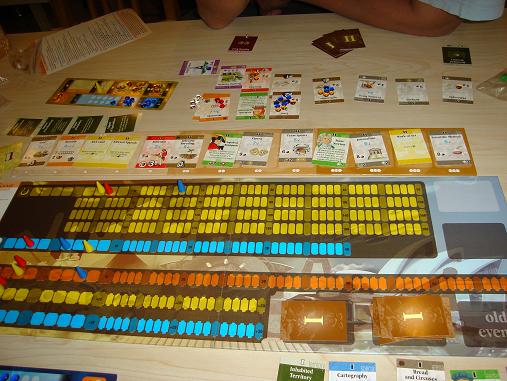
We’re currently re-arranging our daily schedules a bit so as to be able to play boardgames more often, perhaps making our CarcaSean visits a twice weekly rather than weekly affair. The highlight of last week’s sessions was Through the Ages: A Story of Civilization, which was kindly taught to us by Han. As its name implies, it’s a boardgame inspired by the PC-based Civilization series and attempts to abstractly simulate the competition between rival civilizations from ancient history to the modern age. Since this was our first game and due to time constraints, we only played up to Age 2, skipping the third and final age.

The keyword here is abstract as my first thought when all of the components were taken out of the box was “Where’s the map?” Indeed, there isn’t one. The main board basically serves only as a handy way to track the many different variables the game needs, including the Cultural Points that the players need to accumulate to determine victory. Without a map, any civilization is assumed to be able to attack any other when necessary. The only territory that the players fight over are the Colony cards that confer various advantages to the civilization that manages to win them.

Continue reading Tabletop Civilization

The unexamined life is a life not worth living