Who Weeps for the Watchmen?

comedianfull-thumb.jpg

While I generally leave most superhero movie news to The Superheroes Base, I felt that Watchmen deserves a special note here. The movie adaptation to be directed by Zach Snyder, who also directed the movie version of Frank Miller’s 300, is still at least a year away but the release of the photographs of the main characters has me psyched like few movies have. Pictured above is the Comedian, who is sort of a melange of DC’s Joker and Marvel’s The Punisher. Note his crazed grin and the yellow happy face badge on his shoulder. It’s details like this that make me hope Snyder that will do his best to be as faithful to the original graphic novel as possible.

The other photographs on the site are from top to bottom: the Nite-Owl, who is a sort of Batman with high-tech gadgets and vehicles; Ozymandias, who represents the peak of humanly possible perfection in both physical and mental abilities; Rorscharch, who is inspired by Steve Ditko’s Objectivist superhero The Question and is every bit as psychotic as the criminals he hunts and the Silk Spectre. I’m not sure which Spectre the photo represents though, since in the comics the title is held by a mother and then passed down to her daughter. The most glaring omission here is the god-like Doctor Manhattan, the only one among them who actually has superpowers.

Watchmen is worthy of special attention here because it is one of the very few comic books that have transcended its superhero genre to be recognized as a genuine piece of art. It is the only comic to have won a Hugo Award and the only comic to have been included in Time Magazine’s list of the 100 best English-language novels. It tells a dark story that bring superheroes down to the messy, grimy and morally ambiguous real world. My only worry is that the short length of a movie adaptation wouldn’t do the story justice. Please get and read the comic if you can. It will be worth your time.

A Day at the Museum

dsc00114_reduced.JPG

Considering the size of the Solomon Islands National Museum, it’s really more like 15 minutes though. I have to admit that despite having worked in the Solomon Islands for some 8 years now and despite it being located conveniently in the town center just off the main road, I’ve never visited the National Museum. Not that there is really much to see. You can see the entirety of it in the photo above with my wife. That small hall constitutes the entire museum, so it’s pretty underwhelming.

The exhibits are mostly wooden carvings and examples of shell money, bundles of sea shells tied together that used to be exchanged as currency and are still given as marriage gifts in some communities. There are also some old photographs of some of the early explorers who came to the Solomons.

Continue reading A Day at the Museum

Psionic Interface for Gamers

I tend not to write gushy posts about the latest tech toys because I don’t care for devices looking sleek or fashionable. To me, function matters a lot more than form. However, I’m writing about this latest interface device from OCZ because it’s cool enough to make for an exception. It’s called the Neural Impulse Actuator and it’s a headband that can “hear” your thoughts and allow you to use it to interface with a computer, replacing the traditional mouse and keyboard.

Devices like this aren’t exactly news at this point, but this is the first time that I’ve heard of something like this outside of an experimental setting with specially designed software. OCZ’s device has already been demoed at a computer show to play a commercial FPS game, Unreal Tournament, and apparently will soon be in normal production with an estimated retail price of US$300.00. The makers also claim that since the device bypasses the muscles, response time for gamers will be much better. Essentially, instead of your thoughts going to your fingers and from there to the computer, they’ll pretty much go directly from your brain to the computer.

We’ll have to wait a while yet to see how much of this is true and how sophisticated an input device it proves to be. It seems to me that an important factor will be the communications bandwidth that it allows between your brain and the computer. If the bandwidth is large enough, it would cause a revolution in games design since it would allow games with many more options and controls to be designed than would normally be possible given the physical control limits of traditional interfaces.

A Game: Half-Life 2 Episode 2

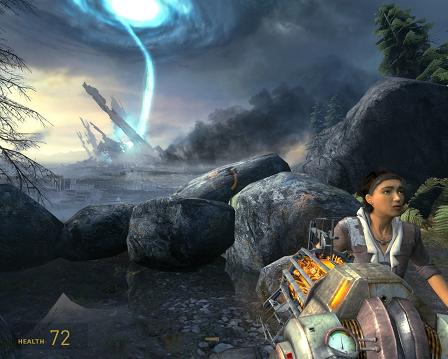
ep2_outland_010001_reduced.JPG

As with Episode 1, Half-Life 2: Episode 2 picks up directly where the last game left off and for the first time in the series, I found myself awed by the visuals. After you extricate yourself from the train that crashed at the end of Episode 1 and reunite with Alyx, you’re confronted with the spectacular sight of what used to be the Citadel. As you soon learn, the Combine is opening a massive superportal to call in reinforcements, and you need to head to the Resistance base at White Forest to warn them and help to shut down the portal.

Again, Alyx Vance accompanies you throughout most of the game, except for an extended sequence when a Vortigaunt fills in for her. They supply much needed commentary since as usual Gordon Freeman is conspicuous in his invisibility and silence (even from the opening cutscene that recounts the story so far such that it ends up looking like the Adventures of Alyx Vance instead). Valve’s storytelling magic is still here and the good news is that this time it’s backed up with great gameplay.

Continue reading A Game: Half-Life 2 Episode 2

Recent Interesting Science Articles (Feb’08)

Four articles this month, one on how behavior in robots can “evolve”, one on a new way of using stem cells, one on a controversial device to disperse teenaged loiterers in the U.K. and a last one on the creation of a material blacker than any previously known.

In the first article, researchers at the Swiss Federal Institute of Technology have created learning robots outfitted with light sensors, light rings and a neural circuitry of 30 “genes” that together determine their behavior. These robots were then placed in a specially designed habitat with designated areas containing either “food” or “poison” that charged or drained their batteries respectively. The “genes” from the survivors of each round, together with some randomness to simulate mutation, were recombined to form a new generation of robots that were again set loose in the habitat. By the 50th generation, some of the robots had evolved the ability to communicate with each other, lighting up to alert other robots to the presence of food or poison and even learned to cheat by signaling food where there is really poison and quietly “eating” the food by itself.

Continue reading Recent Interesting Science Articles (Feb’08)

$10 million note for Zimbabwe

Continuing its slide into barbarism, the government of Zimbabwe has just released a $10 million Zimbabwe dollar note, which as this article writes, is still not enough to buy a single hamburger. An inflation rate of 150,000% is almost impossible to comprehend, so to break it down a bit:

150,000% inflation per year / 365 days = 410.96% inflation per day

To put this into perspective, at a daily inflation rate of 410.96%, something that costs, say, $10 today would end up costing $51.10 at the same time tomorrow. Needless to say, this makes life in Zimbabwe pretty tough. The really sad thing is that Zimbabwe was once one of the most developed countries in Africa with decent transport and power infrastructure and a thriving economy based on agriculture, mining and tourism. This of course is due to President Mugabe’s harebrained land redistribution policy in the late 1990s which resulted in the eviction of 4,000 white farmers and a stubborn refusal to face basic facts.

Between 2000 and 2007, Zimbabwe’s economy contracted by 40%, tourist visits fell by 75% in 2000 and the government has given up publishing official inflation figures. Within a period of less than 10 years, Zimbabwe has gone from a big exporter of wheat to having its citizens hunt for rats in fields to eat. President Mugabe continues to insist that the economy’s problems are due to sanctions imposed by Western countries despite the fact that the only sanctions that have been imposed are travel bans against the members of his government. His government insists that the inflation is caused by shopkeepers who keep raising their prices and has introduced price controls, though these are impossible to properly enforce, that effectively obliges shops to sell goods at a loss.

Zimbabwe will make a fantastic case study of how not to run an economy for many decades to come. It’s an incredibly potent reminder of how quickly and how completely a country can be ruined by gross mismanagement.

Addendum (1st March):

Someone has since commented on StumbleUpon that my daily inflation calculation above is incorrect. He is in fact right and that my calculations suck because they do not take into account the compounded effects of daily inflation. In fact, with an annual inflation rate of 150,000%, the daily inflation rate for Zimbabwe should only be around 2.0240155%. I’ve left the original text unchanged as a record of my stupid mistake.

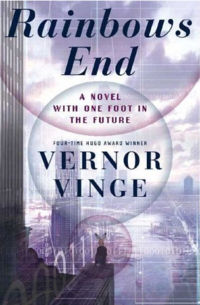
A Book: Rainbows End

Tommie laughed. “You should do some ego surfing. Your hack was noticed. Back when I was young, you could have got a patent off it. Nowadays –”

Xiu patted Tommie’s shoulder. “Nowadays, it should be worth a decent grade in a high school class. You and I — we have things to learn, Thomas.”

– Vernor Vinge in Rainbows End

200px-vernorvinge_rainbowsend.jpg

As the person who came up with the term “Technological Singularity”, any new science-fiction book by Vernor Vinge is always highly anticipated. Unlike his previous two bestsellers, A Deepness in the Sky and A Fire Upon the Deep, both of which were space opera novels set in a universe of his own creation with specific rules to allow a high level of technological development without invoking a singularity, Rainbows End is a solid science-fiction story set in a near-future Earth. There are tech toys aplenty and cyberspace permeates and interconnects with the real world, but it’s still more or less our same old planet with recognizable lifestyles and people. Unnoticed by the most of the world’s population however, who live mostly pleasant and peaceful lives, are events that suggest that the state of the world is not as stable as it seems, and there are hints of upheavals yet to come.

Continue reading A Book: Rainbows End

The unexamined life is a life not worth living