Once again, I’ve been remiss in posting entries, so here’s a smattering of stuff that I’ve recently found to be of interest around the web:
- After a long hiatus, Less Wrong (Eliezer Yudkowsky) finally updated the ongoing Harry Potter and the Methods of Rationality fanfiction work with a few new chapters. I actually didn’t care that much for the Hermione-centered SPHEW arc that immediately preceded this latest update, but the newest arc is totally mindblowing. Chapters 80 and 81 together constitute probably the greatest crowning moment of awesome in a courtroom in anything I’ve read. My only worry is that this ratchets the epic up so high it’s hard to see how this version of Harry Potter can have any kind of normal Hogwarts life after this.
- In the same vein, I’ve started reading the Sequences on the Less Wrong site. It’s a series of essays on rationality with the explicit aim of teaching you how to refine your way of thinking. It involves plenty of logic and math and absolutely no crackpot fuzzy thinking.
- The in-thing du jour is the Hunger Games series. I haven’t read the books and have no real interest in watching the movie but this did remind of the much earlier Battle Royale story which I’ve always wanted to check out. So I started reading the manga. Not quite as good as I imagined, but much more brutal than I expected.
- I’m always a sucker for entertaining anecdotes about creative and/or smart people and this page on the Math Overflow website turned out to be a treasure trove of them. Here’s one of my favorites:
One of the most common and popular Norbert Wiener (1894-1964) stories is of a student coming to Wiener after class and saying, “I really don’t understand this problem that you discussed in class. Can you explain to me how to do it?” Wiener thought a moment, and wrote the answer (and only that) on the board. “Yes,” said the student, “but I would really like to master the technique. Can you tell me the details?” Wiener bowed his head in thought, and again he wrote the answer on the board. In some torment, the student said, “But Professor Wiener, can’t you show me how the problem is done?” To which Wiener is reputed to have replied, “But I’ve already shown you how to do the problem in two ways!”
Dick Swenson, who was at MIT in those days, tells this variant of the story: Wiener showed the kid the answer twice, as just indicated. Then the student said, “Oh, you mean…,” and he wrote the answer (and only the answer) on the board. Wiener then said, “Ah, very nice. I hadn’t thought of that approach.”
Strangely enough, despite being 36 years old this year, the upcoming Malaysian general election is the going to be the first one for which I will be in the country as an adult of voting age. Since Malaysian politics bore me in general so this post won’t be about that. Instead, this post will deal with a good question posted by someone in the general LYN stock market trading thread: historically speaking, how does the local stock market respond to elections? Are there any patterns at all? Out of curiosity, I spent some time making charts of the KLCI for the six months before and six months after each of the four previous elections. So here they are:
Continue reading How do elections affect the KLSE? →
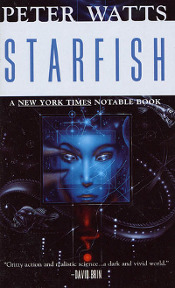
So it took some time, but I’ve finished Peter Watts’ Rifters trilogy, consisting of the novels Starfish, Maelstrom and Behemoth. That’s quite a lot of text, especially the last book which is as hefty as its name suggests, so much so that the dead tree version was split up into two volumes for commercial reasons. After liking Blindsight so much, I just had to read more stuff by Watts even though I knew this prior work wasn’t as well received. Unfortunately even with reduced expectations, I found the trilogy disappointing. It has a ton of cool ideas and a unique post-apocalyptic setting but the story as a whole just doesn’t gel together.
It’s hard to describe all three books in one post without delving into spoilers, so potential readers might want to keep out. The story begins in the middle of the 21st century. Due to global warming, the end of the cheap energy era as fossil fuels finally run out and global conflicts over increasingly scarce resources, the future is decidedly not rosy. Rising sea waters and frequent environmental catastrophes have caused the coasts of North America to turn into refugee zones. Cyberspace grows increasingly wild as self-evolving malware become ever more sophisticated.
Continue reading The Rifters Trilogy →
February may the shortest month of the year but there’s certainly no shortage of interesting science-based news. Maybe because it’s a leap year?
- The New York Times has a story about how Alzheimer’s spreads from brain cell to brain cell like an infection. What’s particularly interesting here is that it’s not being spread by viruses or bacteria, but by distorted proteins known as tau. I pay special attention to all news articles about Alzheimer”s as it’s an especially terrifying disease to me.
- Also from The New York Times, the next article talks about how people who suffer from dyslexia, which is usually associated with impaired reading and learning ability, may benefit from unexpected side effects. In particular, people with dyslexia seem to have superior peripheral vision and can process an entire image at a glance, as opposed to specific details in an image, more quickly. The article then goes on to speculate if these improved abilities have any real world applications.
- Nanotech robots circulating in your blood stream to fix your body has been a science-fiction staple since at least the 1966 film, Fantastic Voyage. This article from BBC News covers research into an attempt to build similar devices out of strands of DNA molecules. Unlike the film, the proposed DNA robot doesn’t come equipped with a tiny surgical laser. Instead, its mooted use is to deliver exactly determined dosages of drug molecules to pinpoint sites in the body.
- Everyone knows that 2012 is a leap year, but did you know that there are also leap seconds? As this article from The Economist explains, leap seconds are inserted into our timekeeping to account for the very slight discrepancy between the strict definition of 86,400 seconds in a day and irregularities in the Earth’s rotations. Without this contrivance, our account of time would eventually fall out of sync with perceive day/night cycles, though hundreds of years for it to become noticeable in day-to-day life. This system however may soon be coming to an end as it is inconvenient for computers around the world to have to manually reset their time every so often whenever a leap second needs to be added. Instead, the powers that be seem likely to allow the discrepancies to add up and fix them in one go later.
- When we think about planets, our first impression is that all planets are like the Earth, in that they are part of fixed system orbiting around a star. This article from the Stanford Report says that this picture is probably untrue and that by far most planets that exist in the universe are actually nomad planets that wander through space without orbiting a star. Such planets may even be big enough and have enough of an atmosphere to support life, relying on radioactive sources and tectonic movement to generate heat energy. Attention all science-fiction writers, update your space exploration paradigms, stat!
The unexamined life is a life not worth living