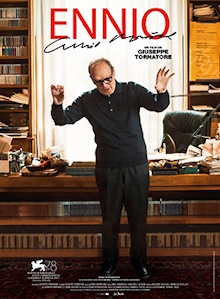
This biographical documentary of the life and work of Ennio Morricone was released a year after the legendary composer’s death. I don’t know when exactly the interviews with him were filmed and I’d imagine they must have taken place over an extended period. But I can’t help but feel that Giuseppe Tornatore finished this just in time and fortunately so because this is one of best documentaries I’ve ever seen. Its scope extends well beyond Morricone’s best known film scores, it features interviews with many famous directors and fellow musicians and it raises fascinating questions about the artistic merits of music composed for films. It could be argued that this treatment is overly hagiographic but if anyone deserves so much praise, it’s surely Morricone.
In his own comfortable home filled with the clutter of a life well lived and a hugely productive career, an aged Ennio Morricone starts his day with a light workout. He then sits down to a wide-ranging interview beginning with his childhood and upbringing. He humorously recounts how his original ambition was to be a doctor but his father, himself a trumpeter, decided he would be a musician and taught him to play the trumpet. While studying composition, everyone else came from a piano or string background and so he was looked down for being a trumpeter. It dives into his lifelong relationship with his teacher Goffredo Petrassi as well as his early work for radio shows and arranging music for pop songs while also playing in a band at clubs. He also dabbled in avant-garde experimental music and of course composed film scores. His earlier work for comedies are less well-known but it would be his work with Sergio Leone that would be the turning point of his career. The two realized that they were schoolmates and their collaboration in A Fistful of Dollars would be the first of many. The final part of the documentary discusses his enduring legacy and how his work would be adapted by many other musicians.
Everyone is familiar with the iconic, coyote-inspired howling sounds from The Good, the Bad and the Ugly but it might be surprising just how large his body of work is. As he states in the documentary, his composing over scores in a single year in 1968 led rival composers to raise doubts that he actually produced so much work on his own. One of the most fascinating questions raised here is that film music is seen as being less prestigious and less serious. His peers from the conservatory he studied at confesses to being dismissive of his work for film and came around only very late. Morricone himself seemed sensitive to such concerns and made an effort to prove that he could do equally good work for operas and symphony orchestras. He recounts a story of telling his wife Maria that he would quit film work at the decade only to repeat the same vow every ten years. Yet clearly he is so good at it because he seems to genuinely love and understand films. This is in contrast to an episode in which his teacher’s work was rejected in favor of his own, possibly because in Petrassi’s case, it was a condescension to do film work. Tornatore makes the adroit decision here of showing only brief snippets of his most famous scores in favor of longer sections to showcase work that might not be as well-known and even cleverly demonstrates how different music can drastically change the vibes of a film.
The primary criticism against this documentary isn’t that it’s too long. Indeed, it’s probably not long enough. It’s that every interviewee called on has nothing but praises for Morricone. Tornatore is arguably too close to Morricone having worked with the composer for every single one of his films since Cinema Paradiso and as a personal friend understandable presents him in the best possible light in all circumstances. So when the documentary discusses Morricone’s minimalistic innovations for Leone’s films, it omits the fact the Spaghetti Westerns were low-budget productions and they simply could not afford to hire a full orchestra. That Morricone did such great work despite such restrictions is further proof of his genius but why ignore the fact that they existed? So when Quentine Tarantino called on Morricone to write the score for The Hateful Eight, you can better appreciate why he chose to use a full orchestra instead of going back to his earlier style. There’s one instance here in which the maestro addresses an accusation that one of his compositions is too similar to an older one but I would have preferred to see more in-depth analysis of his work from fellow musicians rathar more praise.
Certainly Morricone was a far more productive and important than I’d realized before watching this documentary. Tornatore makes a strong case that he definitively changed the entire field of film soundtracks and taught directors how important the choice of music is. The pacing and the choices Tornatore makes on which works to highlight are excellent and it’s just so delightful to watch the many directors and Morricone himself remember past compositions so fondly. I am not a musically-inclined person and do not even listen to music regularly. But watching this made me wish that I did, that’s how good a documentary this is.
One thought on “Ennio (2021)”