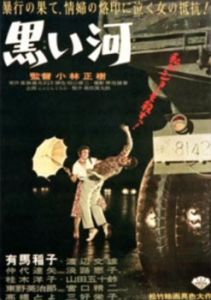
Continuing the series of films that show how bad life in Japan was in the post-World War II period under American occupation, here’s a lesser known one set in the slums outside a US military base. I’d expected it to have more of an anti-American message but it really just has them as part of the background reality that everyone needs to work around. The scenes of poverty, moral corruption and blatant lawlessness are grim and far from the idealized Japan seen in other works of the era. The downside is that its conclusion feels fake and hacked on. In reality the criminals win so comprehensively that there’s no happy ending for anyone else.
In order to save money, university student Nishida move into a rundown slum next to an American base. The dilapidated wooden building is full of holes, has no running water and many of the other inhabitants are either prostitutes or their pimps. After moving in, he notices Shizuko, a waitress who walks by the building on her way to work. They bond over a shared love of books and seem attracted to one another. But Joe, the leader of the local gangsters, has his eye on her too. One night he has his men pretend to kidnap her so that he can swoop in as a hero. In the aftermath he rapes her and she reluctantly submits to him. Nishida sees the two of them together and is disgusted even as Shizuko hates herself for being with Joe. Meanwhile the landlady who owns the building is approached by a businessman who wants to raze it and redevelop the land. They hire Joe and his gang to conduct the eviction process. His goons obtain consent from the renters either by using cash handouts or through fraud in the case of dissenters.
The tragic love story between Nishida and Shizuko is fairly standard fare for this era across countries. Joe and his goons are vile and his scheme is predictable. The only part of that I don’t get is why he even needed that plan at all or that anyone including Shizuko would have bought the deception. He seems ready enough to outright rape her whenever he wants and she is unable to leave due to both fear and his intense charm. Nishida, the ostensibly hero of the film, is mostly powerless. He does stand up for himself and is able to acquit himself in fisticuffs but it’s not like any of his actions make any difference. He is essentially there as an indignant yet helpless witness to events. The forces at work there, the presence of the US base and the lucrative yet illegal opportunities it represents to make money, the corruption in the Japanese government which allows for their building to be torn down, the power that the landlady and the developer have over them, are too much for any one individual to stand against.
Fascinatingly, director Masaki Kobayashi doesn’t depict the tenants as being virtuous either. One woman takes the eviction money and hides it from her husband. Another wife begs everyone to donate blood to save her husband but is fearful of donating herself. The only person looking out for the group as a whole is a Communist who tries to get everyone to work together to report their electricity usage honestly. I’m guessing that this reflects Kobayashi’s own sympathies but the hapless man doesn’t get very far. The Americans aren’t direct villains but as everyone is trying their best to trade illicit goods and services with them, they contribute to the moral degradation. It is even hinted that the love hotel to be built on the site of their old building is meant to serve US soldiers. Meanwhile the army trucks going to and from the base roll through the streets as if they own them without stopping or answering to anyone.
This is a grim portrait of the Japanese society of the era by any measure. Its edge is softened by the lonely and resolute figure of Nishida. Even if the plot contrives to have him and Shizuko unrealistically prevail against Joe, it changes nothing in the grander picture. The building is still torn down and Shizuko is still ruined. The black and white cinematography captures this dark time well. I feel that the ending drags on for too long and the specifics of what happens to Joe isn’t that interesting. But I’d love to see more work in this vein that doesn’t shy away from expressing the bitterness that the Japanese feel about being occupied.