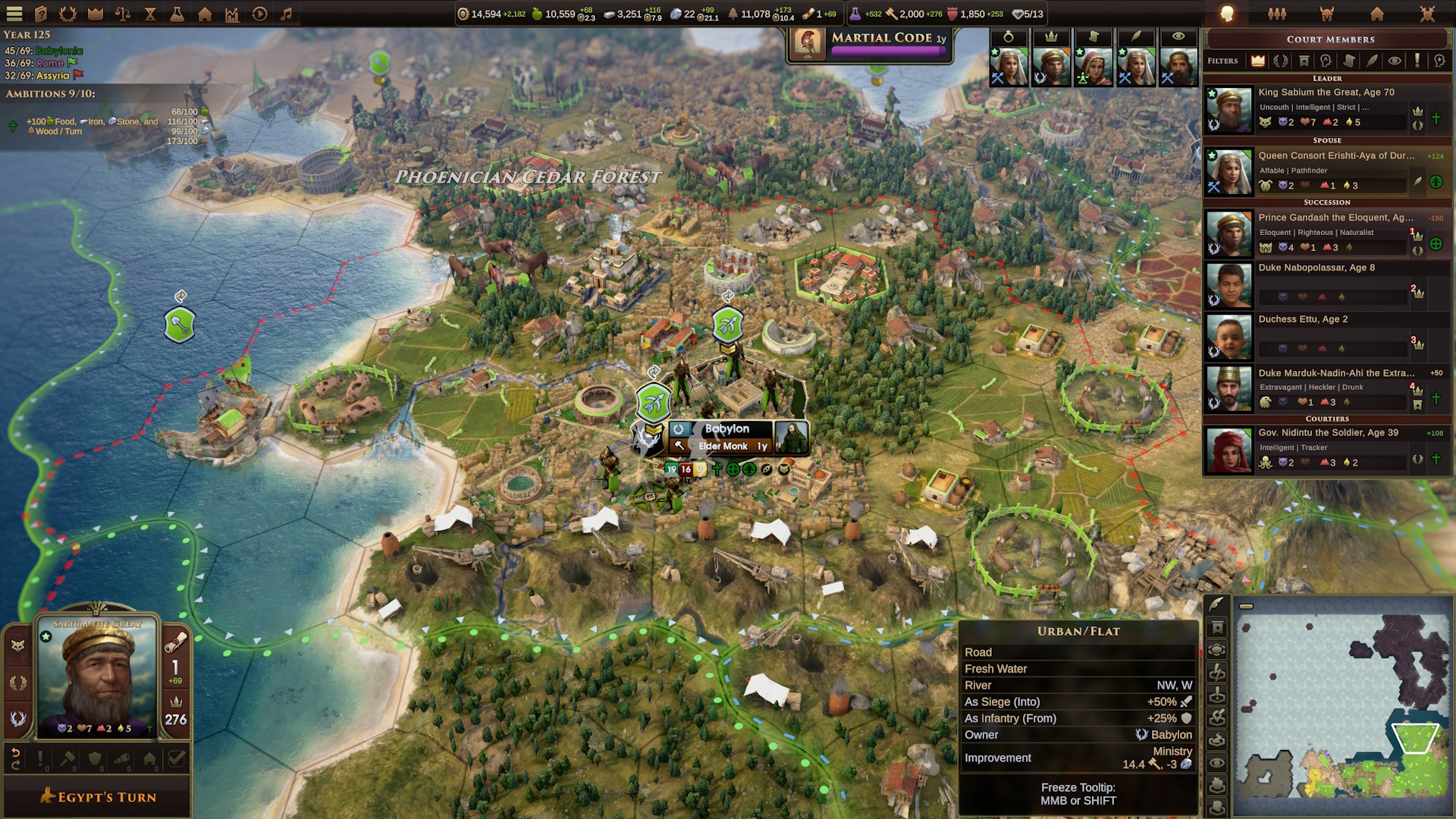
It hasn’t even been that long since the last time I played a 4X strategy game but this one has been sitting in my queue forever and I bought it back then because it was designed by Soren Johnson. This one innovates on the usual Civilization formula in two key ways. One is that its setting is only the ancient and classical eras, hence its title. Two is that you’re constrained by the number of orders you can issue each turn. The intent is to streamline the gameplay and it works. At the same time, there are so very many rules and interactions to learn. I believe that this may well be the most complex 4X game I’ve ever tried. It’s honestly overwhelming. I can see why fans who love optimize everything to the smallest detail love this. Me, I just feel that I’m too old for this much micromanagement.
Similar games in this genre usually have you use your starting settler to explore your immediate surroundings to find a good city site. The Old World is so streamlined that your settler is already on a city site tile on the starting turn. You’re even guaranteed a number of other city sites nearby depending on the difficulty settings. If you don’t like that position, there’s an easy option to just reroll the map. Each game lasts for a fixed number of turns and is won based on a familiar Victory Point system. Many other elements are superficially similar. Workers build improvements on tiles. Cities produce units. You have technologies, religions and civics to choose from. Still, a glance at the user interface is enough to show how much more complex this game is. There are so many types of resources to amass from the more usual ones like money and wood to more esoteric ones like training and of course the famous orders. You also need to care about the opinions of your family members and other court personalities and generals of note. That’s already plenty of juggle and then we come to the special rules.
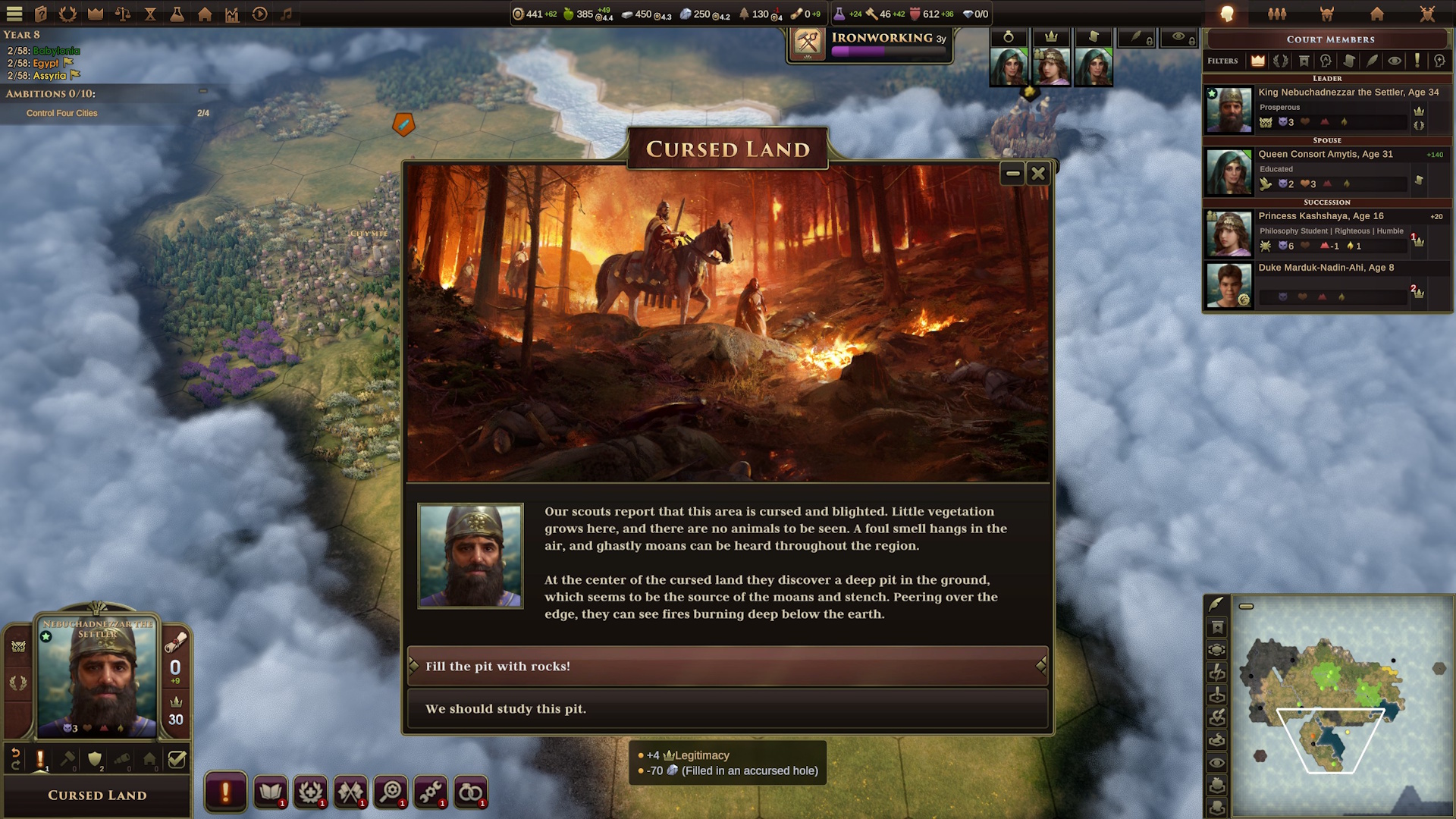
One of the innovations here is that every nation is composed of up to three families, each with a different specialization. It’s a neat way to let you further customize each nation but you do need to manage their opinions of you. What I didn’t fully understand in my first playthrough is that every unit you build also belongs to one of these families and that comes with all kinds of rules. A worker from a Trader family are better at building roads. All workers work more slowly if ordered to improve the land of other families. All combat units from a Champion are better at fighting tribal enemies. Similarly different families produce characters with different traits. This not only affects their performance in different jobs but also how much they like each other if you marry them. There are many more rules like this to take note of and if you ignore them, you’re not playing optimally.
Every 4X game involves combat but there is so much of it here that I’ve read The Old World being described as a wargame with the rest of it meant to support your army. Barbarians and tribes will constantly attack your cities. AI-controlled nations will build vast armies. A proper war might involve a dozen units or more. You’ll soon come to feel that resources exist only to build and maintain these units. Promoted units can gain different abilities. Attaching a general to lead them specializes them even more. Tactics and positioning matter. You need to take into account special abilities like spearmen being able to do splash damage against an enemy behind your target. The AI is surprisingly competent at using their units too and won’t blindly march them forwards. They are smart enough to pull them back as needed to save them and advance only if the way is clear. Again, there is so much to learn and keep track of. It isn’t really possible to hole up somewhere and just build as in some other 4X games because you will need a large standing army to defend yourself.
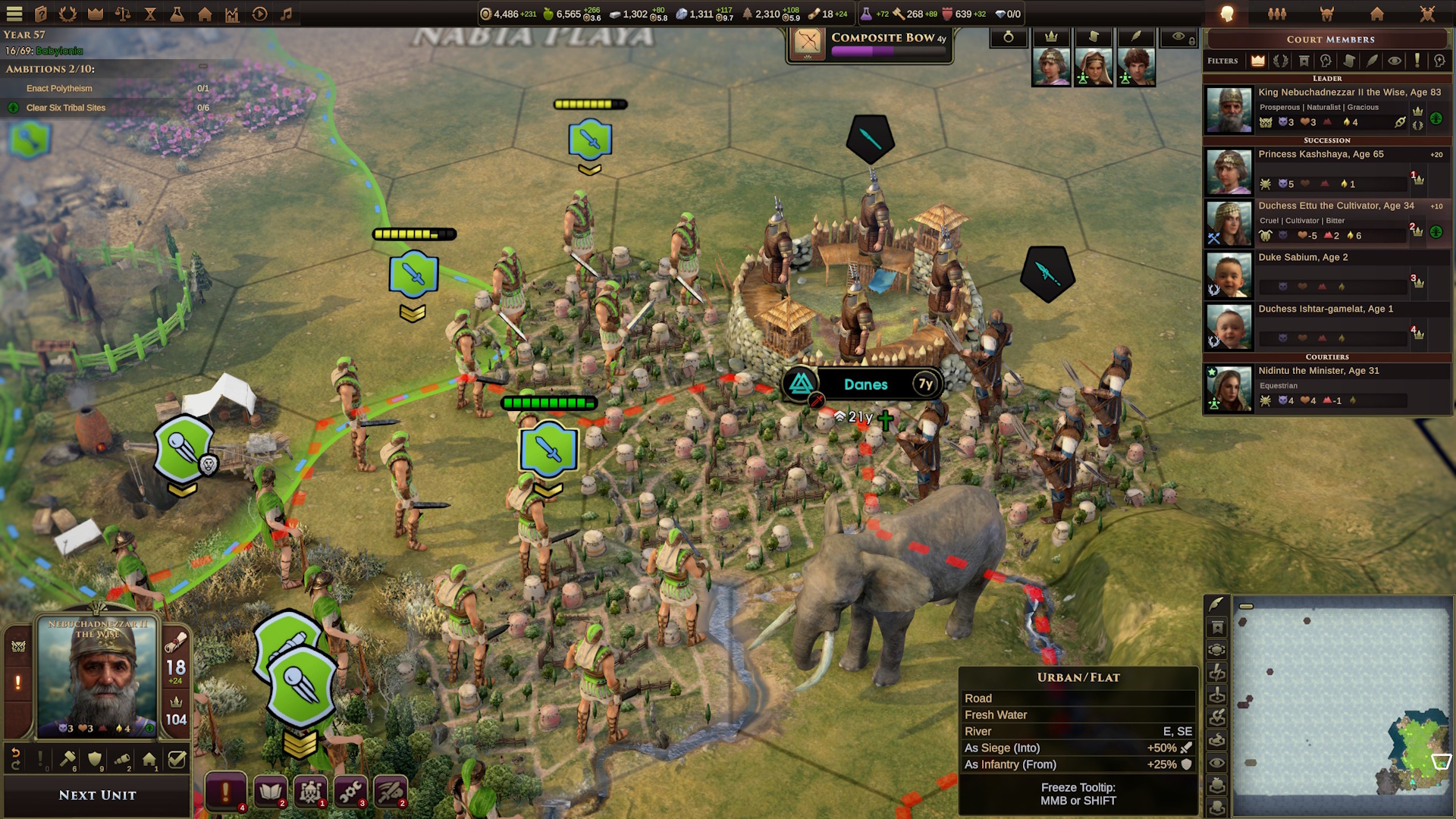
The importance of the orders system doesn’t become obvious until you get into a fight. At first, you probably don’t have enough workers to completely use up the number of orders available to you so you wonder what’s the big deal. But once you’re involved in a war, you probably won’t have enough orders to maneuver all of your units the way you want. That means no orders left over for workers and so no economic development so long as the war lasts. Plus the orders are used for everything, not just units. This includes appointing a governor to run a city, having your ruler tutor a royal child, using your chancellor to pacify a city and much more. So while it doesn’t seem like it at first, the orders are really the most critical resource as it bottlenecks what you can do in a turn.
All this and I have neither covered nor properly learned for myself the systems for religions, each one with their own rules, for spying which provides not only actionable intelligence but tools for softening cities for invasion, diplomacy, trade missions and probably many other mechanics that I’ve missed out on. Many of the mechanics are very thoughtful and interesting. You think that settling a city on the border of the map makes you safe from tribal attacks? At anything above the easiest difficulty levels, they can spawn off-map to attack you. I was surprised that they can even cross bodies of water. The mini-map stretches as you explore, but you can’t be exactly sure what the shape of wider world is before you get to the edges. The ambitions system provides for an alternative victory condition that can lead you to develop your nation down paths you may not have originally planned for. This is, as far as I can tell, a very well-designed game that rewards thoughtful players who pay attention to all of the rules and want a challenge worthy of the most exacting min-maxers.
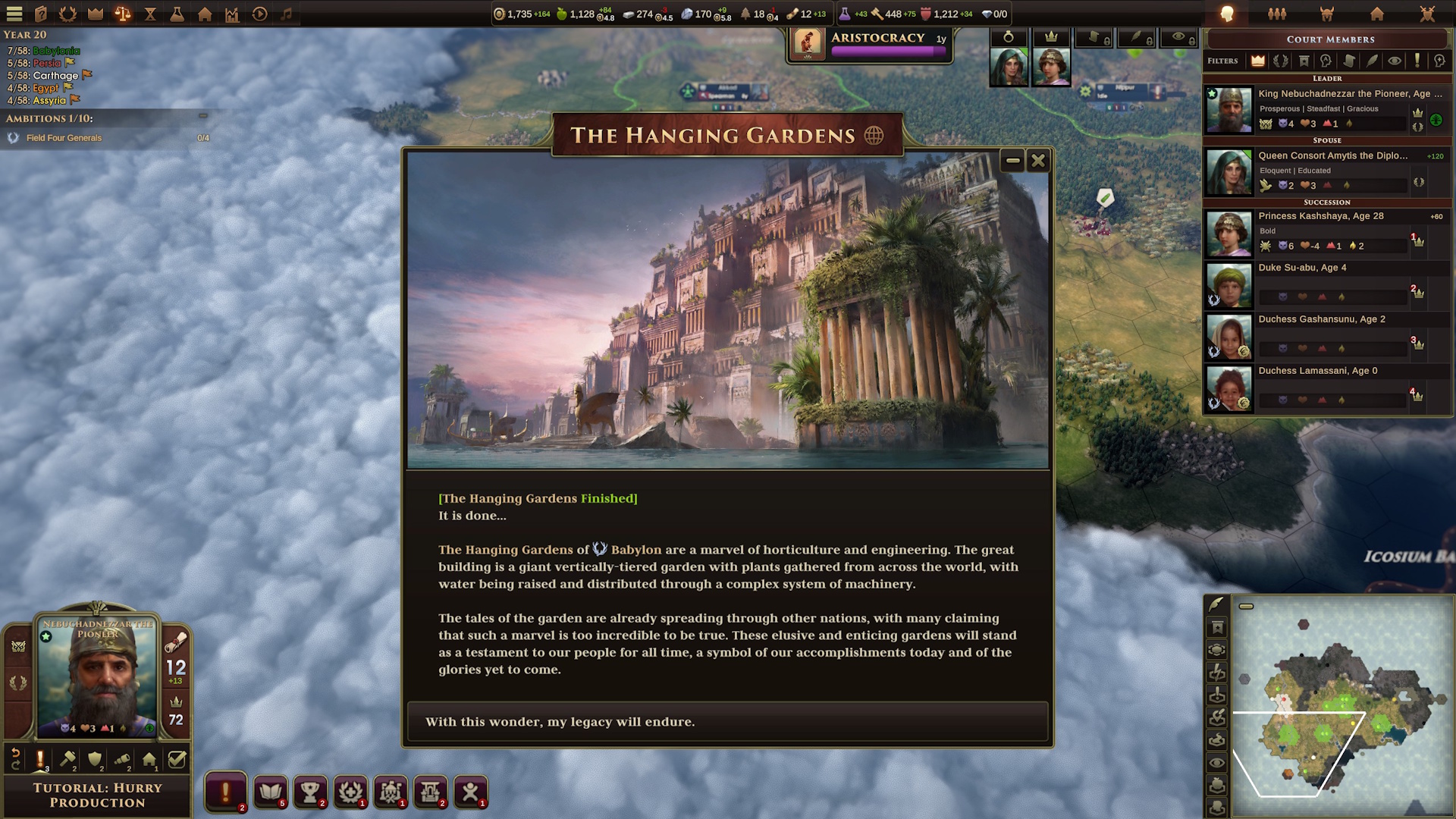
My issue is that I am no longer that kind of player, if I ever was. Playing this the right way is too much work for me and the game is challenging enough that you must know what you are doing. Another thing is that I found its theming a bit dry. The mechanics are all about stacking bonuses on top of each other but in the end they’re still multipliers. This is in line with other historical 4X games but sometimes I prefer the more dramatic differences between factions in fantasy or science-fiction themed games. This is an amazing game and if I had come across it at a younger age, I would have been all over it. But this just too much of a commitment in terms of time and concentration for me now.