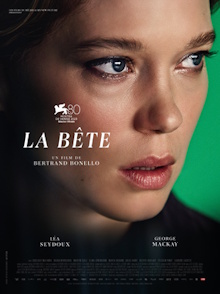
This French science-fiction film has only middling reviews and after watching it, that feels fair. It’s very loosely based on the Henry James’ novella The Beast in the Jungle but has none of its elegance. It takes its time to very clunkily make a trite point that captures little of the essence of its inspiration. At its best, there are brief moments that recall the surreality of David Lynch. But these are outweighed by the mediocrity or downright cringiness of many scenes. This one gets a thumbs-down for me and not just because of the facile anti-AI messaging.
In the far future, AI runs the world and has solved all major problems such as climate change. But humans such as Gabrielle are unsatisfied, feeling purposeless in her assigned job of measuring the temperature of a metal plate. The system suggests that she undergoes a DNA purification process to temper her emotions and make her more rational so that she can be assigned jobs with greater responsibility. Outside the center, she briefly meets a man, Louis, who is there for the same reason and they are attracted to each other. During the process, she relives what might be interpreted as her past lives. In 1910, she is an acclaimed pianist who is married to the owner of a doll-making factory but is attracted to Louis. She expresses to him a lifelong fear of some horrible, indefinable catastrophe. In 2014, Gabrielle is an aspiring actress in Los Angeles while Louis is an American incel who is frustrated that no woman wants him and starts stalking her. Again and again they are attracted to one another when they meet but the AI system tries to tear them apart in the name of rationality.
I’m willing to forgive the scientific nonsense of past lives and DNA cleaning because that’s in the nature of the story that director and writer Bertrand Bonello. It’s still offputting however that the film is so low budget that it uses a simple robotic arm with a needle to represent the purification process. What I truly object to is that the film spends its entire running time building up what it is that Gabrielle fears so much. In the context of James’ novella, that would be the fear of accepting true love, to take real risks and pour your entire heart into it rather than to make do with comfortable safety. That’s a little vapid for a science-fiction film though so Bonello not expands it to recur repeatedly between these two apparent soulmates across time and space but also inserts the AI in between them as the reason why they fail to connect. That’s just not a logic that works. Having an AI that actively wants to tear soulmates apart is terrifying sure, but it diminishes the impact of the insight from James. It becomes an external actor that is plotting against you when the original horror is that it comes from within yourself. Add to that the AI’s motivation for doing so being apparently to suppress human passion, it becomes a house of cards that is unable to support itself.
There’s some cleverness in making the 2014 version of Louis an incel such that it is his own contempt for women that drives others away. Yet even here casting the AI as the villain trivializes a real and topical social phenomenon. Bonello is inventing a boogeyman out of whole cloth and seemingly saying if not for the AI, Louis with Gabrielle’s kindness would have been able to overcome the toxic influences of the manosphere. The film’s conception of love too is wrong-headed and dated. It’s presented as something magical, ineffable and mysterious instead of something that is actively worked on and nurtured from two people knowing each other well and wanting the same things out of life. Léa Seydoux does her best and even she can’t save a film that is deeply flawed from its very conception.
Rather than setting up AI or rationality as the polar opposite of romantic passion, it would have been more courageous to take a page from James’ own life. Perhaps it is artistic passion that inhibits romantic passion as after all a happily married, contented James might not have thought so deeply about loneliness and the meaning of life and so produced the great works for which he is known. This film is driven by facile thinking born from the unimaginative framing that rationality must be forever opposed to passion. It is both uninteresting in what it wants to say and mediocre in its execution of it.