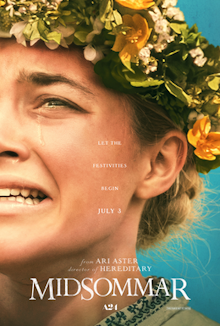
This horror film has enough of a hold on the public imagination to be regularly talked about even years after its release. I hesitated to watch it as the reviews are middling and director Ari Aster’s work is inconsistent for me. In the end I’m very glad I did despite it being too long and psychologically less complex than it needs to be, as this is one of the rare horror films that can aspire to break out of the confines of its genre. The setting featuring intense, unrelenting sunlight and bright, cheery colors instantly marks it as being unique, proving that horror doesn’t have to exist only in the dark.
After being badly traumatized by the murder-suicide of her sister and parents, Dani is emotionally reliant on her boyfriend Christian. He however has been wanting to break up with her for a while but feels unable to do so in the wake of her loss. He reluctantly invites her to come along with him and his friends on a trip to the Hårga commune in rural Sweden, led by Pelle, a Swedish student from that commune. They are due to hold a midsummer festival that occurs only once every 90 years and one of the American friends is eager to write a thesis about it. Upon arrival, they meet a British couple who have similarly been invited by a member of the commune and participate in a psychedelic mushroom trip. Dani has a bad experience, causing her to hallucinate about her dead family and flees in panic. The next day they are brought to the commune proper and are amazed by the idyllic setting and the warm welcome they receive. At night as they go to sleep in a large barn, Pelle explains that there will be a ättestupa ceremony the next morning. Josh is surprised but doesn’t elaborate. So the rest of the outsiders are shocked when they see that it means having two oldest members of the commune jump to their deaths from a cliff as they have already lived out their full allotted lifespan of 72 years.
This is a long film by horror movie standards, yet it makes good use of the running time by opening with an extended sequence of Dani spiralling after receiving a scary message from her sister. This opens the way to a truly fantastic scene in which Dani wails uncontrollably in grief. Most horror films have terrible events happen, yet the characters’ reaction to them is either muted or takes place off-screen. Aster not only places it front and center but calls back to it later. When one of the two elderly isn’t instantly killed by the fall but screams in pain instead, the entire commune screams with him until he is put out of his misery. When Pelle tells Dani that he was able to deal with the loss of his own parents because the entire commune stepped up and shared in his pain, he is absolutely earnest. Their beliefs and rituals are horrific but the corollary that they share everything so closely that they are almost a hivemind is true as well. It’s terrific worldbuilding especially since there are plenty more secrets of this commune that are left unanswered such as the contents of their religious text. Along with the idyllic lifestyle, it’s a plausible reason for why someone like Dani might find solace in such a commune.
Bold as the film is in this regard, it is still awkward in others. Picking off the outsiders one by one in classic horror movie style is predictable and boring. I feel that it is uncharacteristic of the commune to be evasive about their actions so they should just have let the British couple safely leave when they asked to. But it would be plausible for them to start killing the Americans when they break the community’s rules, whether knowingly or not. That would make the film less formulaic and gives a kind of logic to the community’s actions. Another failing is that it is too reluctant to dive deeply into the dynamics of Dani and Christian’s relationship. The film seemingly wants to cast Christian in a bad light for being emotionally unavailable to Dani. But I’m sympathetic to his wanting to get out of the relationship and is hesitant only because of the fear that breaking up with her would cause her to be suicidal. Or is it actually subversive in that Dani is really a crazy ex-girlfriend with unreasonable expectations of Christian? The film badly needs a confrontation between the two that never happens.
It’s actually a very good sign that this film is good enough that we’d want to dissect it in this way. If it were just a throwaway horror flick, we would’t care about such subtleties. As it is, Midsommar has enough thought put into it that it’s worth treating as a serious film yet it can’t quite shake off the usual horror tropes that only drag it down. I loved the artistic direction and the color palette, though Aster probably overdoes it by dragging out the scenes showcasing the commune. I’ve read critics disliking because they didn’t think it was scary enough. I’m the opposite. The immediate threat to the characters doesn’t have to be scary. It’s the idea of such a commune existing that should be scary and that’s why I’d give this a thumbs-up.