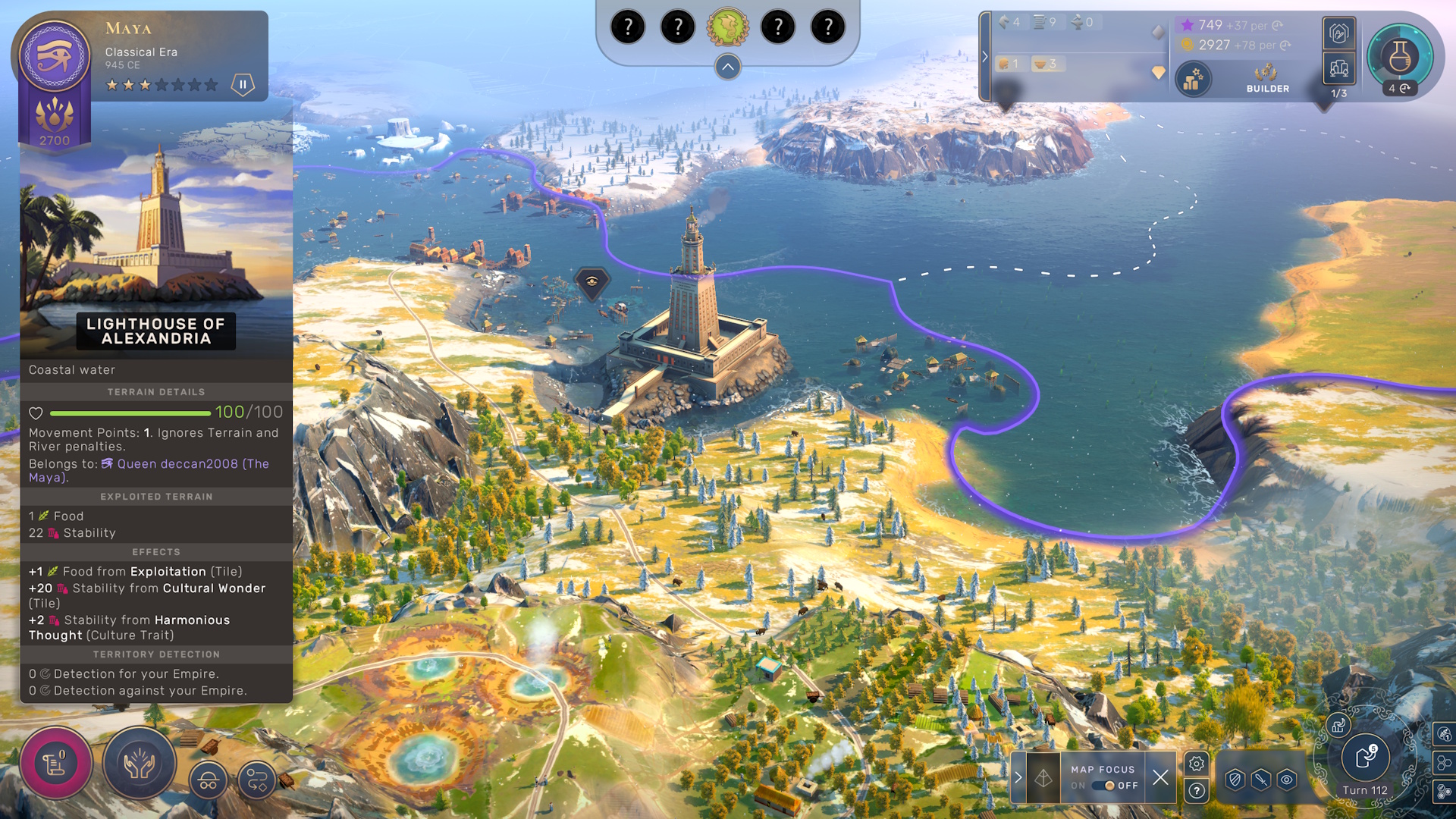
This was another free game from Epic which I wouldn’t have bought on my own but was glad to try since it’s been a long time since I’d played a Civilization type game. Yet this isn’t Civilization, which makes it both interesting and tricky. There were many times I’d assumed the mechanics worked similarly and was proven wrong. I believe that this was designed so as to be completed at a more reasonable pace and in this it succeeds. Unfortunately its rules make it too game-like, almost like a boardgame writ large and so neither simulates well the history of nations nor feels very thematic.
As with all such games, this one has you start as a nomadic tribe with no home of your own. Arguably, it starts you at an even earlier era than other games, the Neolithic era, as you can’t immediately pick a spot to settle. Instead you must complete certain achievements to be able to found a city. In the very first era, this means growing the tribe through gathering food, learning knowledge through exploration or hunting animals. In later eras, your options are expanded but the mechanics are similar. Each time you complete one of these objectives, you earn Fame and Era Stars. Fame is the score that determines who wins at the end of the game. Earn enough Era Stars and you can transition to the next era. This is the key distinctiveness of Humankind. You can pick a wholly different culture for each era. This changes the bonuses you get and the best playstyle to employ to earn Fame as a Scientist culture will benefit more from research while a Militarist one is better off fighting enemies. All of the other players will change cultures as well in each era. This is why there are complaints that it can be difficult to keep track of who’s who. You might be fighting the Caribbean Pirates and then suddenly they’ve changed to become the Germans.
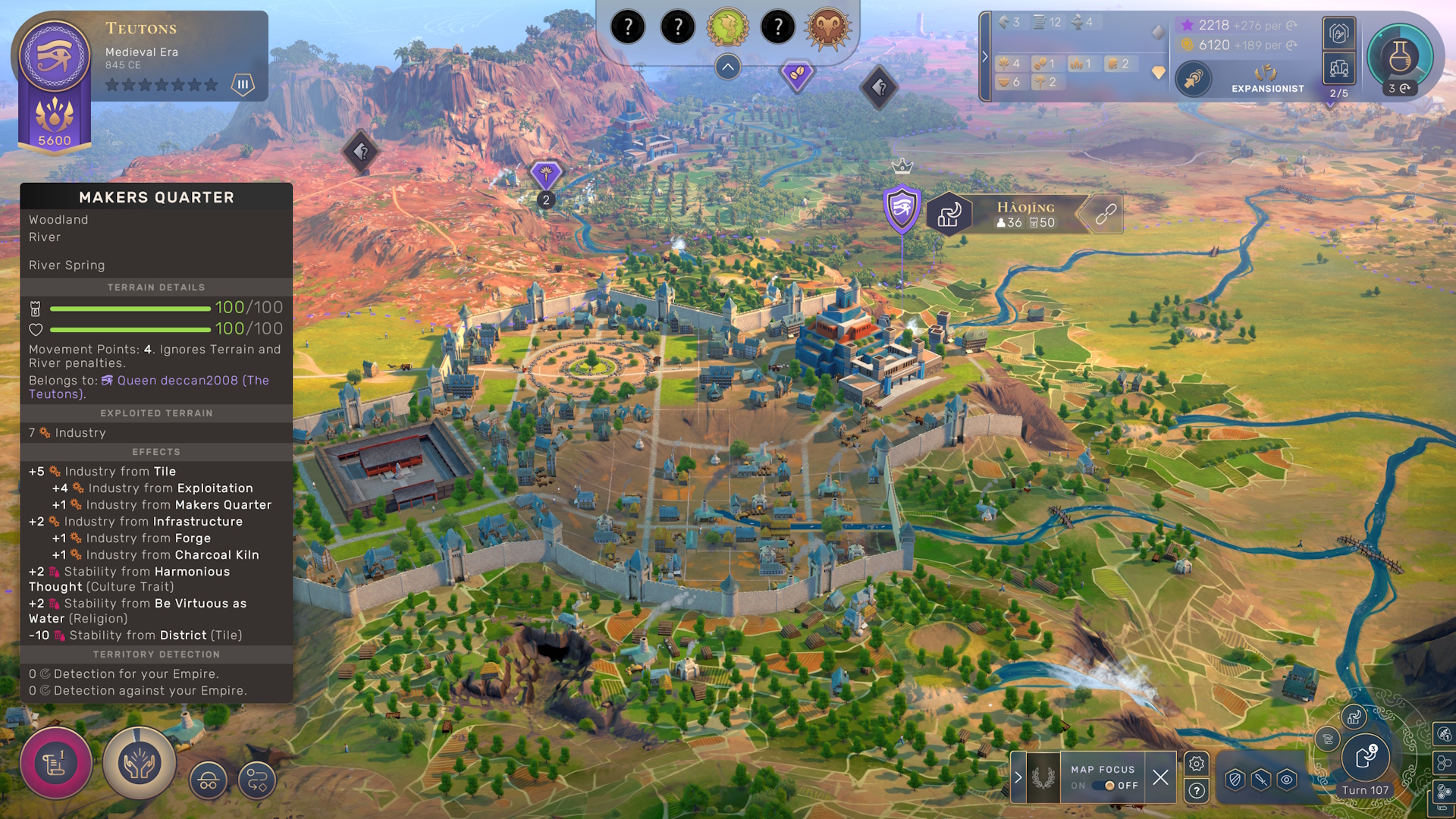
Another more subtle and yet very important difference is that you don’t need workers to exploit tiles. Anytime you build something on a hex, you instantly exploit it and all of its surrounding hexes. Add to the fact that you can expand a city by attaching neighboring territories to it, and you get the massively sprawling urbanization of the endgame. Doing this makes your city’s stability drop so you do need to build things that keep your people happy. This means that a city might have almost no population yet can have high industrial production which isn’t intuitive at all but that’s how these rules work. Constructing any unit at all does use population as a cost and that population is returned if you disband the unit within one of your own territories. You can even deliberately do this to transfer excess population from one city to another.
Due to these changes and more, Humankind has no difficulty distinguishing itself from Civilization. But you should also appreciate why it feels unintuitive and perhaps a little unnatural. Usually in these games, I try to do a bit of role-playing, acting in accordance with a certain personality. The mechanics of this game however encourage a more erratic playstyle. You’d delay advancing to the next era to maximize earning Fame from one category. You’d totally change your strategy according to the culture you pick. Due to the way the War Score mechanic works, I often find it better to totally raze an enemy settlement and rebuild it from scratch as waiting to claim it properly at the end of the war just takes too long. There’s no global council in this game and no diplomatic repercussions for committing such acts. As the object is to earn as much Fame as possible, you need to do at least a little bit of everything so there’s no such thing as a military victory or a diplomatic victory. There is a Space Race series of events which gives bonus Fame but mostly hastens the end of the game so that the Fame of each player can be tallied.
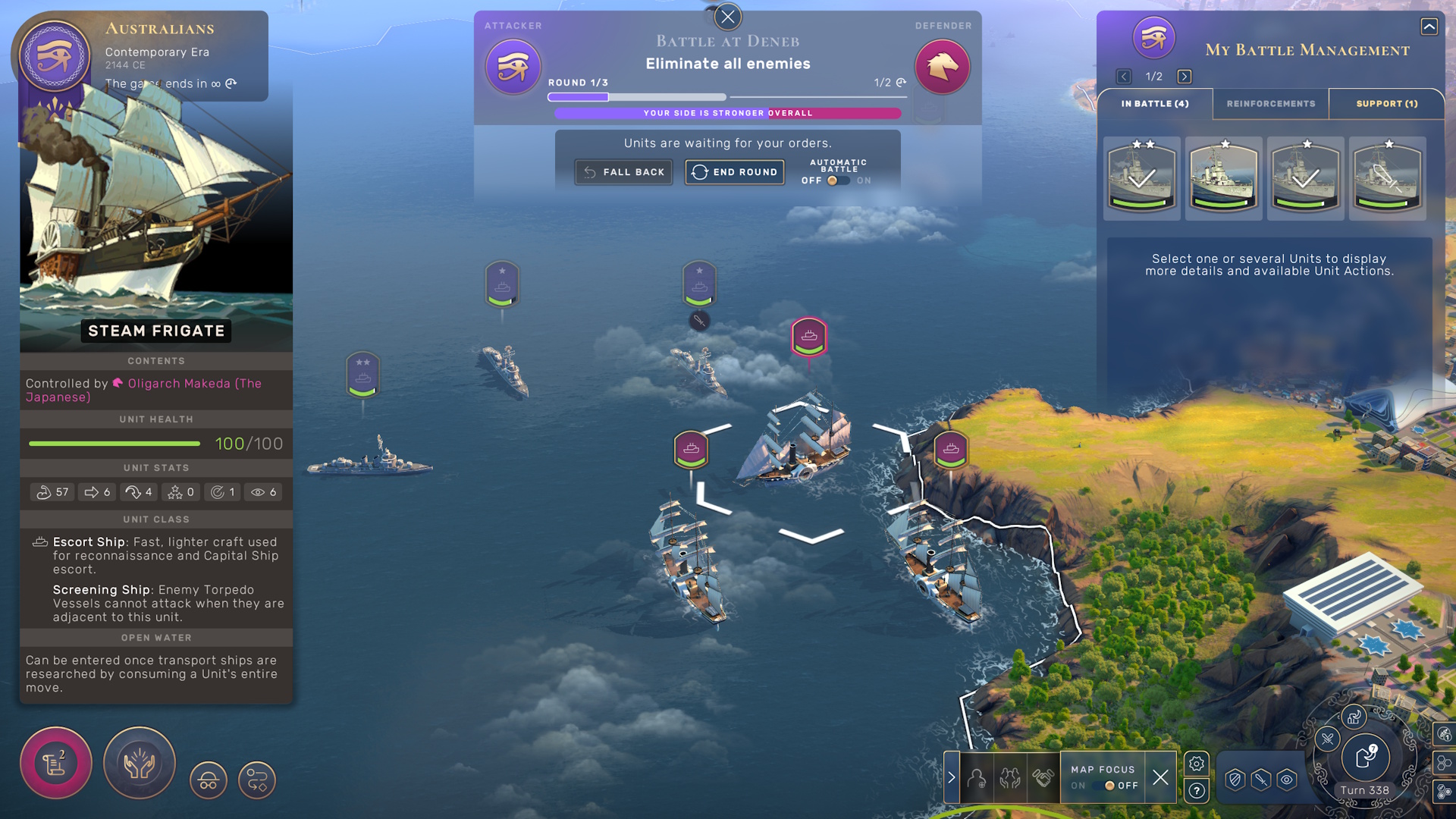
I don’t much care for how combat works either. The manual battle option puts you into a tactical view of the map so that you can control the individual units of your army. You can just opt for an instant resolution but the results are guaranteed to be far less favorable. The combat rules are the usual ones: take advantage of high ground, don’t stand in the river, focus fire on enemies etc. It’s nothing special but works well enough. The issue is that it slows down gameplay without adding much in the way of richness. In most cases, it’s obvious what the best move is and you just repeatedly do the same thing every battle. I suppose the benefit is that you can watch the animation of your battleships launching missiles at enemy carracks.
I will say that the game looks very pretty. It is satisfying to actually see the infrastructure, Wonders and other buildings appear on the world map. You can zoom in quite far and see all kinds of cool details of vehicles moving around and so on. I haven’t spent much time with it on the higher difficulty settings but the AI seems reasonably competent. I do feel that the pace is too quick on the earlier eras yet slows down again to normal Civilization speed in the last era. Most of all it feels sufficiently different from Civilization to make it interesting. But is it actually better? In my opinion, no. That seems to be consensus among other gamers as well since is why this was never a big hit and so a sequel to it is unlikely.
One thought on “Humankind”