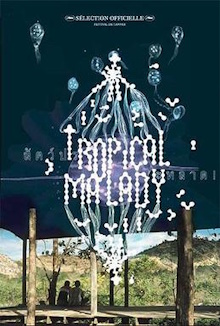
Being a big admirer of the work of Apichatpong Weerasethakul, I’d been searching for this title for a long time. It predates his 2010 breakout hit Uncle Boonmee Who Can Recall His Past Lives and was good enough to win the Jury Prize at Cannes. Unfortunately while the director’s fingerprints all over it are familiar and it even presages his later films in some ways, this is on the whole inferior. His ability to string together images into something that is compelling to watch is as magical as ever but both the story and the structure here are almost conventional and nearly boring.
This film is an anthology of two stories, both featuring the same two male leads. In the first story, a troop of soldiers discover an unidentified corpse while out on patrol. Carrying the corpse, they stop by a village for a meal. There one of the soldiers Keng meets one of the villagers Tong who is of a similar age. They run into each other again later in the city and kindle a friendship which slowly grows into something more intimate. At one point they follow an older lady who takes them to visit an underground shrine. In the next story, the same actor who plays Keng is again a soldier, sent into the jungle by himself to deal with a tiger spirit who was once a shaman and which is able to take the form of a human. It appears to him as a naked man played by the same actor who played Tong. The spirit gets the better of the soldier in their initial tussle, tossing him down a ravine. He survives but loses all of his equipment except for his gun. He then meets a monkey who tells him that he must kill the shaman or he will be devoured and taken into the spirit world.
Beyond the fact that the same actors play the lead characters, there are other hints that the two stories are connected in some strange way. The first troop of soldiers are supposedly out to investigate dead cattle and the story ends with a report of a monster being spotted in the village. There’s no logic to it as it defies straightforward causality or even temporal linearity. But this is par for the course for this director’s work and the circularity of the relationship between these two young men should be in keeping with Buddhist principles. Watching this, I was mainly struck by the sense of just how autobiographical Apichatpong’s films are meant to be. He has always said that his work is meant to represent himself and not Thailand in general but it feels much more so here. It doesn’t say exactly where in Thailand these scenes take place but some of the scenery shots are very similar to those in his later work so I would guess that they’re based on his memories of living in Khon Kaen. The character live visibly poor lives in a gritty environment but you still get a strong sense of nostalgia for the era and the director’s affection for the milieu shines through.
The film’s portrayal of a budding homosexual relationship is both heartfelt and bold. While there is nothing explicit, the scenes of them tentatively teasing and playing with each other does get rather sensual. It’s easy to believe that Apichatpong who is gay himself had similar experiences in his youth. Unfortunately it’s not that groundbreaking at this point and it doesn’t handle youthful romance any better than other films. It’s really only interesting in that it’s set in Thailand. Similarly while the presence of the supernatural is felt in this film, it’s not as cogent as the effect in his later work. I didn’t like the second story at story at all. It doesn’t make much sense why a single soldier was sent out on a mission on his own. The ambiguousness of who is the hunter and who is the hunted might be spiritually meaningful to some but has little resonance for me.
As such, I’d consider this an okay watch for those who can’t get enough of the director’s work and would like to know more about him. It’s far from required watching however as I would consider it inferior to his later work. It’s good to see some scenes of life in other parts of Thailand beyond Bangkok and other notable places but that’s it.