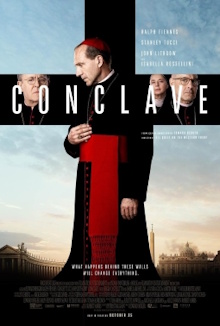
This film was remarkably well-timed, being released in November 2024 only for Pope Francis to pass away in April 2025, causing interest in it to spike. It’s fictional of course but its detailed portrayal of what exactly the election for a new pope entails was just what the world needed. There’s plenty of intrigue right from the beginning and scandals are not far behind. All of this seems reasonably plausible to me and makes for a riveting watch. Unfortunately the twist at the end is a leap of credibility too far as the election would never turn out that way in real life. I know that director Edward Berger is plumping hard for a liberal ending but this is just wishful thinking.
Thomas Lawrence, the dean of the College of Cardinals, is summoned to the pope’s room one evening. He is informed by Janusz Woźniak, the prefect of the papal household, that the pope has passed away from a heart attack, so Lawrence will have to convene a conclave to elect a successor. Immediately however there is intrigue as he learns that the last person to speak with the pope Joseph Tremblay delayed the news of the death and Woźniak tearfully claims that the pope asked for Tremblay’s resignation in their meeting. Just as the cardinals are about to be sequestered in the Domus Sanctae Marthae, a previously unknown participant turns up. Vincent Benítez claims to have been appointed as Archbishop of Kabul in secret for his protection and his documents seem legitimate. Lawrence himself supports his friend Aldo Bellini who is a moderate and is repelled by Goffredo Tedesco, an Italian traditionalist who wants to the liberal reforms of the past sixty years. Another leading candidate is Joshua Adeyemi who being a black Nigerian is disliked by the traditionalists but he too holds illiberal views on homosexuality. When Lawrence opens the conclave with a homily urging the cardinals to embrace doubt, this is interpreted by some as him advancing his own candidature and so he too gains some votes.
Detailed procedurals like this are always very satisfying to watch especially when they pertain to a subject as mysterious as the election of a new pope. The film does a fine job of walking us through the process and between the replica of the Sistine Chapel where the voting takes place, the elaborate vestments and the rituals with paraphernalia and Latin verses, there’s lots to gawk at too. Lawrence himself feels like something of a religious James Bond as he sifts through snippets of information about the various cardinals, follows up on lies and intrigues and embroils himself in the factional plotting. I dislike that there are characters who are obviously good and others who are so obviously, even cartoonishly, bad. It’s an insult to the audience’s intelligence and an oversimplification of the real internal politics of the Catholic Church. But it works well enough, until it nears the ending when it veers off the rails to ramp up the drama.
Berger was also responsible for the recent remake of All Quiet on the Western Front which I excoriated for utterly failing to get why the original is so highly regarded. He takes similar shortcuts here. It’s one thing to simplify the internal politics of the Catholic church enough so that it can fit within a film. But it’s another thing to flatten the characters into simple good and evil archetypes. That it takes the liberal side as the default good side is a mark against its seriousness. The film even uses the old trick of having the protagonist Lawrence’s flaw actually be a point in his favor. He has doubts about his faith and believes himself unsuited to be pope, which means that by artistic logic, he is the best candidate after all. The issue of corruption undermines one candidate but there’s no further mention of how worldly wealth and money laundering is an ongoing problem and a major motivation of the cardinals. It is laughable that one speech full of the usual platitudes would have any effect at all on the voting intentions of the cardinals.
This is a slick, well-made film to be sure and it’s much better than Berger’s previous work. Telling the story of a papal conclave is an inspired idea and it does shed light on how it works in practice. But it’s also a film that doesn’t take religious faith seriously, equating it merely with moral goodness as judged by the director’s values, and as such it’s filled with psychologically shallow characters. It opts for shock and drama when a more grounded treatment based on current problems would be more authentic. It’s a film that deserves to be watched but not one that should be taken too seriously.