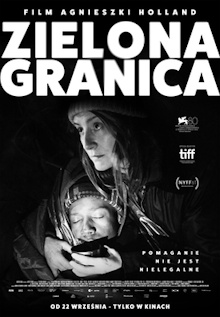
Sometimes a work feels too depressing, the problems it highlights so intractable, that I don’t look forward to watching them. This Polish film about the refugees trapped between Poland and Belarus certainly qualifies and one critic condemned it as being misery porn. While harrowing in parts, this is on the whole a balanced and fair portrayal of the crisis. It doesn’t only emphasize the cruelty of the Polish Border Guards but also shows the kindness of Polish activists and the generosity of Poland as a whole in their separate treatment of Ukrainian refugees. It’s an excellent treatment of a complex, politically charged issue and I applaud Agnieszka Holland’s heroism for making it.
A Syrian family travels by air to Belarus, hoping to cross the border into Poland and make their way to a relative in Sweden. On the plane, they befriend Leila, another refugee from Afghanistan. She joins them in a van that has supposedly already been paid for but they are forced to pay more to guards at the border and cross illegally on foot. They spend a day and a night trudging through the forest carrying their belongings until they are found by the Polish Border Guard. They believe that they will be allowed to claim asylum but are instead forced back over the border to Belarus. They would be repeatedly ferried across the border countless times by both sides. Meanwhile Jan, a young Polish border guard, has a wife who is expecting. In a briefing, his commander warns them the refugees are Belarusian dictator Alexander Lukashenko’s weapons and to show them no mercy. Finally we see scenes of a Polish activist group doing what they can to help the refugees, giving them food, water and medical aid, without breaking the law. They are joined by Julia, a therapist who lives near the border, after she finds Leila and one of Syrian children in the swamp.
I’d already read up on the border crisis but I suspect that as the film doesn’t provide a background briefing, some non-Polish audiences may be lost. These refugees were of course tricked by Lukashenko into believing that they could easily enter the EU through Belarus and so were wholly unprepared for the ordeal. They have little children and infants, carry luggage like any ordinary tourist and don’t have food or water. There are refugees from all over the world, with the Syrians even initially mistaking Leila for one of their own, and English being their only common language. The film shows the brutality on both the Polish and Belarusian sides though the latter are far worse, actively exploiting the refugees for all they’re worth. The multiple perspectives also show how this psychologically damages the Polish guards themselves and how there are plenty of Poles who are outraged enough to defy their government to help the refugees. It’s a reasonably even-handed and carefully researched depiction of the crisis. Though it paints the Polish government’s response in a bad light, in my opinion it’s actually rather flattering towards Poland as a whole.
Nothing excuses the deliberately dehumanizing cruelty exhibited by the authorities here yet I would hesitate to declare that the pushback policy on the part of the Poles is unwarranted. The refugees clearly are there as part of a hostile action by an enemy state and aren’t Poland’s responsibility. They have a clear interest in being unwelcoming to the refugees to deter others from attempting the same illegal passage. This film doesn’t show the full extent of the incursions, with the Belarusians providing the migrants with tools and materials to damage barriers at the border. The film deliberately highlights the contrast between how the migrants at the Ukrainian border are treated with the ones shown here, perhaps to shame the Polish response. But what I see instead is that Poland has already made an extraordinary collective effort and sacrificed much as part of the Ukrainian war effort. While it’s wrong for them to be cruel towards these other migrants, it’s not wrong in my opinion to turn them away.
While my politics may be different, I nonetheless applaud this as an extraordinary film that was made with great care and consideration. I’d believed that this was banned in Poland but actually it was widely shown and praised in the face of heavy condemnation on the part of the Polish government and the security services. The content of this film is rightly distressing for many but the moral courage and spirit demonstrated by the Poles here both in shooting this film and making it such a success, is actually very uplifting.