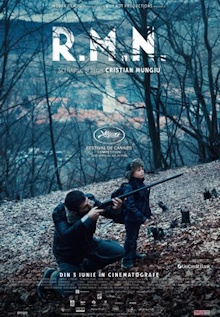
Here’s another Eastern European film, from Romania this time, that talks about migration. While it follows a fictional main character, the story is based on a real incident that took place in 2020. Of course, an art film would be expected to take a stand against xenophobia but this one goes deeper into the underlying divisions in Romania. Unfortunately I found it very inaccessible as fully understanding what is going on would require being able to differentiate between the Hungarians and the Romanians in the film and there are surrealist moments that are hard to make sense of. Even the choice of Matthias as the main character seems questionable, so as much as I admire the effort, I don’t much like it at all.
Matthias is one of innumerable Romanians who elect to make a living in Germany, in his case working in a slaughterhouse. He leaves to return home near Christmas time when a colleague insults him as being a gypsy and Matthias reacts aggressively. At his home village of Ditrău, his estranged wife Ana is raising their son Rudi. Both are concerned that Rudi has stopped speaking after seeing something in the woods and Matthias is upset at Ana for coddling him. Meanwhile he also reconnects with Csilla, a former girlfriend. Csilla now works for a bakery that is one of the largest employers in the village. The owner wants to hire additional workers to qualify for EU subsidies but is unable to attract any locals as they are only paying the minimum wage. They take on workers from Sri Lanka instead and Csilla assists with getting them situated. But the local residents are vehemently opposed to their presence and rally the local reverend into speaking up for them. Csilla condemns their xenophobia while Matthias tries to refrain from taking sides, saying that none of this is his concern.
The increasingly acrimonious reaction of the villagers against the foreigners is the heart of this film yet that story doesn’t properly begin until about an hour in. Before that, we follow Matthias as he leaves Germany in a hurry, bounces between the home of his estranged wife and his mistress, and tries to help his increasingly frail father. I get that he is meant to represent the typical everyman Romanian through whose eyes we understand how they react to globalization. But the exclusive focus on him feels like an odd directorial choice as we wait almost half the film for the story proper to begin. It doesn’t help either that Matthias is so ambivalent about the crisis and only tangentially involved in it. I was constantly wondering why Matthias’ love life matters, why the film is named after the nuclear magnetic resonance to scan his father’s brain for issues and most of all, what’s up with Rudi’s encounter in the woods.
Its frank and straightforward depiction of the Sri Lankan workers arrival in the village is competent. The nature of the objections the villagers have are about as expected, ranging from the ludicrous such them being unhygienic and carrying foreign viruses to cultural and economic worries that are harder to refute. I like how it shows that the villagers resent not just the arrival of the foreigners but the perceived interference of the EU in their affairs. However much we decry their xenophobia, it remains true that the bakery owner was careless in ignoring local opinion and primarily brought in the workers to capitalize on available EU funds. At the same time, the film wants to point out their hypocrisy. They resent the discrimination that they face while working in Western Europe and especially hate being called gypsies while being proud of having driven out the Roma from their region previously. There is irony too in this specific village being inhabited by ethnic Hungarians who are a minority in Romania being so hateful to the Asians. Yet while the subject is interesting and the intent laudable, I found it difficult to be emotionally engaged in it. It might be necessary to actually be Romanian to fully appreciate the many layers of the crisis.
In real life, the crisis seemed to have been successfully defused without coming to violence. The bakery kept the Sri Lankan workers and added more from Nepal. Other companies announced plans to bring in their own foreign workers. Globalization seems to have won. It’s tough for me to discern exactly how the villagers were talked down but from what I can tell, the crisis attracted the scrutiny of the entire country who effectively shamed the villagers. This film does not cover the fallout, preferring to focus on Matthias’ cowardly indifference. I feel that while artistically interesting, it is also incomplete and I feel uneasy about this being framed purely as a win when the village actually is experiencing a change so many residents dislike. I fear that there are no easy answers and no right choices here.