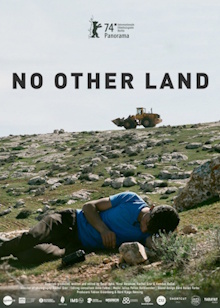
The slew of awards and international recognition this film won more than qualifies it a must-watch. I was hesitant to approach it however, being cognizant of its contentious and depressing nature. Indeed as the end of this documentary itself shows, the crisis at Masafer Yatta that is its focus, has since been overshadowed by the October 7 attacks. The Palestinian perspective it offers is both interesting and invaluable. Its images show exactly how a people is smothered to death slowly over the course of decades. Yet it probably doesn’t offer much that is new to those who are already reasonably well-read on the subject and is too roughly put together to be a great documentary.
Basel Adra is a resident of the region of Masafer Yatta in the West Bank and like his father is an activist doing his best to resist Israeli attempts to displace them. His only weapons in this fight are his camera and his phone which he uses to document the demolition of Palestinian homes and appeal for international sympathy. His ally is Yuval Abraham, a Jewish Israeli journalist who has learned to speak Arabic and sympathizes with the Palestinians. During one such eviction, they record a resident of the region get shot by Israeli soldiers. Prevented from rebuilding, his family sets up in a cave. The bulldozers and soldiers are overseen by an Israeli man named Ilan who fends them off. During quiet moments, Basel and Yuval bond with one another. Despite being of the same age, their lives are drastically different as Yuval is free to come and go as he pleases and is able to return home safely after participating in the protests. But Basel is in effect a prisoner in the West Bank with little hope for the future as they are helpless against the overwhelming power of the Israelis.
This film consists mainly of footage of the many incursions the two witness along with recordings of their conversations. The quality isn’t the best though that does contribute to their authenticity. I was disappointed however by the almost complete lack of exposition to provide context. We’re told that the buildings there are considered illegal under Israeli law as the area has been declared to be a military firing zone despite there being Palestinians living there for generations. But we get little other information including even a map of the area, the numbers of people who live there, how they make a living and so on. I think the film would have been more effective in garnering sympathy if they had shown more footage of what life under ordinary circumstances for them is like. I appreciate the scenes of Basel and Yuval speaking quietly to one another but neither of them are especially eloquent nor are their discussions insightful. Their conversations mostly just peter out after running out of steam and aren’t satisfying to watch.
Even so, the merciless logic of what the Israelis comes through clear enough. They plainly want their own people to settle that land and make it part of Israel proper. But actually massacring them would be beyond the pale for both their own citizens and international opinion. So they use legalism to make ordinary life impossible for the Palestinians who eventually must either leave or resort to violence. In the latter case, the Israelis then retaliate against them with lethal force claiming that it’s self-defense. The only thing the Palestinians can do is hope to keep the eyes of the world on them as much as possible because it can slow down the Israelis’ demolition work. It’s an impossible and endlessly frustrating dilemma as this film demonstrates because it’s just delaying the inevitable. We don’t get to see Basel or Yuval’s reactions to the news of the October 7 attacks, another reason why this documentary isn’t as good or as unflinching as it could have been. But I can imagine that it made their activism work pretty much irrelevant overnight and the problems of Masafer Yatta seem so much smaller in comparison.
There are few causes worthier of championing and both Basel and Yuval are unquestionably courageous in doing what they can to resist the slow destruction of the Palestinians. Yet while they’ve done their best with little in the way of resources, this is still not that strong a documentary. I would actually have preferred it if they used more of the old footage from Basel’s father which shows how thriving their community once was and how much they’ve lost. Maps, figures and other forms of data would have also been useful to expand this out beyond a personal perspective. It’s fine work but I wish there could have been more to it.