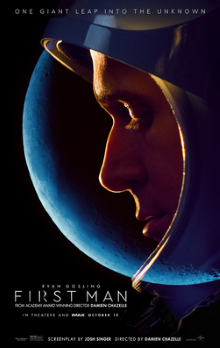
The fact that we liked both of Damien Chazelle’s previous films so much as reason enough to go to the cinema to watch this but privately I suspected that this would basically be a sequel to The Right Stuff and, ‘lo and behold, it was indeed so. Once again it stars Ryan Gosling in the leading role though Claire Foy as Neil Armstrong’s wife is a bit odd and it seems to me that her British accent comes out in one especially emotional scene.
I’d thought it would be a quiet month on the science front due to the Nobel Prize announcements but there’s a decent mix of stuff.
Probably the bit of news that has been most talked about this month in academic circles is the attempt to replicate the famous Sokal hoax. Three people collaborated on a year-long project to write 21 bogus papers and submitted them for publication. Seven of these were accepted. The papers were deliberately outlandish, such as one about dog on dog sexual assault, and the idea is to mock the preposterousness of some fields of humanities. Yet as this article that I chose to highlight lays out, the joke seems more on the three than the field in general and their political motivations are obvious, such that this needn’t be taken seriously at all.
To balance out the above, next is a respectable paper on gender studies with a result that I find legitimate but may annoy some feminists. Based on survey data, the authors find that contrary to some predictions, the more that women have equal opportunities, the more skewed their participation in different occupations may be because they have more freedom to enter fields that they prefer. The data showed that the more developed the country, the more women expressed different preferences from men in their willingness to perform different jobs.
Staying on the topic of gender but in a different way, how could I avoid covering the news about baby mice being born to two female parents. The team used the CRISPR technique to ensure that the full set of genes that comes from a female mouse are switched on and injected the edited stem cells into the egg of a second female mouse to form an embryo. The resulting animals were born healthy and were even able to have babies of their own in the normal way. Of course, this is an artificial, invasive technique so it’s not as if males are completely obsolete just yet.
The next paper we cover has a pretty obscure title: voluntary arousing negative experiences (VANE) but its subtitle says it all: it purports to explain why people like to be scared. The researchers surveyed visitors to a “haunted” attraction and measured their EEG reactivity to cognitive and emotional tasks. They found that going through the scary experience improved the mood of the participants, especially if they were feeling tired, bored or stressed beforehand, and could help them cope with stress afterwards.
Finally, here’s a longer read, a retrospective of the Spanish flu pandemic that the article argues was the worst catastrophe of the 20th century, killing at least 50 million people and perhaps as many as 100 million. Yet it is almost forgotten today except by historians and health experts. The article covers its history and notes that the virus could not have evolved as it did without the trench warfare conditions of the First World War that, due to so many young men forced to live so close together in unsanitary, dangerous conditions, made it the perfect incubation environment to create a uniquely virulent form of the flu.
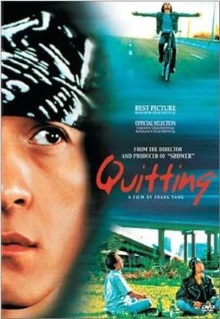
Zhang Yang is a director who I thought is worth paying attention to ever since I’ve seen Paths of the Soul and this one in particular seems to have extra cachet in the West. It’s also a very unusual film that is difficult to judge and it purports to tell the real story of Chinese actor Jia Hongsheng while starring the actor himself as well as his real family members playing themselves.
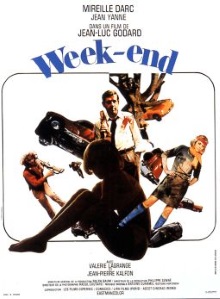
So it turns out we’re far from done with the films of the French New Wave and this one was a specific recommendation from our cinephile friend. Though this isn’t as incomprehensible as Adieu au Langage, this is easily the craziest of the films we’ve seen yet by Jean-Luc Godard.
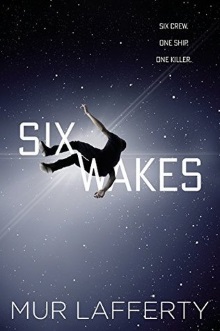
This was a finalist for the Hugo and Nebula Awards though it ended up winning neither of them. I was intrigued by a Broken Forum member describing its premise as a science-fiction mystery novel. Unfortunately the premise is the best thing about the novel. Though author Mur Lafferty sets up the mystery beautifully, the way it plays out wasn’t satisfying to me as the plot revolves around a single malefactor whose identity can easily be predicted by the reader but is pieced together by the characters only at the end of the novel.
This marks the third film we’ve watched by director Lee Chang-dong though it’s of his earliest works. It’s a bit of a coincidence that the same Gwangju Uprising that was covered in A Taxi Driver we’ve seen only recently is also a key event here but it makes sense that such a pivotal moment in the history of modern South Korea appears frequently in the country’s creative works.
So this is the film adaptation of the famous novel made by the famous director Stanley Kubrick. I have neither read the novel nor watched any adaptation, but Lolita is very much part of the cultural background everyone is familiar with so there’s nothing very shocking or surprising here. While this is a solid film and the material itself is extraordinary, I found this to be a straightforward, uninspired adaptation that has few signs of Kubrick’s usual genius.