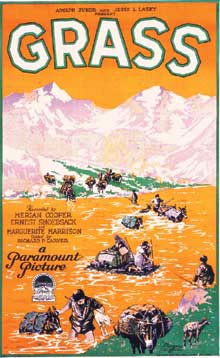
I like to watch even very old films because I’m a completionist but I have to admit that sometimes it’s necessary to put up with poor quality black-and-white images and lack of sound. This isn’t the case for Grass, one of the very earliest ethnographic documentaries ever made. As a silent film, it relies on music and intertitles to convey what is going on and the way it tints the film to match different situations can be crude. Nonetheless, its depiction of the migration of a nomadic Persian tribe, along with all the hardships they must endure, is truly incredible. The intertitles can be annoying in the heavy use of Americanisms and play up the exoticism of the Bakhtiari tribe. Nonetheless the result is fascinating, dramatic and at times even humorous. It’s very much worth watching on its merits even today.
Three Americans, Merian C. Cooper, Ernest B. Schoedsack and Marguerite Harrison, set out to document the seasonal migration of the Bakhtiari to lead their herds to fresh pastures. In that era, even getting to the tribe’s location in what is now western Iran is a grueling endeavor. A significant portion of the film shows them setting out from Turkey, following the caravan route across Arabia on camels to get to Persia, a journey that takes months. Along the way, they brave sandstorms and enjoy the hospitality of a caravanserai. Once there, they meet Haidar Khan, the chief of the Bakhtiari. After a night of festivities, they tag along with the fifty thousand members of the tribe along with countless animals on their journey in search of grass. The result is the breathtaking spectacle of a massive migration that involves every member of the tribe from the youngest to the oldest. This includes mothers carrying babies on their backs in wooden cradles, puppies riding on top of larger animals, older men and women struggling with walking sticks, all snaking across a forbidding landscape. To get to their destination, they must brave fast-flowing rivers, trek barefoot through snow and climb mountains, an effort that seems impossible to our modern sensibilities.
As this is a silent film, all of the narration is provided through the intertitles. These unfortunately tries too hard for sensationalism and exoticism at the expense of being informative. It’s silly that it frames the expedition as a quest for the Forgotten People and only names them as the Bakhtiari when they meet. It also gives the impression that the migration is more epic than a seasonal undertaking with established routes. We could have used much more in the way of details like the beliefs and history of the tribe, their hierarchy, their language and so on. As it is, we know almost nothing from them here save that they are nomadic. The humor is hit or miss. It’s amusing when it highlights a lamb travelling on the back of a larger sheep or shows Haidar’s 9-year-old son and heir proudly carrying his father’s pipe. It’s more dubious when it claims that the tribes battle cry to get everyone moving is “Yo Ali!” I did appreciate that the intertitles try to give a sense of the sounds and smells of the massive convoy.
The amount of effort and work that goes into the migration is mind-boggling. The tribe has to pack up all of their belongings and take them along, leaving nothing behind including their huge tents. When they come to a raging river, you wonder how they’re going to cross it with all of their animals. Rather ingeniously, they inflate animal bladders to use as flotation devices and construct rafts around them. When they need to cross snow-capped mountains, the men need to use hand tools to break a trail. For the steepest ascents, there simply is no alternative to brute force, either carrying animals like goats on their backs or hauling up larger ones like cows with ropes. It takes them six days to get across that one river and the entire migration apparently took something like 48 days. It’s a momentous undertaking and a display of raw human effort on a scale that we can barely comprehend. The intertitles suggest that losses are inevitable. We see some shots of animals struggle in the water and can expect that plenty die. The film unfortunately shies back from the most unpleasant details. We can guess that not all of the Bakhtiari make it and the animals that die on the way are consumed but the film never dives into these aspects of the journey. It leaves out so much else that I’m burning with curiosity to know, like how they camp for the night during the trek and how they eat
The upshot is that Grass is not only an incredible spectacle that is well worth your time, it’s uniquely important in history. This seems to be the only visual documentation of this type of migration. Indeed some twenty years later Cooper wanted to remake it as he considered it only half-finished. He learned that due to advances in transportation technology and infrastructure, the Bakhtiari no longer performed such migrations.