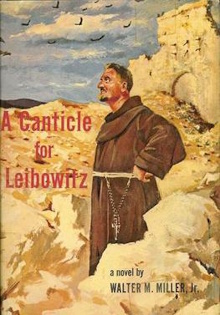
A Canticle for Leibowitz is one of those classics of science-fiction that has long entered the public consciousness. It’s so well-known as a staple of post-apocalyptic fiction that I’d somehow thought that I’d already read it. It’s embarrassing to realize that in fact I haven’t and reading it for the first time over the past month, I’m blown away by how powerful it is as an expression of the cyclical nature of history and the enduring faith of religious calling in persisting on a mission that spans thousands of years. This is a book that has not aged at all and feels just as relevant today as it did when it was published in 1959.
Hoping to be accepted into Albertian Order of Leibowitz, Brother Francis Gerald of Utah is performing a strenuous Lenten fast of 40 days in the desert when he spots a wandering pilgrim. He provides directions to the abbey and the pilgrim in turn finds a stone for him to complete the shelter Francis needs to protect himself from wolves at night. After the pilgrim leaves, Francis finds on the rock Hebrew writing that he isn’t able to read and underneath it the entrance of what we would recognize as a fallout shelter along with documents and handwritten notes that he treats as relics. When he returns to the abbey, the discovery causes the uproar as the monks believe that the relics belongs to the founder of their order Isaac Edward Leibowitz. Furthermore they believe that the pilgrim Francis saw was perhaps an apparition of Leibowitz himself. The order has been trying to get Leibowitz canonized as a Saint and the current head Abbot Arkos worries that New Rome will treat this discovery as a deception. We learn that several centuries have passed since civilization was destroyed by nuclear war. After that the world descended into a Dark Age as the masses destroyed books and persecuted intellectuals. The order was founded to preserve as much ancient knowledge as possible, recopying them as necessary.
The book consists of three separate stories, each set about six hundred years apart, and the summary above is only the beginning part of the first story. I consider it the best of the lot as it takes its time to immerse us in its world and inhabit the mind of Francis. It would hardly be a surprise to modern readers that the medieval setting is the result of a nuclear apocalypse. When Francis remarks about the strangeness of finding metal inside rocks, we know that that it’s just reinforced concrete. When he puzzles over handwritten text, we recognize it as just a shopping list. In this era of illiteracy, the order treats all text as sacred and so collects and stores them without even the hope of being able to understand what they mean. In the second story, secular scholars have emerged who are able to systematically study what the order has persevered and so rediscover the lost knowledge. Yet the return of civilization also brings with it the prospect of wars between nations. The last story is set at a time when humankinds has fully rebuilt civilization and has even surpassed past achievements with starships and off-world colonies. But naturally humanity has grown no wiser in that time.
The first story left a profound impact on me as I came to realize the depth of the dedication and sacrifice Francis devotes to the so-called relic he discovered. As a novice, he is unwaveringly punctilious in adhering to the rules of the order. He reports exactly what he witnessed out in the desert in the face of pressure to either deny everything or add extraneous interpretation of what it might mean. He does not understand the blueprint he has found but in effect still dedicates his life to it, not only recopying it to have backup copies but working on an illuminated artwork based on it. It’s one of the most moving depictions of the religious mindset I’ve read. The implication is that their single-minded devotion to the preservation of knowledge would not be feasible without the religious dimension. I was shocked when the book tosses the character aside after spending so much time with him but the lesson is that the work is for the ages and extends well past the lifetime of any individual.
The other two stories affected me less. I did like that in the second story the then abbot is challenged by secular scholars over whether the knowledge gathered is meant to be diffused and use or simply hoarded. As the world undergoes a scientific revolution once more, it will inevitably fuel industrialization and be weaponized, no matter the wishes of the monks. The final story is a predictable affirmation that humanity never learns its lessons and so the world faces a new nuclear holocaust once more. Even here a confrontation between the abbot and a doctor over euthanasia once again asserts the primacy of religious doctrine over practicality as anything less would be doing the devil’s work. This is beginning to sound repetitive, but even as an atheist I’m always impressed by writers and thinkers who take religion with the proper intellectual seriousness and integrity.
The three stories were originally published separately and author Walter M. Miller Jr. had to do some patch up work to make them fit together. To my mind, that helps to explain why the first story has such a different writing style than the other two. The book as a whole is unquestionably the definitive word on the horror that mankind might rise from the ashes of a destroyed civilization only to repeatedly destroy ourselves once more. From the religious perspective, it suggests that it could not be otherwise no matter how far we go as this is not heaven we still await the coming of the messiah. I don’t have to be a believer to appreciate how powerful this message is.