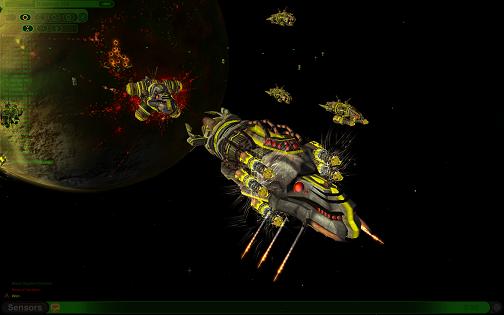
There’s no denying that Kerberos Productions has their priorities right: in a space-based 4X game, the big draw are the ships and Sword of the Stars, with all of its expansions added in, delivers that in spades. Want to build a missile boat with launch tubes dotting its entire surface? You can do that. How about an impactor ship that can fire powerful long-range rail cannons but whose arc of fire is limited to enemies directly in front of it? You can do that too. As of the A Murder of Crows expansion, you can even build drone carriers if fielding a swarm of carrier-based fighters is your thing.
As I’ve previously mentioned, Sword of the Stars is best understood as a space-based version of the Total War games. While the turn-based strategic layer is present, it’s extremely streamlined and designed to be able to be played quickly in order to facilitate multi-player sessions. A campaign game takes place in a randomly generated galaxy and you’re given a huge variety of options on what your galaxy looks like, including total number of stars, average distance between stars and the overall shape of the galaxy. The galaxy itself is in true 3D, which can be hard to make sense of since you’re going to have to constantly pan and rotate the galactic map. If that’s a problem, simply choose a disc-shaped flat galaxy to make things more or less 2D.
Continue reading A Game: Sword of the Stars (Ultimate) + Argos Naval Yards