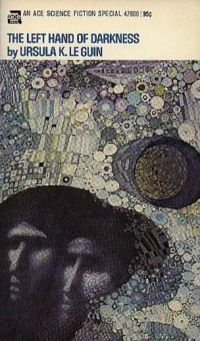
I’m still slowly working on reading the great classics of science-fiction that every fan of the genre should read at least once. I’ve been a fan of Ursula K. Le Guin’s Earthsea series ever since high school but I’ve read precious few of her more substantial Hainish Cycle novels. The Left Hand of Darknes, originally published in 1969, is perhaps the most well-known of these and was the big book that made Le Guin a great SF writer so it’s well past time that I got around to reading it.
I have read The Dispossessed, published in 1974 but judging from the events in the books apparently set thousands of years before The Left Hand of Darkness. There are obvious stylistic and thematic parallels between the two books. In each of the two books, two different societies that are rivals to each other are described. The reader takes the role of tourist to compare and remark upon the differences and similarities between the two rival societies. In The Dispossessed, the contrast is between the capitalist Urras and the anarcho-communist Anarres, obvious allusions to the United States and the Soviet Union.
Just four articles for the last month of December 2012 and one of them isn’t a science article at all but is a retrospective on the year with a perspective that I hope more people would share.
The first one is on a subject that Hiew actually forwarded to me earlier in the month. It’s about how it may be possible to know whether or not the universe that we currently exist in is actually a simulation run on some unimaginably powerful computer. The idea is that if our universe is simulated using an evenly-spaced three-dimensional lattice then the structure of that lattice itself imposes fundamental limits on the energy levels that any particles within the system can possess. And according to the team behind the paper, our universe does indeed have this kind of cut off in the spectrum of high energy particles. Personally I’m leery about this approach because it makes unfounded assumptions about the structure of the simulation. For example, instead of a fixed, regularly-spaced lattice, one could easily imagine a flexible system which could be as dense or as sparse as required to track the particles that are present locally. In any case, for a look at a fictional scenario of this, check out the novella True Names by Benjamin Rosenbaum and Cory Doctorow.
The next link is not an article but rather a letter written in response to an earlier article. The original thesis made two complementary claims: 1) that humanity as a species is becoming less intelligent over time due to the accumulation of mutations that have deleterious effects on intelligence and 2) that if this is so the question of why we managed to evolve intelligence at all in the first place is because modern society shelter humans from the full effects of natural selection. Hunter-gatherer societies it is claimed have greater use for intelligence while in our time even relatively stupid people may thrive and live long enough to procreate. This letter argues against these conclusions stating that mutations occur in individuals and not the entire population as a whole while intelligence is correlated with the number of surviving children in modern societies.
Then we have this article from Smithsonian.com about why humans blink so frequently. As the article states, some blinking is obviously necessary to lubricate the eyeballs, but we seem to blink more often than necessary for these basic functions. It turns out that another reason for blinking is to temporarily shut out the world to give ourselves a moment for introspective thinking. In effect, our minds shift to an altered mental state more conducive to thought at the moment when we blink.
Finally our non-science article is this optimisticretrospective of 2012 from The Spectator. One of my personal pet peeves is people being unreasonably pessimistic about the present and like to view the past through rose-tinted glasses. But as this article reminds us 2012 has really been the best year ever for humanity as a whole. Poverty has never been lower. On a global scale, inequality is down too. Far fewer people die from violence or disease. And despite doomsayers’ repeated proclamations of peak oil, we live in an age of energy abundance not scarcity. So here’s looking forward to 2013 being an even better year!
Updated on 28th December 2014 to fix errors caused by a change in the CodeSkulptor library.
The latest Coursera class I’ve been taking is Introduction to Interactive Programming in Python, a long and unwieldy title. It was conducted by professors Joe Warren, Scott Rixner, John Greiner and Stephen Wong of Rice University and ended yesterday so, as usual, I thought I’d write a few words about it.
To tell the truth, I was misled by the title of the course. I thought it really was an introduction to writing interactive programs. Since all of the programs we worked on in the Algorithms class were non-interactive, I thought this would be a good new experience. It turns out that this course should really be labelled something like Introduction to Programming via Interactive Games in Python, which is even more of a mouthful but more aptly describes the content of the course.
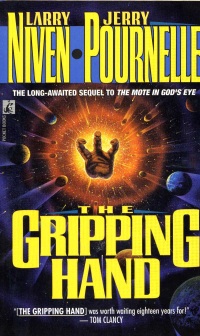
The Gripping Hand is the sequel to The Mote in God’s Eye. In some markets, it is also sold as The Moat around Murcheson’s Eye, which is a mouthful for a title but perhaps makes more sense. It was released in 1993, a full eighteen years after the first book was published. (George R.R. Martin fans might want to take note.) That’s almost as long as the time that has passed in-universe between the events of the two books.
The sequel centers around two characters from the first book. Kevin Renner who was navigator on board the INSS MacArthur during the mission to Mote Prime and Horace Bury, the trading magnate who initially saw the Moties as a tremendous money-making opportunity but later became terrified of them. The two are now agents of Navy Intelligence, with the responsibility of ferreting out rebel threats to the Empire while the Imperial Navy concentrates its resources on the Motie blockade.
Majorly late with this one, I know. I’ve been in Kuala Lumpur for extended period lately. But better late than never and I’m determined to keep this blog alive if updates now are less frequent. So let’s get on with it.
This first one is a bit trite and still a truth worth keeping in mind. It’s from the BPS Research Digest and talks about how people tend to think of their own names as being rarer, and therefore more special, than they really are. Also connected is the finding that people with genuinely rare names tend to be happier with their names, further confirming the observation like to be special. But I think people should be careful about going too far and end up choosing names that are just plain ridiculous.
The next article from the website MNT and covers the subject of how people might be able to solve mathematical problems unconsciously. The study in questioned distracted the participants with another stimuli while an arithmetic equation or a verbal expression was displayed. The result, to no one’s surprise, is that the so-called unconscious stimuli primed participants to be more likely to respond with the correct answer. Personally I find this particular piece of research to be fairly dubious. The mathematically problem given as an example seems to simple that it should be solvable by reflex so it’s not clear to me what the news here is.
Next up is a feature from The New Yorker which talks about the world’s grandest computer simulation of a brain. The initial target is to simulate the brain of a macaque monkey on a collection of ninety-six of the world’s fastest computers. It’s more of an overview of this area of research than this particular project since we have only the announcement and not much else to go on. Count me in as one of the skeptics on this one. I have a feeling that brain computation involves more than just neurons and ignoring the rest of the complex biochemistry going on is a mistake.
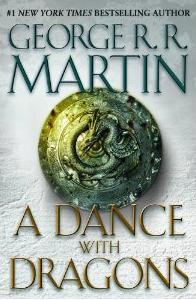
So I’m finally done with the fifth book in the Song of Ice and Fire series. It’s a monster of a novel at well over 1,000 pages and has been nearly six years in the making. It’s impossible to talk about it without tramping into spoilers so here are a few short spoiler-free comments about it before going into full-on analysis mode. Does stuff actually happen in this book, as opposed to say, A Feast for Crows? Well, yes, but less than you might expect from a novel of this length. Is it good? It’s decent but falls markedly short of the first three books due to lack of focus and poor prose. Does it finally tie things up? Not really.
The last couple of months have been great for anyone who enjoys a good dose of schadenfreude. First, in Malaysia we’ve had the implosion of the Genneva gold ponzi scheme. The LYN forums have had active threads on them for years. And for years we’ve seen dedicated Gennevarians pop up in the forum to defend the company and claim that it isn’t a ponzi scheme. But then after the raid on October 1st, all of them disappeared from LYN and instead regrouped to their Facebook page which actively censors dissenting opinions.
The amazing thing about the Genneva affair is how many of their so-called customers continue to insist that it is a legitimate business even after the raid. As the LYN crew is fond of pointing out, in Singapore Genneva customers sue the company to get back their money (and the company has repeatedly failed to mount a defense in court cases in Singapore). But in Malaysia, the customers seem likelier to sue the Malaysian Central Bank for killing their golden goose.