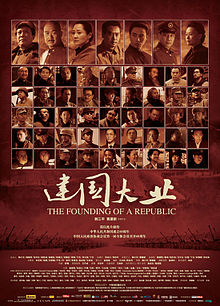
The Founding of a Republic

My experience of writing a game diary for Hearts of Iron 3 prompted me to do some extensive reading on the Chinese Civil War and the early years of the People’s Republic of China. Naturally, this led to seeking out and watching The Founding of a Republic, the 2009 historical film made to mark 60th anniversary of the country. So who says that videogames aren’t educational?

There is no doubt of course that this is a propaganda film. It was explicitly commissioned by the China’s film regulator and made by a state-owned film company. It’s main claim to fame outside of China is that it features dozens of celebrities, albeit mostly in very minor roles, all of whom worked for free, no doubt out of a sense of patriotism, or maybe just out of fear of causing offense and missing out of paid gigs. Yet within China itself, it has established itself as the highest grossing domestically produced film, suggesting that despite being propaganda, it is not entirely without merit.
Continue reading The Founding of a Republic

Interesting links for further reading

Due to a combination of various factors including illness, an unexpected holiday and an abnormally slow Internet connection, I have been remiss in writing new posts this week. Here are a few links to some interesting items to tide you over:

  • China’s State Administration of Radio, Film & Television has effectively banned all plots involving time travel from films. The stated reasons are that such stories treat history frivolously and disrespectfully and time-travel itself is unrealistic bad science. The suspected real reason is that China does not want people to compare the society that they have now with living conditions in the past. I’d also hazard that China feels uncomfortable about exploring “what if” historical scenarios. Additional fun fact: the Hearts of Iron games are also banned in China because it depicts places like Tibet, Shaanxi, Yunan etc. as independent states.
  • Iphone and ipad users should be careful. Apparently Apple has been secretly tracking the movement of users of the devices. The devices seem to automatically log its geographic position together with a timestamp at irregular intervals and save the data to an internal file without asking permission from owners or telling them that it is doing so. As many Internet pundits have noted, if you’ve been having an affair or lying to your employer about where you have been, a look at the file will reveal all your secrets.
  • In the latest of many pages on the sins of the Catholic church, an investigative reporter has written a new book alleging that thousands of Vatican-based priests have illicit sexual relationships. The book tells stories of priests having families complete with children in secret, of paid sex with escorts and of gay priests partying in nightclubs in Rome. It also cites research alleging that up to a quarter of Catholic priests in the US are involved in heterosexual relationships with women. My take: it’s not the sex that is offensive, it is the hypocrisy that rankles.
  • Finally, I recently learned that Ted Chiang has a short story available for reading online. Exhalation was apparently made available for free when it was nominated for the Hugo Award for 2009. It won incidentally. It’s a fantastic story that successfully paints a picture of strange society of alien within just a few succinct paragraphs. Ted Chiang is probably my favorite writer of short science-fiction right now ever since Greg Egan’s quality dropped in the 2000s. My favorite story of his however is still Story of Your Life which examines free will from the perspective that language determines thought.

Fake eggs

I’ve been amused by the recent news reports of fake eggs in Malaysia, which were supposedly imported from China. By now, the Veterinary Services Department has announced that the eggs are actually real, albeit low-grade ones that aren’t supposed to be sold to the general public. But the Consumer Association of Penang continues to insist that at least some of the eggs are fake. All this is despite an earlier announcement that Malaysia does not actually import fresh eggs at all from China.

So what prompted all this? My guess would be that someone noticed some odd looking eggs in a shop, recalled reading the widely e-mailed news reports of fake eggs from China from about 3 to 4 years ago, and put two and two together. But were those reports credible in the first place? My curiosity piqued, I set out to do some serious Googling.

The gold-standard in websites exposing scams and hoaxes of all sorts is of course Snopes, but unfortunately they don’t appear to have an article on this subject. The forum on Snopes however does have this discussion thread dating back to 2007 which largely concludes that making artificial eggs from chemicals doesn’t make economic sense and that no mainstream news organization picked up on the story. Since the tainted milk scandal in China was widely reported around the world, it doesn’t make sense that something as egregious as fake eggs would escape notice.

Another website specializing in scams and hoaxes, Hoax-Slayer, does have an article on the subject, also dating from 2007. It shows the widely circulated e-mail about the fake eggs in its entirety. This article also broadly concludes that there is no credible evidence that such reports are true and also traces how the hoax was originally spread by a number of websites and subsequently retracted. But as with all rumors, people only remember the rumor itself and never the retraction or refutation.

Recent Interesting Science Articles (Mar ’11)

Three articles for this month. The first is a new form of psychiatry that may come to eventually replace the traditional psychoanalysis. The second is really a business school paper than a science article, but I found it interesting nonetheless. The last one is an amusing insight into the paradox of why whales even exist.

The first one is from The Economist and covers is new form of psychiatric treatment now called Cognitive-bias modification (CBM). The article explains that the conventional form of treatment now recognized is psychoanalysis which everyone associates with lying down on a couch and talking out your problems to a sympathetic therapist. Psychoanalysis seems to be a reasonably effective remedy for a variety of common ailments but takes too long and is therefore too expensive. CBM on the other hand seems to work after just a few 15-minute sessions and you even need a therapist for it. A specialized computer program simply takes the place of the therapist.

Continue reading Recent Interesting Science Articles (Mar ’11)

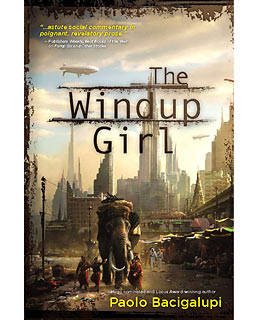
The Windup Girl

I picked up The Windup Girl by Paolo Bacigalupi solely on the strength of the blurb advertising it as having won both the Hugo and the Nebula for best novel. Not bad for a debut novel by a relatively unknown writer. It turned out to be a very pleasant surprise and I was particularly impressed by how deftly it portrays Southeast Asia. While I have misgivings about the plot and how events rush to an unsatisfying end, I still consider it to be one of the best novels I’ve read in recent years (not that I’ve been reading much admittedly).

Despite the title, the real star of the show here is arguably the city of Bangkok itself which is where the novel is set. In the 23rd century, the rising waters caused by global warming has destroyed many cities and even entire countries. With the world’s fossil fuels all but depleted, globalization as we now know it, is no more. The most powerful entities are the biotechnology companies who feed the world using their genehacked crops, maintaining their dominance by employing bio-engineered plagues to destroy natural food sources and even sending in private armies to topple governments when necessary.

Continue reading The Windup Girl

Tohoku earthquake and tsunami

That seems to be what the disaster is being officially called. Some of my own thoughts on the events, divided into a few categories:

Civil Order / Looting

Many commentators, particularly in Asia, have noted how civilized the Japanese have acted and how little looting there is. Most people cite it as evidence of their superior educational system and the way their culture frowns upon individualism. But that’s a shallow and general observation that doesn’t satisfy. What would be interesting are concrete examples of how the Japanese are taught differently and how their system is set up that delivers these results.

Continue reading Tohoku earthquake and tsunami

The disputed origins of Yoga

As much as I would like to write something about the ongoing events in Japan, events are developing too quickly to really write anything intelligent about it. The situation with their nuclear reactors could really go anywhere at the moment. Obviously, I hope that things go well. The Japanese sure could use a break.

Instead, here’s a link to an article disputing the Hindu origins of yoga. It has since evoked a great deal of controversy and ignited a significant debate over the issue. Considering how popular yoga is in Malaysia now and how it has stirred some debate over here as well as to whether or not it is a religious practice, I thought it would make for interesting reading.

Part of the article is a reaction against the “Take Back Yoga” campaign in the United States by the Hindu American Foundation who are upset that the modern practice of yoga is, more and more, shorn of its Hindu elements. In response, the author roughly makes the following points:

  1. Yoga, as it is popularly practiced and known throughout the world, is really just the physical component of yoga, hatha yoga. This style is extremely popular in India as well and has little spiritual or meditational content.
  2. This form of yoga is not really that old after all. The author claims that it was born in the late 19th or early 20th century as a form of exercise during the Hindu Renaissance that incorporated Western ideas of science, evolution, health and physical fitness.
  3. Effectively the techniques were drawn from drills, gymnastics and boidy-building techniques borrowed from Sweden, Denmark, England and the United States and then grafted together with the Yoga Sutras. In particular, the author traces the teachings to physical yoga to a school based at the Jaganmohan Palace of the Maharaja of Mysore in the early 20th century. In the 19080s, a Swedish yoga student found in the library of the Palace of Mysore a book entitled Sritattvanidhi that illustrates many of the techniques of modern yoga but also included rope techniques practiced by Indian wrestlers and traditional Indian gymnastics. It may also have drawn from exercises developed by a Dane and introduced to India by the British in the early 20th century. The palace at that time was certainly equipped with a Western-style gymnasium including wall ropes and props.
  4. Finally, the author claims that it is impossible to trace the ancient origins of most yoga sutras. Some yoga teachers claim that the sutras exist in some texts that now no longer exist. Others claim that a particular text contains some of these sutras yet other scholars cannot find them. One prominent yoga teacher claims that he traces his teachings to a text that dates from over a thousand years ago but now no longer exists. He knows of it because the ghost of an ancestor dictated it to him while he was in a trance.

Obviously, all of this is strongly disputed by opposing parties and the magazine even hosts a rebuttal by another author who fiercely disputes these conclusions.

The unexamined life is a life not worth living