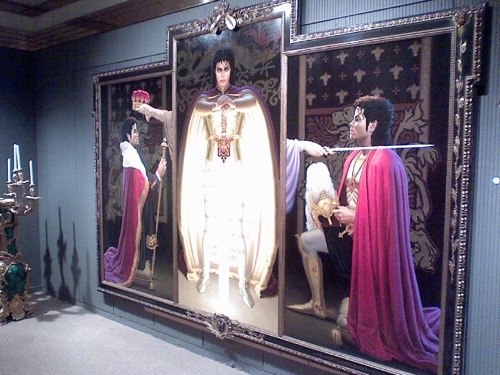
Awesome collection of Michael Jackson’s possessions

1240012136-excalibur

Everyone knows that Michael Jackson is crazy by now, but just how far his craziness extends can be seen in this collection of his possessions that was put for auction. Now we know what he spent his vast fortune on. This seriously has to be seen to be believed. It’s clear from all this that Jackson’s affection for fairy tales and all things child-like isn’t an act, but it just makes me feel pity for him. Also, probably a very good example of someone who literally had more money than he knew what to do with, and spent it on satisfying every little whim, no matter how frivolous or expensive.

The auction has now been cancelled, but as one commentator noted, that’s probably a good thing because otherwise all of this stuff will become scattered amongst many collectors, never to be seen in one place again.

Jackie Chan joins in the anti-democracy bandwagon

Just a bit of news that popped up over the weekend:

Action star Jackie Chan said Saturday he’s not sure if a free society is a good thing for China and that he’s starting to think “we Chinese need to be controlled.”

Chan’s comments drew applause from a predominantly Chinese audience of business leaders in China’s southern island province of Hainan.

The 55-year-old Hong Kong actor was participating in a panel at the annual Boao Forum when he was asked to discuss censorship and restrictions on filmmakers in China. He expanded his comments to include society.

“I’m not sure if it’s good to have freedom or not,” Chan said. “I’m really confused now. If you’re too free, you’re like the way Hong Kong is now. It’s very chaotic. Taiwan is also chaotic.”

Chan added: “I’m gradually beginning to feel that we Chinese need to be controlled. If we’re not being controlled, we’ll just do what we want.”

And of course the predictable backlash from Hong Kong and Taiwan:

“He’s insulted the Chinese people. Chinese people aren’t pets,” Hong Kong pro-democracy legislator Leung Kwok-hung told The Associated Press. “Chinese society needs a democratic system to protect human rights and rule of law.”

Another lawmaker, Albert Ho, called the comments “racist,” adding: “People around the world are running their own countries. Why can’t Chinese do the same?”

In democratically self-ruled Taiwan, which split from mainland China during a civil war in 1949, legislator Huang Wei-che said Chan himself “has enjoyed freedom and democracy and has reaped the economic benefits of capitalism. But he has yet to grasp the true meaning of freedom and democracy.”

My wife’s first reaction was to say that he’s an uneducated idiot prone to make shallow comments. Someone on QT3 commented that he’s actually illiterate and needs people to read his scripts to him, but I don’t know how true that it. Anyway it’s clear enough that he’s an airhead who only gets attention due to the gigantic soapbox he gets from his superstardom, but I still wish someone famous from the Chinese entertainment world would be brave enough to speak out on behalf of democracy and freedom.

Index funds in Malaysia

Since I got into, well, not exactly an argument, but at least a rather heated discussion over this topic on the LYN forums, I thought it might be interesting to write down a summary of my posts there and also what I’ve learned from that thread. Please note that all of this mostly applies only to Malaysia.

Now I’m just a neophyte investor and I don’t make any claims to exceptional knowledge or skill. But I do take care to read through the basics and try to educate myself in whatever it is I’m getting into. One of the most basic and well known ways to invest your money is through the stock market. You can either do it yourself, picking stocks that you personally believe will do well and pray, or you can entrust it to “professional” mutual fund managers and pray. I’m guessing that most working people don’t have the time or inclination to actually do their own research and will opt for the latter. That’s what I did and this is where things get interesting.

Continue reading Index funds in Malaysia

A Book: Incandescence

As for every human born since the Stone Age, as for the ancestors of every member of the Amalgam, there was nothing the universe was capable of doing that the Arkdwellers were not capable of comprehending. They were not mere clever-looking animals, with some hard-wired repertoire of impressive but inextensible skills. With sufficient motivation and freedom from distractions – and perhaps a modest boost in longevity – they could have grasped anything. Apart from the subjectivities of art or language, where everyone needed tweaking to cross the species barriers, there was nothing in the Amalgam’s million-year-old storehouse of knowledge that would have been beyond their reach. That was the ability, the potential in every one of them. There was, however, no drive to realize it: no curiosity, no joy in discovery, no restlessness, no dissatisfaction.

– Greg Egan in Incandescence

incandescence

(After thinking about it for a while, I’ve decided to write a discussion of the novel rather than a review. There are already plenty of reviews on it available on the net, most of them probably better than anything I would be able to come up with. For a favourable review, check this out. For a dissenting opinion, read this and maybe Egan’s rather fierce rebuttal to same.)

Cracking open a new Greg Egan novel is always a momentous occasion for me and since Incandescence is the author’s first new novel in six years, you can imagine how great the anticipation must have been. At the end of it however, I’m left with mixed feelings. On the one hand, I can recognize the tremendous amount of work that must have gone into it and on a purely intellectual level, can’t help but be impressed by it. On the other hand, with not much to go on in the way of plot or characters, I had a hard time being emotionally engaged in the book. In that sense, it may be a work of fiction, but it’s more of an extended thought experiment than a novel.

Continue reading A Book: Incandescence

Facebook makes you dumb.

It’s official because a report from the Ohio State University has concluded from a study of 219 US graduates and undergraduates that students who use Facebook had a significantly lower grade point average than those who did not.

FACEBOOK users may feel socially successful in cyberspace but they are more likely to perform poorly in exams, according to new research into the academic impact of the social networking website.

The majority of students who use Facebook every day are underachieving by as much as an entire grade compared with those who shun the site.

Of course, this is a ridiculous assertion because it basically boils down to the same thing: students are easily distracted from studying. If it weren’t for Facebook, the students would probably be playing video games, or partying or doing something else.

Or check out this alternative explanation from Chris Matyszczyk:

But I have a suspicious and entirely unscientific feeling that all this research may tell us so far is that bookwormy, people-uncomfortable types do well in school tests.

So nothing’s changed, right?

Rethinking democracy

One thing that often irks me is when seemingly reasonable and well-educated people who hold liberal values actually choose to decry democracy. Their argument is that ordinary people are too uneducated, too narrow minded, and generally too stupid to be trusted with the power to ultimately determine the course of government. A good example of this kind of thinking can be found in this post on Fool’s Mountain, found via Jed Yoong:

In the big picture: what should be the purpose of governments? Should government be limited to providing a set of processes and institutions that normatively allocate power within a society or should government take a lead role of establishing a vision of a common good and leading the charge to execute that vision of the common good?

My tendency (and many Chinese on this board) is to believe the second. “So what if you are democratic,” we ‘d say. What is the proof that it guarantees better governance or social stability?

Many of us have reservation about the democratic process because “good” democracy seems to depend on a lot of stars aligning. The media has to be fair and objective to generate good public debates. The people have to be educated enough, well fed enough, and to care enough about the political process to participate in the political process. The people need to also have a healthy sense of social awareness and public duty to exercise their political power judiciously for the good of their country – not just for themselves.

Obviously this is a straw man argument. No proponent of democracy claims that it “guarantees” better governance or social stability. As the blog author himself notes, the very same argument can even more easily be applied towards authoritarian forms of government. Surely by now there should be no need to quote Churchill’s dictum that democracy is the worst form of government, except for all the others.

Still one line criticism of democracy does have some merit, but it applies not to the principle of democracy itself but in how governments choose to implement a system of governance and then call it a democracy. As this book review in The Economist reminds us, simply holding elections doesn’t automatically make your government a democratic one. Elections are a necessary but not a sufficient condition towards the establishment of a healthy democracy. For starters, the elections need to be genuinely free and fair, with all political parties having equal rights to make their appeals and arguments to voters as they see fit. Furthermore, the power of any elected government needs to be constrained by a robust system of  checks and balances.

Finally, I agree with the view that until a country has successfully undergone a peaceful and orderly transition of power from one political party to another at least once to prove that all of mechanisms of government are functioning, that country cannot truly be called a democracy. Unfortunately, this rules out most Southeast Asian countries including Malaysia. One of the ironies of the region is that of all the countries in this part of the world, it is Indonesia, known as one of the longest lived dictatorships in the world under Suharto, that is now considered the healthiest and most exemplary democracy.

Pointless inventions

00

I managed to resist the urge to post about this outdoor treadmill when it first got posted on QT3, but the ropeless jumping rope has pushed me over the edge. Basically it seems to be a matched set of two weighted jumping rope handles with fancy electronics embedded to count your jumps and calculate how long you’ve been jumping. Except that it doesn’t have an actual rope connecting the two handles, so you won’t need to worry about tripping, or getting your rhythm wrong, or maintaining proper form. Because, hey, actually jumping with a rope is too hard and simply jumping in place without any equipment is just stupid.

The unexamined life is a life not worth living