Return of the financial crisis

Last week has been a very exciting time for anyone with any money in the stock markets. The KLCI plunged to lows not seen since the depths of the financial crisis of 2008, then strongly rebounded over the next couple of days. Anyone who had bought SP Setia’s warrants early in the week practically saw their money doubled following the takeover announcement by PNB. This week looks set to be a continuation of the rollercoaster ride though the overall trend remains bearish. I personally expect the markets to edge down for at least the next few months, though there will certainly be plenty of technical rebounds along the way.

The pundits are calling this the return of the financial crisis. For those in the US, it feels more like the crisis merely took a breather and is now back with a vengeance. For middle-class Americans in particular, it has already been a lost decade echoing what happened to Japan. With no end in sight for the European debt crisis and with the Americans set for a rematch between the Republicans and the Democrats over the raising of the debt limit in November, things look certain to grow worse before they can get any better.

What galls me the most however is the fact that this rerun of the crisis is almost entirely due to political factors rather than fundamental economics. Yes, America’s budget deficit looks bad and their debt is growing at an unsustainable pace. But that is really a long-term problem and in the short and medium term, the US debt is perfectly fine. US bond yields are laughably low and there is no prospect of them going up any time soon. With inflation low as well, the US government still has plenty of scope to use fiscal policy to stimulate the economy.

Over the long term, the US debt problem can be attributed almost entirely to healthcare costs. They need to do a fundamental rethink of how much right their citizens have to healthcare and how to distribute those costs. They need to either accept that there is a certain point beyond which each extra month of life that they can give a dying patient isn’t worth the money or to accept that taxes need to raised significantly to pay for the healthcare costs of the elderly. Everything else is a sideshow that buys a bit of extra time but will never resolve the problem until they confront this choice head on.

As for Europe, I agree with The Economist in that the EU needs to man up and draw a line between insolvent and illiquid countries. Greece is insolvent. Everyone knows this no matter how fervently EU authorities deny it. Portugal may or may not be insolvent depending on the next few months. Every other country in the EU currently under pressure in the bond markets is merely illiquid. Insolvent countries need to have their loans restructured, essentially imposing losses on creditors. This would destabilize the EU banking system. So be it. Let bank shareholders eat the losses until their equity is gone, then use public money to recapitalize the banks and rebuild the financial system as necessary. Basically, the EU should bail out banks as institutions, but not their shareholders and not insolvent countries.

In the meantime, illiquid countries need to be given unlimited backing by the rest of the EU. This will increase borrowing costs for safe countries like Germany and the Netherlands, but their public needs to accept this as the cost needed to save the EU.

Naturally, none of this will happen because the political costs are too great. In the US, the Tea Party has successfully sold to the general public the idea that deficits must be cut immediately and savagely without any care of how much damage this would cause to the economy and no politician will dare to say otherwise. Similarly, no politician in the US will dare to tell American citizens that sometimes a tiny incremental improvement in healthcare isn’t worth the massive costs it would incur.

In the EU, singling out Greece would be too humiliating to contemplate and the more often Sarkozy and Merkel declare their infinite support for Greece, the harder it will be to do the right thing no matter how much more worse Greece gets. And of course, any northern politician who dares to tell his voters that they need to pay a bit more tax to help out the southern countries will be cleaned out at the polls in election season, even if this means everyone will be better off in the long run.

This means that both the US and the EU will continue to limp on, kicking the can down the road as far as they are able. Sometimes it sucks to be a democracy.
Chronicles of the Black Company

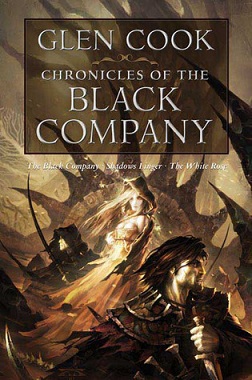
Most fantasy series take place in an imagined world filled with powerful magic and fantastic creatures. As a matter of course, the stories tend to focus on the lives and doings of the most powerful and influential beings of their age, the better for readers to a get a proper sense of the epic scale of events as they unfold as well as to be sure of having a front row seat to the most spectacular battles. Glen Cook’s The Black Company series is set in a unnamed world that is no less wondrous than that of his fellow fantasy writers. Here there are the usual ancient evils and prophecies; sleeping gods and sorcerors potent enough to create storms or turn large companies of soldiers to ash; monsters such as were-panthers, talking stones and flying mantas.

What sets this series apart is its focus not on the generals and nobility, the most puissant mages and most renowned generals, but on the lowly common foot soldiers that make up the bulk of every army. In this case, the spotlight is on the Black Company, a band of mercenaries who peddle their services to the highest bidder. Chronicles of the Black Company is an omnibus volume that brings together the first three novels of the series, The Black Company, Shadows Linger and The White Rose. The first of these books were published  in 1984 but I only heard about this series several years ago from QT3.

Continue reading Chronicles of the Black Company

Recent Interesting Science Articles (Aug ’11)

Four articles for the month of August 2011. While I’m going to try to continue with this as a regular feature, I’ve decided to be briefer and to summarize less, since readers can always go read the original text anyway. So here goes.

  • MedicalXpress has an exciting story about a new broad spectrum viral therapy that can seemingly target any sort of virus. The treatment works by identifying cells that have been infected by viruses by detecting the presence of double-stranded RNA (dsRNA) and instructing such cells to commit suicide. Many people are expressing skepticism about the broadness of the claims being made or that it would safe to assume that all cells that contain dsRNA may be destroyed without harm. But if this checks out, it will be huge.
  • Like some people, I’m very adverse to spoilers of any kind for any media I intend to read or watch for myself. But the psychology department of the University of California at San Diego begs to differ. According to their study which involved asking participants to read one of twelve short stories, around half of which were prefaced by a spoiler paragraph, including the spoilers seemed to increase the entertainment value of the story. This was true even for genres like mysteries and ironic-twist stories. The authors suggest that this isn’t as unintuitive as one might expect as this nicely explains why people like to reread a favorite book or rewatch a favorite film.
  • The Economist covers new evidence to support a theory of why some traditional societies are patriarchal and others matriarchal. The key lies in whether or not each society developed and adopted the plough as part of its traditional farming practices. It explains that before the advent of the plough, women were in charge of farming while men fought or hunted. But the plough, while improving yields, required greater physical strength that only men possessed. Such societies subsequently became more dominated by men. The researchers involved found that whether or not the ancestors of an ethnic group used the plough is a good predictor of attitudes about women in the workplace or about women as leaders in society.
  • Lastly, Wired has an article about the discovery of a planet that appears to be composed almost entirely of diamond-like crystals. The planet has an unusually high mass to volume ratio and orbits so close to its parent star that a single revolution just takes two hours. Furthermore, it’s parent star is itself a pulsar that rotates at more then 10,000 times per minute. Now that would make for an interesting star system for a spaceship to explore.

Roadside Picnic

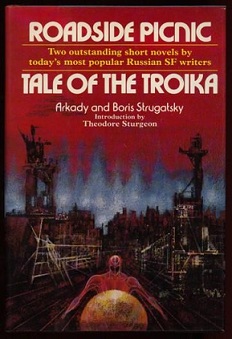
Russian writers seem to have a special talent for highlighting the grimness and misery of ordinary life. Roadside Picnic, a novella by the brothers Arkady and Boris Strugatsky, is a fine example of how this morosity shows up even in science-fiction. Computer gaming fans will know this novella, first published in 1972, as the ultimate inspiration for the STALKER series of games, albeit by way of the film version directed by Andrei Tarkovsky that was released in 1979.

Naturally, the original novella differs markedly from the video game. The novella for example is set in the fictional town of Harmont in some unnamed Commonwealth country, instead of the area around the Chernobyl reactor in Ukraine. This in turn is only one of six zones scattered around the global that were created by the alien visitation event. Still, many themes and even individual elements, such as how the stalkers use throw bolts to detect the boundaries of some types of anomalies, will be recognizable to STALKER fans.

Continue reading Roadside Picnic

Recent Interesting Science Articles (Jul ’11)

For the curious, I’ve recently moved to Seremban and have taken up a new job. This has left me with far less free time than I had previously, so I will no longer be able to update this blog regularly. Nevertheless, I shall try my best. So here is my belated round up of three of the most interesting science related articles I came across in July. Two of the articles in this entry deal wit optics, though in very different ways. The last article is a psychological study on the values championed in television shows.

The first article is from New Scientist and covers a new range of devices that might be called social x-ray specs. It’s basically a pair of spectacles that come with a built-in camera that tracks whatever the wearer is looking at. This data is then fed into computer about the size of a deck of cards and the results displayed to the wearer inside the spectacles itself. What’s interesting about the device is what it looks for. As everyone knows, when engaged in any sort of social interaction with other people, humans will inevitably give out all sorts of unconscious physical responses to their interlocutor. Think of examples such as subtly nodding your head, arching your brow or pursing your lips.

Continue reading Recent Interesting Science Articles (Jul ’11)

Harry Potter and the Methods of Rationality

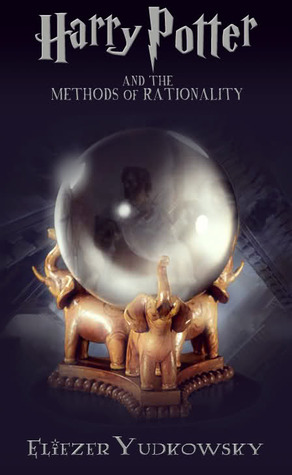
What’s this, you ask? You’ve read all of the Harry Potter books but have never heard of this one? That’s because Harry Potter and the Methods of Rationality is a work in progress piece of fan-fiction, written by someone under the pen-name Less Wrong. That person is Eliezer Yudkowsky, a prominent American researcher in the field of artificial intelligence and an advocate for transhumanism. Now I ordinarily don’t go anywhere near fan-fiction regardless of how much I may like a series or a setting. It’s a dark recess of the Internet with a well-deserved reputation for terrible writing inspired mostly by the obsession to pair favorite characters into romantic couples, regardless of how little sense that actually makes.

MoR however distinguishes itself from its peers both through the quality of its writing and the strength of its fundamental premise. It’s been endorsed by established sci-fi writer David Brin, been featured on The Atlantic magazine and it is by far the most reviewed story on the popular FanFiction.net website. That’s some heavyweight support and after reading what’s been released so far of it, I agree wholeheartedly. This is something that every person who thinks of himself as a rationalist must read and every person who is a Harry Potter fan ought to read.

Continue reading Harry Potter and the Methods of Rationality

My thoughts on the Bersih rally

I promised to write some of my thoughts on the Bersih rally earlier but never got around to it. The main thing is that others have already written what I’d wanted to say, and said it better to boot. The best one is probably this that was linked by Tan Kien Boon. This post on Marina Mahathir’s blog is good too. I’d hate to repeat what others have already said, so I’ll keep my own thoughts brief:

  • The government could have handled things much better if they had moved into damage control mode instead of counter-attacking like that. It makes me wonder if this is a reaction born out of panic and fear of losing power, or whether they actually need to be appear to be tough before the more hardcore elements of their constituency in order to avoid being usurped in an internal power struggle. If it’s the latter, it’s at least good politics even if the results aren’t too great for Malaysia. If it actually is the former, then it’s just plain stupid of them to act like this.
  • Like many other Chinese, I was struck by the high level of camaraderie in the crowd. Since I’ve spent many years living abroad and have little contact with the other races in Malaysia, it was hard for me to gauge how much support the rally had among the Malays. One commentator on QT3 asked me about this and I honestly didn’t know enough about Malaysia to answer. It was extremely heartening to learn that many Malays are far more enthusiastic in their opposition to the Barisan Nasional than the Chinese.
  • A. Samad Said commented that this was the finest display of 1 Malaysia he had ever witnessed. While this sounds cheesy and I have plenty of things to disagree about with Malaysia’s poet laureate, such as his insistent championing of the Malay language, in this instance I am inclined to agree. It was a truly novel experience for me to speak and cooperate with Malays without having to be conscious of our different races.
  • The lameness of the mainstream media is an old subject by now but I think this episode makes it more apparent than ever. Many, many middle-class Malaysians had to read accounts of the event that they personally knew were untrue from eyewitness accounts. It’s hard to believe all these thousands of Malaysians can go back to trusting what these media organizations say.
  • On the negative side, I’m still nonplussed that apart from Ambiga Sreenevasan herself and A. Samad Said, most of the leaders prominent in the movement are attached to opposition parties. Where are the heads of the trade unions, religious groups and other NGOs that are part of the coalition? Obviously the opposition politicians have more incentives to trumpet their prominence, but I’d hoped that the other NGOs could be more visible so as to credibly turn the movement into a more neutral affair.

Despite the lower than expected turnout, I think it’s hard to call the rally anything other than a success, especially after how the government repeatedly shot itself in the foot in its response. People are certainly far more alive now to how much in-grained opposition there is to Barisan Nasional and more cognizant of just how far the government is willing to go to hold on to the power. Most people who turned out at the rally are extremely happy and proud that they did so while those who didn’t go have expressed disappointment in themselves that they missed the chance to be part of something big and important. It’s still a long slow grind towards true democracy but the Bersih rally will likely be remembered as a critical stepping stone along that path.

The unexamined life is a life not worth living