Schild’s Ladder

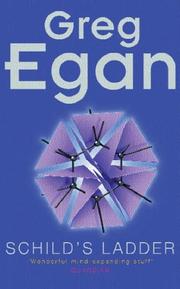
I’ve been cleaning up some of the old books I have scattered around my mother’s house. Some of these have been too damaged by poor storage conditions and need to be junked. Some others I’m too embarrassed to keep and will be donated. The rest needs to be packed up to be ready to be moved to Seremban. Greg Egan’s Schild’s Ladder is of course in that last category and while staying in Kuala Lumpur, I’ve found that my memory of it was poor enough to merit rereading the novel. Since I’ve never written about this particular book here as well, I thought I’d remedy that as well.

The Wikipedia entry for this novel calls it Greg Egan’s hardest SF book ever and considering that Egan is easily the hardest of the hard SF writers, this is a daunting statement indeed. This is because Schild’s Ladder begins with a fictional theory that unifies relativity with quantum mechanics, the so-called Sarumpaet rules of Quantum Graph Theory. In the far future universe of the novel, this has been the basic foundation of all physics for thousands of years even as humanity has spread out and diversified throughout the galaxy. Some of these descendents of humanity exist only as pure software constructs. The acorporeals as they are known  aren’t even raised in an analogue of 3D space, preferring more complex spaces due to the belief that this will unnecessarily restrain the flexibility of their developing minds.

Continue reading Schild’s Ladder

AI Challenge 2011 Update

Due to real-life issues, I’ve had less time to devote to the contest that I’d expected so my progress has been slow. I should have more time from here on out so hopefully I’ll be able to do better. Most people haven’t been as lazy as me however and more people have entered than I expected. As of the time of the writing, there are over 6,600 entrants. The contestant count for last year’s contest peaked at less than 5,000.

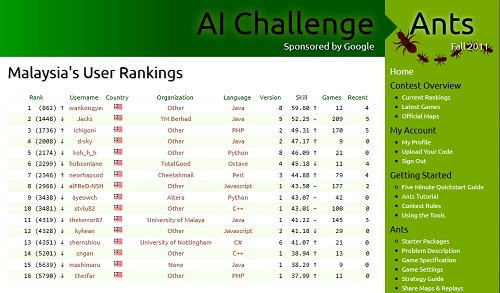
As a rough gauge of the quality of the competition, I recently climbed to the first place for Malaysians, but my overall ranking is only 800+. By contrast, the user named Jacks who self-identifies as from TM Berhad held the Malaysian top spot for over a month but in the overall rankings he peaked in the 500s and has since gradually declined to the 1,400s. This suggests a combination of very good new entrants and users who have been actively improving their bots.

Continue reading AI Challenge 2011 Update

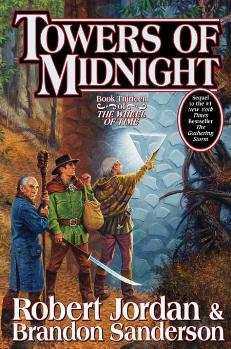
Towers of Midnight

Way back at the beginning of this year, I wrote a post on the first chapter of the Wheel of Time series that was handed off to Brandon Sanderson. Now as 2011 draws to a close, it’s time to do the same for the penultimate chapter of a saga that first started over twenty years ago. As usual for the series, this is a massive tome, with my paperback version clocking in at an incredible 1,200+ pages. I like to think that it’s so massive that even the printers have a hard time with these books, as a good portion of the pages from my copy have faded ink. Be warned that spoiler abound, in case you’re the type to get squeamish about such things.

As with The Gathering Storm, old plotlines are resolved at a furious pace. One of the main ones in particular dates all the way back to the very first book in the series, The Eye of the World, where Perrin Aybara killed two Children of the Light in a frenzy of bloodlust. Another deals with the nigh invulnerable gholam which has been hunting Mat Cauthon since book seven. For the fans, I believe this book also ends all of the will they or won’t they romantic threads left dangling. Just about every major character gets a romantic partner. This includes not just the long expected pairing of Egwene al’Vere and Gawyn Trakand, but also such characters as Morgase Trakand, Thom Merrilin and even Berelain of Mayene!

Continue reading Towers of Midnight

Recent Interesting Science Articles (Oct ’11)

Only a couple of articles for this month and one of them is a general feature about a subject rather than a recent discovery. But anyway:

  •  The feature in question is an article on how intelligent octopuses are from Orion Magazine. There are interesting anecdotes in there about how they can recognize and form relationships with humans, solve puzzles and engage in playful behavior with toys. My favorite part is how three-fifths of their neurons aren’t in their brain at all but in their arms, which allows the arms to act independently even when severed from the main body.
  • The other article is from The Economist and is about how happiness not only has a genetic component but that due to genetics, different races may have different levels of ingrained tendencies to be happy. The mechanism the  team in question fingered is a gene that encodes the serotonin-transporter protein. This gene comes in two variants, a long one and a short one, and the team found that those with the long versions were more likely to report themselves as being happy. Where things get really interesting is that different ethnic groups tend to more of one variant of the gene than the other. Black Americans for example tend to favor the long version of the gene while Asian Americans tend to mostly have the short version. ‘Lo and behold this blends in nicely with observations that newly rich Asia reports far lower levels of happiness than their GDP per person figures suggest. This also adds weight to earlier findings that societies composed of people with the short version of the genes lean towards collectivist political systems that emphasize social harmony and de-emphasize individual independence and freedom.

AI Challenge 2011

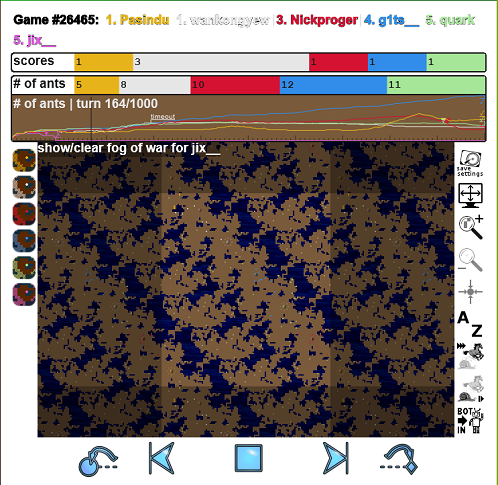
Around this time last year, I participated in the Google AI Challenge, eventually finishing in 47th place out of nearly 5,000 participants. The contest this year had a bit of shaky start. There was some controversy over the name of the contest as it’s wholly organized by the Computer Science Club of the University of Waterloo. Google is providing sponsorship and has agreed to allow their name to be used but is otherwise completely uninvolved in what is otherwise a student project. Hence, this year the name is simply AI Challenge with a note that it’s sponsored by Google.

That wasn’t the only problem. Despite deciding on the nature of the game to be played fairly early on, the organizing team seemed to have a great deal of trouble coming up with the required tools, documenting everything and making sure the starter packages all work properly. It was annoying to see that while the contest had already started and is open to submissions, the website and the rules of the contest were still a work in progress. Nevertheless, everything now seems to be working correctly, apart from the fact that the server is far too slow and that there aren’t enough games being played. So I’ve submitted an entry and you can track my progress here.

Continue reading AI Challenge 2011

Nobel Prizes 2011

As usual the announcement of the recipients of the Nobel Prizes for 2011 happened with almost no fanfare in the mainstream press. As I did last year, here’s a summary of this year’s winners.

  • The Physics prize goes to Saul Perlmutter, Brian P. Schmidt and Adam G. Riess for a discovery that all astronomy buffs now knows: that the universe is not only expanding but the rate of expansion itself continues to accelerate. This was worked out by studying distant supernovae and noting the Doppler Effect on its light as the distance between the supernovae and the Earth increases. Today, physicists still have no real explanation of why the universe continues to expand at an increasing rate, indicating that some force, other than the residual energy of the Big Bang, is pushing space apart. This is what physicists label “dark energy” for now while they search for a better understanding of what is going on.
  • The Chemistry prize goes to a single individual, Daniel Shechtman, for a discovery that will make mathematicians as well as chemists proud. While studying a slice of aluminium-manganese alloy, he inadvertently stumbled on quasicrystals a heretofore unknown form of materials. Normal crystals consist of atoms that are packed together in a symmetrical and repeating pattern. Shechtman however discovered a type of crystal that have orders of symmetry that  that were previously thought to be impossible, allowing them to fit together in such a way that the pattern never perfectly repeats itself. In 2D form, mathematicians know this as Penrose tiling, named after the British mathematician Roger Penrose, who first formally formulated this form of geometry. Islamic artists however have been known to use this sort of motif in their work for centuries. Today, quasicrystals are used in many areas of materials science, such as the liquid crystals in display screens and some types of steel.
  • The Physiology prize goes to three persons who all worked on the immune system though the discoveries are not directly related. Bruce Beutler and Jules Hoffmann discovered a protein-binding mechanism that helps the immune system recognize invaders and trigger a defensive response. Ralph Steinman discovered the dendritic cell, which he found helps to activate T-lymphocytes, which play a role in the immune system’s ability to adapt to different types of threats. The prize underwent a bit of controversy this year as the rules state that Nobel Prizes may not be awarded to deceased individuals. As it turned out, Steinman passed away just before he received the news that he had been awarded the prize. As the Nobel committee was unaware of his death at the time of their decision, the decision was allowed to stand.
  • The Economics prize goes to Thomas Sargent and Christopher Sims. Both economists worked on uncovering cause and effect in macroeconomics, in particular addressing how to incorporate changing expectations by rational actors in a macroeconomic model. Sargent showed how businesses and households learn about economic conditions and adjust their expectations accordingly and how this in turn should be taken into account of within macroeconometrics. Sims developed the statistical tool of vector autoregression that is used to work out the effects of how a change in economic conditions affects both the supply and demand curve in complex ways.
  • The Literature prize goes to a Swedish poet, Tomas Tranströmer, who is not well-known outside of his home country. His oeuvre, which is not large, is characterized by the committee as being economical and granting fresh access to reality. This is the first time that a poet has won the prize since 1996.

As usual, detailed information on the recipients and explanations of their work can be found on the official Nobel Prize website.

Steve Jobs’ death used as example by natural health advocates

By now most people will have read all manner of eulogies about the co-founder of Apple, but you’ve probably haven’t read anything like this ridiculous editorial. Natural health nuts all around the world who decry conventional, evidence-based medicine and claim that cancer can be cured simply using vitamins and health supplements are pointing to Jobs’ death as proof that chemotherapy and radiotherapy doesn’t work. The article also goes on to a weird tangent on how Jobs was a once in a lifetime creative talent who was sadly abused by the capitalistic forces of society.

The irony of this particular editorial is that Jobs seemed to actually favor alternative health remedies, for the all good it did him. As his bio on Wikipedia makes clear, Jobs is pretty much the living embodiment of the counterculture, pot-smoking, hippie demography. So much so that he saved money from his first job to go on a pilgrimage to India and came back as a Buddhist with a shaved head. In short, he’s exactly the type of person who would read a website like Natural News and be skeptical of evidence-based medicine. According to this Fortune article from 2008, when Jobs first learned of his cancer, he resisted treating it with conventional methods and chose instead to go on a special diet and explored alternative treatments.

It was only nine months after his cancer was first diagnosed, following pressure from his company staff and investors worried about his health and after learning that his tumor had grown despite the alternative medicine he was using, that Jobs agreed to undergo the surgical procedure his doctors had recommended. At that time the surgery was considered a complete success but even back in 2008, it was pointed out that by delaying the procedure for so long, Jobs had dramatically increased his chances of his cancer recurring. It is arguable that things might be different today if Jobs had chosen to heed his doctors advice immediately.

On a personal note, I knew a colleague while working in the Solomon Islands who was diagnosed with head and neck cancer. Being a Johor native, he underwent treatment in Singapore but was eager to come back to work. A short time after he arrived back in the Solomon Islands, some symptoms recurred. Instead of flying back to Malaysia immediately, he listened to some of the local people and decided to have a local traditional medicine man treat him in a remote village. Most of the staff of the company opposed this as we were worried about him and it was difficult to stay in contact with him. According to his account, the treatment consisted of various oils and using hands to press the fluid out of his developing tumor. He stayed at the village for more than six months. Eventually, his condition deteriorated until he was forced to fly back and he was immediately hospitalized in Singapore. He died less than two months later. I remember his case keenly because he was the exact same age as me and died in his late twenties.
 

The unexamined life is a life not worth living