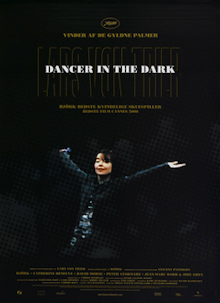
Dancer in the Dark is one of my major omissions from the filmography of Lars von Trier. My wife had already watched it by herself a while back plus it was surprisingly poorly reviewed despite being quite a famous film. It’s not a very good looking due to being shot using a handheld digital camera and the main story of a mother doing everything she can to save her son is crude emotional manipulation. Yet the character played by Björk is so fascinating and framing it as a musical is darkly imaginative of Trier. It’s definitely a lesser work but still one worth watching.
An immigrant from Czechoslovakia, Selma Ježková is a single mother raising her son by working in a factory. She is slowly growing blind due to a neurodegenerative condition but hides it from everyone. Knowing that her son Gene will also inherit the same disease, she works hard to save the money needed to operate on his eyes. Despite her poverty and dire straits, she has a joyful demeanor and imagines herself living in a musical by interpreting all the sounds around her as music. Her friend Kathy becomes aware of her condition and tries to cover for her at work and a man Jeff is intent on wooing her. Selma and Gene live in a trailer on the property of Bill, a police officer. One day Bill confides that he is facing financial difficulties due to his wife’s overspending and his property is at risk of being foreclosed. Selma in a show of trust tells him that she has been saving money for Gene’s operation. Bill betrays that trust by secretly watching where she keeps the money and steals it. When Selma confronts him to claim the money back, Bill gets shot during the scuffle.
The footage Trier captured for this film gives it a low-quality home video look which is not appealing at all. It’s doubly strange since this really is a full-blown musical with choreographed song and dance sequences and all of it looks like that. I suppose this is Trier’s point, making a musical that is as much un-musical as possible. The music uses sounds of mundane objects like factory machines and trains. Even the 1960s American setting is uncovincing, being shot in Sweden. Selma might be explained away as a Czech immigrant but Kathy as played by Catherine Deneuve is unapologetically French. The story itself is fairly conventional even if the subject matter is dark. I dislike the false dilemma of forcing Selma to choose between saving herself or giving Gene the gift of sight. Furthermore, there’s no real link between Selma’s musical view of the world and her love for her son. Gene’s character is underdeveloped here. We know how much Selma loves him from her actions but they have too few interactions together and she inexplicably keeps him away when she is in prison. This suggests to me that Gene might provide the motivation for Selma’s actions but maternal love isn’t what interests the director.
To me, the true heart of the film is the character of Selma herself and the strange way that she perceives the world. It’s considered part of Trier’s Golden Hearts trilogy, Each of them features characters who are neurodivergent in some way. Selma may not be mentally impaired but her cheery outlook in the face of her miserable circumstances and child-like innocence certainly marks her out as being different. What is fascinating is that this doesn’t prevent her from being shrewd and fully capable of planning for her son’s future. Her unusual mindset is psychological cope to deal with a bleak hand that life has dealt her and it’s not like it magically offers her a way out of her problems. It reminds me of the pretend games in Roberto Benigni’s Life is Beautiful except it’s directed purely inwards so it’s honest rather than being deceitful. It’s a fantastic feat of imagination that Trier was able to conceive a character like that who would naturally live in a musical world.
I can’t see how Trier could have made this without Björk’s music and acting. It’s one of the most unique musicals out there and though I disliked the low production values, it matches the setting and the themes he was going for. Unlike many of the director’s other works, this wears its heart on its sleeve so it’s a more obvious and perhaps shallower film. Combined with the simplistic plot and Björk’s star power, it’s not surprising that this met with mainstream success but isn’t among the director’s best work.