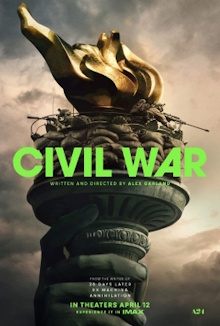
None of Alex Garland’s films have ever really clicked with me. Critics love him however and I’ve read analyses about his work that raise interesting points that I’ve missed, so I’m willing to give him the benefit of the doubt. Yet after watching this, I am left even more disappointed and puzzled. Conceptually, I love this and I’m pretty sure I understood what he was going for. But his execution of the idea is so unserious, so deliberately low brow and over the top that it feels like a waste of a good idea. So I’m still not a fan of his work and I really don’t get what his deal is.
The United States is several years into a grueling civil war that has pitted an increasingly despotic Federal government against multiple secessionist factions. Lee Smith is a veteran war photographer who has become jaded from her experiences. She aims to travel to the White House with her colleague Joel to interview the President just as Western Forces are on the verge of taking Washington DC. While attending a protest, she meets Jessie Collin who hero worships her and aims to be a photographer as well. They survive a suicide bomber attack and the next day, she learns that Joel has agreed to take Jessie along with them, together with an older journalist Sammy. Outside the city, they stop for gas at a station guarded by armed men. Jessie notices that at the nearby car wash, they have hanged two men accused of being looters and is horrified. Lee defuses the situation by asking to take a photograph of the armed guard with the victims. Jessie is upset at herself for being too panicked to take any photos at all and resolves to do better. But of course the group is going to come across even worse atrocities on their road trip.
When this project was announced, everyone naturally thought that this was going to be about a war between Republican-led and Democratic-led states. But that isn’t Garland’s point at all as he makes clear by lumping Texas and California together as one of the warring factions, a team-up that would be impossible in real life. Instead, he wants to portray the US as just another war-torn hellhole and a failed state, the kind that we’re used to dismissing on the news. So the very first suicide bomb scene might be something we’d expect to happen in, say, Iraq but the fact that this is the US is shocking. The same goes for all of the other the random encounters the group comes across, combat scenes, summary executions of enemy combatants, mass massacres etc. As one soldier tells Joel, it doesn’t matter any more who’s who so specific details are unimportant. All that matters is that someone on the other side is the enemy. This is the high concept behind the film that I liked, as if the filmmaker were saying that the US isn’t special and what is happening in other countries American prefer not to pay attention to could easily happen at home as well.
My problem is that it goes about it so badly. Right from the beginning, the allusion to Lee Miller is so crass and inappropriate. Miller was an accredited war correspondent who worked with the Allied forces, Here, Smith and her companions appear to be enterprising independents who believe that just because they wear vests and have a vehicle with “Free Press” markings, they’re entitled to go anywhere they want. They observe and film live combat at such close ranges that they should be considered combatants. It’s ridiculous that they can see a soldier bleeding out right in front of them and do nothing except take photographs. The climactic scene ramps things up even more, putting them first on the scene ahead of any soldiers, so that they are making the news rather covering the news. I’m pretty sure that Garland’s intent here is to point out that by the end they’re predatory vultures little different from the soldiers and militia members responsible for the killings and atrocities they’ve come across. But is that really a worthy point to make and do you really want to condemn war journalism like this while invoking the name of Lee Miller?
Watching this only a short while after 20 Days in Mariupol only make it more obvious that is shown here is very much not how journalism is supposed to work. They take immense risks by staying within the war zone, they’re not suicidally throwing themselves into the middle of firefights. That’s why I often find it difficult to understand what Garland is going for. Surely he’s done enough research to know what is or isn’t a reasonable portrayal of the work of journalists? Is it just so that he can shoot Hollywood-style action scenes and make this more commercially palatable? Is he just holding a rude middle finger up at everyone and everything? The soldiers, the President, the secessionists, the peaceful town who claims to be sitting out of the war, and even the journalists? It seems to me that he is and that’s why I don’t like his work much at all.
One thought on “Civil War (2024)”