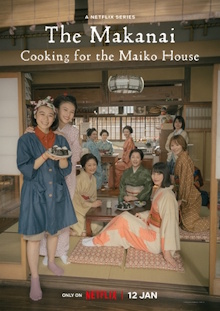
We liked Asura so much we decided to give this earlier series that Hirokazu Kore-eda also made for Netflix a shot and its focus on food would only be a plus for my wife. However it becomes evident quickly that this is not at all in Kore-eda’s usual style. Instead it’s a sweetly wholesome story without an ounce of darkness in it and barely any conflict at all. I suspected that this was adapted from a manga and indeed it was so. It’s prettily made and serves as a neat pocket tour of the customs surrounding the geisha of Kyoto but it’s too superficial to engage with seriously.
Two teenaged girls, Kiyo and Sumire, are best friends from Aomori. Rather than complete their high school education, they decide to go to Kyoto to become apprentice maiko. They are put up in the maiko house Saku run by two retired geiko, Mother Chiyo and Mother Asuza. Living there are a few other maiko along with Ryoko, Asuza’s daughter who goes to ordinary high school. At the school where they are taught the mai dances, Sumire excels but Kiyo has difficulty keeping up and is told that the path of the maiko is not for her. At the same time, the makanai cooking for the house has health issues so Kiyo enthusiastically takes up the role after the other maiko complain about being tired of ordering takeout. As Sumire continues to improve, she is apprenticed to the top geiko of the district, Momoko. As the Saku House goes through different events, the return of an ex-geiko after the failure of her marriage, Sumire’s father arriving to express his disapproval of her being a maiko, Momoko having to choose between being a geiko and getting married and more, Kiyo is always there with just the right dish for the occasion.
This is a very episodic show with only a loose overall storyline tracing Sumire’s success. In spite of the title, the show isn’t really about Kiyo. After the first couple of episodes which establishes her as the makanai of Saku House, she is just sort of in the background supporting everyone else. Even in the love-themed episode in which Momoko is considering a marriage proposal, Sumire is missing the boy the both of them left behind at home and even Ryoko is thinking of her estranged father, Kiyo has eyes only for her food. While issues and worries do crop up, they are always resolved painlessly with smiles all around. It’s uplifting as these shows so often are as epitomized by Kiyo’s happy-go-lucky attitude to life as she skips through the streets of Kyoto going about her errands. Of course, it’s also terribly unrealistic as life is never all sunshine and rainbows and real people are psychologically complex. As my wife observes, any house full of women like that would in all probability be rife with petty jealousies and catfights. The worst that happens here is gentle teasing even when someone steals food from the common refrigerator.
Watching this on Netflix in the Japanese language with English subtitles, I notice that many words have not been translated at all, leaving it up to the non-Japanese audience to infer their meaning from the context. For example, they use the word geiko instead of the more recognizable geisha for English speakers since this is the preferred nomenclature in Kyoto and leave it untranslated. The same applies to the words for foods, dances, items of clothing and accessories, festivals, traditions and so on. It’s a rather bold decision but it does effectively showcase the culture around the geisha. It’s surprising that it is the men who dress them and do their makeup and hair. The show isn’t so indiscrete as to discuss money, but I kept thinking how ludicrously expensive holding an ozashiki must be as shown here. The gatherings are so small, Momoko clearly does very well for herself as she has her own apartment and the fees must also cover the support structure of the maiko houses, the tutelage and so on.
I read that Kore-eda made this partially to dispel some of the common misconceptions perpetuated by Memoirs of a Geisha. None of the girls here were forced into the profession and it is considered to be a respectable, even noble aspiration. Yet this probably goes too far in whitewashing it. Having the girls drop out of school to be maiko is a questionable decision and in real life there is no such thing as a teenaged makanai. I regard this as live-action anime. Pretty to watch and pleasantly entertaining but too shallow to stand proudly next to rest of Kore-eda’s body of work.