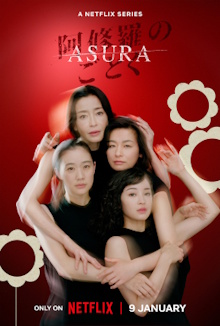
I’m not sure how or why a renowned director Hirokazu Kore-eda has the time to also make television shows but this is highly acclaimed and readily available on Netflix so I’m all for it. It’s a remake of a 1979 series and so is set in that year. The moment I read its premise about four sisters discovering that their elderly father is cheating on their mother with a mistress, I thought that Kore-eda is doing his usual theme of pointing out the failure of parental figures again. But it’s more than that as over the leisurely course of seven episodes, he is able to intricately map out the relationships between the sisters and their families.
One day, Takiko who works as a librarian and is the third eldest of the Takezawa sisters, convenes her siblings for what she says is an urgent matter. They meet in the home of Makiko the second eldest who is married to a corporate executive Takao and has two children. Takiko tells them that their father has a mistress and visits her and her son on the days when he is supposed to be at work. The sisters are shocked but then Makiko along with Tsunako, the widowed eldest sister, seem to downplay the matter. The youngest sister Sakiko who is dating a boxer dismisses it as their father just having some fun. Takiko who is more serious and conservative than the others becomes frustrated at their responses. But the next day the two eldest sisters secretly try to resolve the matter by meeting the mistress and paying her to end the affair but fail to find an opportune moment. Meanwhile we see that their mother has long been aware of the affair but maintains silence to keep up appearances even though it greatly upsets her. Makiko later discovers that Tsunako is having an affair herself with the husband of a restaurant owner and she herself is convinced that her husband’s secretary is also his mistress.
I’d believed that the series would revolve around the father’s affair but it’s really just the kicking off point to delve deeply into the lives of the four sisters. Being set in 1979, a key theme is how little autonomy or social status a woman on her own has. Their elderly mother has no choice but to ignore the affair as to acknowledge it would mean destroying the marriage and the family and giving up any power that she has. Tsunako at one point tells Makiko that a husband who cheats is better than not having a husband. Meanwhile the father comes across as affable rather than malicious. He is apologetic when the affair is made public but never suffers any real consequences for it. It’s just something that is normal for men. Even so, we can see how it’s getting better across generations. Takiko has remained unpartnered for a longer time than the others and would not accept anyone who isn’t completely faithful. Instead of keeping quiet, Makiko keeps needling Takao over his mistress. Sakiko does put up with her boyfriend’s misbehavior but seems motivated by not losing face to her sisters. As to be expected from Kore-eda, the interplay between the characters is deep and rich with subtle details. We can tell how close the two eldest sisters are as they keep finishing each other’s sentences while two youngest ones constantly bicker as Takiko judges Sakiko’s actions.
The visuals are splendid with careful attention paid to recreate the era down to the smallest detail. I always enjoy getting a glimpse into what households in different eras and cultures are like and this one feels genuine. It’s especially fascinating as between the houses of the sisters and their parents, we get to see households at widely varying levels of wealth. It’s notable for example that the living space of even Makiko who has a proper house looks cramped. Plus of course the whole thing is a fantastic showcase of Japanese customs, manners and culture. Even if you don’t speak Japanese, you can catch the pitter-patter of the puppet shows and notice how and when they enjoy various foods and festivals. Finally the theme here seems to be that family loyalty trumps everything else, including ethical principles. Their carefully cultivated manners and social graces paper over any improprieties but it’s still clear that everyone acts according to their own best interests.
Those who watch shows for their plots will probably be disappointed with this one as what actually happens isn’t that surprising or even interesting. In a very real sense, life just goes on through both the good and the bad. But is it a very finely crafted portrait of the characters, capturing how the women of the era live, think and feel and for that this certainly qualifies as one of the best dramas available on Netflix.
One thought on “Asura”