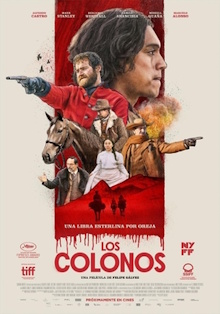
This Chilean film by a new director Felipe Gálvez Haberle is instantly recognizable as a Western. It has rugged characters riding horses across vast landscapes, gunfights and especially the killing of natives. This is no action movie however as the action is all one-sided. The cowboys here are literally committing genocide against defenseless Indians on behalf of their wealthy rancher employer, based on historically real events. It’s brutally blunt both in its messaging and in its imagery but it certainly succeeds in its goal of bringing more attention to an atrocity that most of the world is probably unaware of.
In 1893, employees of the wealthy rancher José Menéndez are erecting fences to delimit the extensive lands that he owns. He calls together his men, saying that he wants to clear a path all the way to the Atlantic coast. A Scottish former soldier Alexander MacLennan volunteers and asks only for one other man to accompany him. After a shooting competition, he chooses a young mestizo Segundo to go with him. Suspicious of the half-Indian, Menéndez forces them to also take Bill, an American gunfighter. The three get along badly as Bill questions Alexander’s claimed rank as a lieutenant and is wary of Segundo’s loyalties. When they reach the Andes, they meet Argentine soldiers who are escorting a surveyor engaged in mapping the border between Argentina and Chile. Menéndez’s lands extend past the border however so they continue. The surveyor gives them directions to a settlement of Onas Indians and they head there. To Segundo’s horror, Alexander and Bill proceed to carry out the real purpose of their journey: to exterminate the Indians to the last woman and child.
The brilliance of this film is that it uses the established cinematic language of the Western genre to tell the story of colonization. It takes all of the standards tropes: assembling a posse, setting out into the wilderness on a mission, skilled gunmen but inverts the morality. The cowboys here are marauders and by colonization, they mean wiping out the native population so that the newcomers can exploit their lands. Menéndez expresses surprise that Alexander needs only one other man and that’s because they have guns while the natives don’t. They make no attempt to communicate when they encounter the Onas. Instead they just launch an attack at dawn to wipe them out. The film even shows us what it’s all for at the end as Menéndez’s family enjoys the fine life in his manor. His daughter wearing a thickly layered gown plays a piano while little white children sing beautifully. In effect, he has brought the heights of European civilization to the southernmost tip of the continent and has paid for it with the blood of the native population.
These days no one would make a straight Western as no one would buy into the myth of the cowboy as a hero. This film takes the revisionism to its logical extreme, framing them outright as the villains. It might be a bit too on the nose by having a Spanish businessman, a British sailor and an American soldier as characters so we know exactly who the colonialists are. I’m also slightly disappointed that Segundo does little more than seethe in rage at what he witnesses. But as we see at the end, the horror of colonization goes beyond killing the native population. The state investigates the massacre only to whitewash the results and legitimize Menéndez’s business holdings. Half-blood Indians like Segundo and the native woman he marries are coopted and forced to assimilate into the burgeoning country. They get to live, yes, but only as the underclass to the people like Menéndez. There are no heroes and no redemption in this film, which makes it a depressing watch, but anything else would only undersell the enormity of what happened.
Needless to say this is extraordinary work for a first-time director. Both Menéndez and MacLennan were real people and the stories of what they did could fill up so much more than a single film. Most of the world remains ignorant of the Selkname genocide and I expect this excellent film will go a long way towards correcting that.