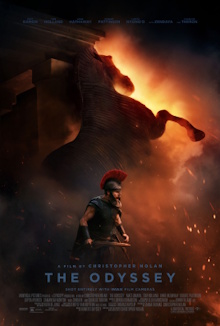
The Odyssey had a lot of negative press going in with critics zeroing in on his ahistorical choices and an overly modern interpretation of the Greek classic. But when the film finally hit the cinemas, it looks like Christopher Nolan has done it again and won over both the critics and audiences. I admit that I had my doubts as well and certainly it’s simplistic in how it casts Odysseus as a flawed hero but still a hero. But sitting down in the cinema before a huge screen, this level of depth is more than good enough as Nolan has delivered an epic, audio-visual experience like no other this year that will effortlessly keep you glued to your seats for its nearly three hours running length.
On Ithaca, numerous suitors occupy the house of Odysseus who left for the Trojan War twenty years ago to court his wife Penelope and his son Telemachus is unable to keep them in line. A bard recounts the now well-known story of how the Greeks used the Trojan Horse trick to gain access to the city and win the war but Odysseus is still missing. Flashback scenes recount the ending of the war and Odysseus leaving Troy with his men. Unlike Agamemnon’s fleet, he decides to take the slower southerly route. Along the way, they stop at various settlements to resupply and simply seize what they need. On an island, they follow a lone into a cave only to be trapped inside when the giant Cyclops rolls a stone to block the entrance. Every day, the Cyclops feeds on a few of the men until the men blind the creature and escape from the cave. That in turns is one the first of many encounters with the fantastical. Meanwhile on Ithaca, Telemachus is desperate for news of his father and travels to Sparta where other veterans of the war have already returned home.
Even long as this is, no film would be able to fit in the entire epic poem but it is astonishing how much Nolan manages to include. Almost all of Odysseus’ adventures are in with the notable omission of perhaps the island of the lotus-eaters but it does fold in the concept of the lotus into the scenes with Calypso. As pure spectacle, this more than does the poem justice with its grandeur and scope. Nolan has an incredible visual imagination. Familiar scenes like the appearance of the Cyclops and Circe transforming men into animals are brought to life in novel ways that straddle the line of being realistic enough for the age of legends. There is never that cheap, fake look that ruins so many fantasy films. The soundtrack is similarly overwhelming in its intensity. One issue I did have is that the dialogue is not only too modern as so many have commented on, but is very direct and on-the-nose. Every character pretty much says out loud what they are thinking and feeling. This conciseness may be necessary to keep the film at a reasonable length and make it easy for audiences to understand what is going on. But it also means that there’s no subtlety in the performances here at all. This is not a film that is going to win acting awards.
The most interesting subject of discussion is how Nolan ties together what might otherwise be the random adventures of a Greek war hero with a coherent theme. The film repeatedly reminds us of Zeus’ law and so the entirety of Odysseus’ misadventures can be attributed to the Greeks’ violation of it in order to win the war. Wracked by PTSD and guilt over his war crimes, Odysseus fails to go home because he’s mentally unready to do so. This is of course a very modern interpretation of the character and not at all what Homer would have had in mind. It is interesting and gives the film structure but it’s starting to feel like Nolan is repeating himself here with the guilt-ridden hero archetype. There’s also some mixed messaging in here as from Odysseus’ perspective, everything does seem to be preordained by the gods and all of their prophecies come true. Yet in this case, why should he feel any guilt at all if he is merely a pawn of the gods? There are also small bits like Penelope decrying how little power or agency she has but it’s not really connected to anything else.
So Nolan has indeed made an amazing film but it is very much his version of The Odyssey. All of his decisions are in aid of his vision including the much critiqued casting ones. For example, Matt Damon doesn’t really work as the Homeric Odysseus and he does fit the part of the guilty soldier. Perhaps Nolan’s greatest skill is his ability to craft a film that is legible enough and entertaining enough to be appeal to most audiences while still giving more discriminating critics something to think about. This is not in the end that deep a film but it is spectacular and it is interesting.