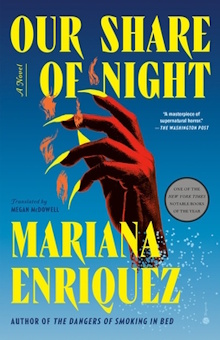
This is a novel that straddles the line between genre and mainstream literature. It’s serious enough to have won a major literary award and be reviewed by the mainstream press due to its political theme. At the same time, it’s supernatural horror with no ifs and buts. Dark magic is very much real in this world and the novel doesn’t hold back in describing the most horrific tortures imaginable to make it work. Taking place across more than thirty years, it covers some of major upheavals that Argentina undergoes in that time and works in a shadowy cult that has manipulated its politics behind the scenes. I found the ending abrupt and unsatisfying but the rest of the book is so very good.
In the 1980s, Juan Peterson’s wife Rosario has just been killed in a bus crash. Despite his physical fragility and deteriorating mental state, he takes his young son Gaspar on a long road trip from their home in Buenos Aires to Iguazú where Rosario’s wealthy family owns an extensive property. Along the way, we learn that Juan has magical powers and is a medium through the cult called the Order channels a god-like being known as the Darkness. Using the secrets and power thus gained, the Orders gains fantastic wealth and it is implied even controls the dictatorship in Argentina. Extensive flashback scenes detail the Order’s founding and their past experiments with previous mediums who invariably die from being used to repeatedly summon the Darkness. Juan suspects that the Order’s leaders including his mother-in-law Mercedes had Rosario killed to prevent her from one day taking over the leadership. He also knows that Gaspar has inherited his powers and so enacts a plan that will play out after his own death to protect his son from being used in the same way. Gaspar is kept unaware of the truth and perceives his father’s actions as abusive and possibly insane.
Told through multiple perspectives dating from the 1960s to the 1990s, Our Share of Night is a fantastic read even without the supernatural elements. Rosario’s scenes in England are a whirlwind tour of the glamorous lifestyle of the scions of the wealthy elite in the 1960s. In between studying at Oxford and Cambridge, they party, drink and do drugs, hang out with David Bowie and read poetry, all the while looking good in the coolest fashions. The adult Gaspar’s experiences from the 1980s onwards cover the AIDS crisis in Argentina, the queer community, student protests as the country transitions from the dictatorship to democracy and more. Shorter flashback scenes take the reader to Nigeria in the 19th-century where an ancestor of the Order all but abducts a local priestess to become their first medium, how the founders made their fortunes with yerba mate plantations and other vast enterprises and built their mansions. The writing is dense with detail about their foods, the music, the flora and fauna, the architecture, the local beliefs and festivals etc. The prose is beautiful and fully immerses the reader in a setting that to us non-Latin Americans often feels as exotic as fantasy.
Yet this is a horror novel and the sections from Juan’s point of view are suffused with terrifying manifestations of the supernatural. Juan is both physically and magically powerful. Yet due to congenital health issues, heart surgery performed on him when he was a child and the strain of being a host for the Darkness, he is so fragile that Gaspar fears he will die every time he falls asleep and relies on painkillers to function. These chapters are easily the best parts of the book, both because of the supernatural elements and the sights that the father and son see on their road trip. At Iguazú, they witness its famous waterfalls. They stop at the house of Tali, Rosario’s sister and also another of Juan’s lovers, where she also maintains a chapel to San La Muerte. Gaspar discovers that he is able to see the spirits of the dead so Juan teaches him how to ignore the manifestations. There are plenty of sex scenes as Juan is bisexual and draws power from the act. In the dungeons of the Order, we see the many victims of their experiments to force the creation of a medium. The descriptions of the torture inflicted on them are some of the worst I’ve ever read in any book. There is a political salience here as well as the dictatorship too disappears large numbers of people to maintain control of the country. The author Mariana Enriquez has a talent for horrific imagery as when she reminds us of the tragedy of Omayra Sánchez Garzón who died over the course of several days in 1985 stuck in volcanic mudflow.
The atmosphere the book evokes is second to none and experiencing the changes in Argentina through the eyes of its many characters is engrossing. I’ve criticized mainstream novels where the speculative elements can be denied as the delusions of the characters or conveniently inconsequential in the grand scheme of things. Here there’s no denying that the dark powers is real and the members of the Order have used them to their benefit. Still, the book is disappointingly vague about the Order’s connections to the dictatorship or how leaders like Florence and Mercedes actually exert their influence. As a story of the lives of Juan, Rosario and Gaspar, it’s amazing but the plot of them fighting against the Order is unsatisfying. For the longest time, they are powerless against the Order’s authority. Then at the end of Gaspar’s story, he gets the better of them with laughable ease and speed and the book just ends. It leaves so much that is unanswered including the nature of the Darkness itself. It’s a book that is much more about the ride than the destination.
I’ve been thinking that I should be reading more mainstream literature and this book is a pretty good example of what I’d be missing out on if I only stuck with genre fiction. I have so much to gain from exploring the many different cultures and historical settings from the real world instead of staying only in fantastical ones. So yes, I really enjoyed reading this novel and hope to discover more like it.