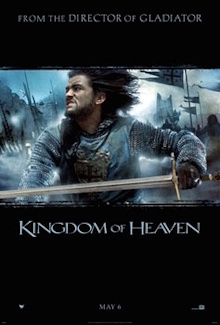
Kingdom of Heaven was critically panned upon release so I never got around to watching it even though I really liked the idea of a historical epic about the Crusades. Critical opinion then turned around with the much longer Director’s Cut that Ridley Scott claims is the version that should have been released in the first place. That is of course the version that I’ve finally just watched. All the old criticisms are still valid including the obvious weakness of Orlando Bloom as the lead, how it can’t quite decide where to opt for gritty realism or fantastical heroism and the historical inaccuracies. But damn if it isn’t a spectacular epic that dunks extra-hard on organized religion.
Balian, a blacksmith in rural France, is in prison after his wife commits suicide due to a miscarriage. When Crusaders pass through the village, their leader Baron Godfrey reveals that Balian is his bastard son and offers him a place in his unit. Balian refuses but that night he murders his brother who is a priest after being provoked and catches up with them. A fight breaks out when the authorities led by Godfrey’s nephew attempt to arrest Balian and Godfrey is wounded. He succumbs to his wounds in Messina after knighting Balian and naming him his heir. After a perilous sea crossing in which he is the sole survivor and confronts a Muslim cavalier, Balian finally arrives in Jerusalem. He is welcomed by his father’s men, meets the leper King Baldwin IV and his marshal Tiberias and becomes involved with the king’s sister the Princess Sibylla. The king desperately wants to uphold peace with Sultan Saladin who leads the Muslim forces but many of the Christian knights including Sibylla’s husband Guy de Lusignan wants to provoke a new war, confident that God will lead them to victory.
While a Balian of Ibelin who defended Jerusalem historically existed, this film takes so many liberties with the character that he may as well be fully fictional. Kingdom of Heaven frames him as a chivalric hero, the proverbial perfect knight, and invents a romance with Sibylla. That turns it into more of a standard action movie which is unfortunate as it has the makings of a more serious, gritty film. The violence is brutal and gory, even showing how horribly Baldwin’s face has been consumed by leprosy, unsentimental in its treatment of religion and the greed of the Crusaders, and offers perspectives from both the Christian and the Muslim sides of the conflict. The action scenes do look good and are epic in scope when the camera pans out, even if I dislike how Balian is hypercompetent at everything. It’s not enough that he’s apparently a fantastic swordsman after only a short training scene, he’s also a great war leader and knows enough about engineering to improve the lands he was given. A better actor than Bloom might be better able to sell the character but he is the weak link in a strong cast of other performers who are all much better than him. This director’s cut is over three hours long but it still moves plenty fast as it covers so many characters and events.
What particularly fascinates me is that while the central conflict is between the Christian Crusaders and the Muslim Saracens, Sultan Saladin is not portrayed as the villain here. He is the honorable opponent as Balian acknowledges that both sides have valid yet competing claims over Jerusalem and its holy sites. Instead the villains are Guy de Lusignan along with all of those who urge for war in the name of religion. Even early on, Balian’s own brother schemes against him using his authority as a priest but the intent is clearly to seize control of Balian’s property for himself. It’s a microcosm of the motivations of most of the Crusaders who war in the name of faith but are really after land and wealth. Balian does embrace a more personal brand of faith that makes himself accountable to God and no one else. It might not be a particularly original take and you can see how it’s a reaction to the post-9/11 world. But I admired Balian’s take it or leave it attitude to religion in that any God that is not compassionate and understanding isn’t one that is worth bowing down to.
Unfortunately the director’s cut can’t fix the film’s most glaring flaws, Casting Bloom was a mistake and Scott focuses on the wrong elements such as the silly perfect knight archetype and the romance that degrade the film’s gravitas. Key parts might have been inspired by historical events such as how the Christian army was ultimately defeated by thirst but the simplistic way it’s shown here make them look like bumbling idiots. Watching this made me think of the more recent Napoleon adaptation which was panned badly. It’s clear that Scott cares more about the story in his head than historical accuracy. He gets away with it better here as the events are so far back in the past that they’re verging on being mythical figures. It’s a watchable film that is impressive on some levels. But it’s not a great film.