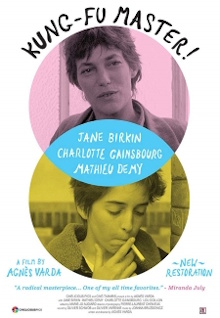
An Agnès Varda film bearing the title of Kung Fu Master is an oddity that I feel compelled to investigate. What’s more is that it stars Jane Birkin and the rest of the performers are relatives of Birkin and Varda herself. The title turns out to be a reference to an arcade video game and the film is full of other 1980s cultural references. But its core is an age-inappropriate relationship. Varda handles the taboo subject with her usual equanimity, never quite letting us know what she herself thinks. It’s a minor Varda film and perhaps not that good but it is fascinating in a very disturbing way.
Lucy the teenaged daughter of housewife Mary-Jane is hosting a garden party with her friends at their home in Paris. Mary-Jane is mildly annoyed at the noise while she is caring for her sick younger daughter Lou. She runs into one of Lucy’s classmates Julien who has drunk too much and teaches him how to throw up into the toilet. She is thereafter intrigued by him and after nearly hitting him with her car outside school, takes him to a café. There he demonstrates his obsession with his favorite video game Kung Fu Master. They meet several more times under different pretenses and Julien grows bolder with her. At one point, he invites her to what he says is his cousin’s house but the address turns out to be a hotel. She refuses to go to a room with him but he does manage to kiss her. Meanwhile Lucy believes that Julian has a crush on her. When they are working on a school project together, she mentions going to her grandparents’ place in England for the holidays. As his mother is away is Africa, he manages to talk his way into joining the trip, allowing him to spend more time with Mary-Jane.
Before realizing what it’s really about, this film feels like a nostalgia throwback to the 1980s. In addition to the arcade video games of the era, we have teenagers sporting leather jackets and learning to smoke, punks with mohawk hairstyles in London, Dungeons & Dragons, the Spitting Image show featuring a puppet Margaret Thatcher, Julian and his friends making water balloons out of condoms and the omnipresent campaign of public awareness about the AIDS crisis. It isn’t meant to be nostalgic as Varda made this while it was all fresh and perhaps it’s a way for her to show how much she is still in tune with the times. But for us watching in 2026 it certainly feels that way. There’s a kind of endearing sweetness here especially since the performers are all close family members who know each other. As Birkin’s real daughters are playing Mary-Jane’s daughters, the family chemistry is real. The opening scene of Varda’s own son Matthieu Demy as Julien in a white gi playing out video game kung fu moves in real life is so cute. It’s a film with very pleasant and familial vibes which makes the way it casually segues into a romantic relationship between Mary-Jane and Julian so very disturbing.
Varda is astute enough to remain ambiguous over just how physical their relationship gets and the focus is on their emotional entanglement. It beggars belief that the English grandparents tacitly give Mary-Jane space to get closer to Julian but fortunately everyone else including Lucy seems sane enough to be properly horrified and shocked. We still need to ask why Varda made this film and it seems that it was at the instigation of Birkin herself while they were working on the documentary Jane B. par Agnès V in parallel. My own interpretation is that this is a portrait of an incredibly immature and unwise woman. Feeling lonely after her divorce, she has latched on to the first male she comes across even if he happens to be an adolescent. Her obsession extends to Julian’s hobbies even though they have nothing in common. In modern parlance, she is crazy and needs therapy. I suppose the twist is that it’s difficult to see Julian as the victim here when he clearly doesn’t take the relationship seriously and casually boasts about the fling to his friends.
I’d say it’s a minor film as there is too little of interest here beyond its shock value. The most charitable meaning that I can glean from it is that all passion, no matter what it’s about, is great so long as it is genuine and sincerely held. I think that’s ridiculous and Mary-Jane gets away with far too little backlash in the film for her actions as even her daughter seemingly forgives her at the end. I suppose a dedicated fan might watch this for the older Birkin and her family members but it’s not really worth watching for most audiences.