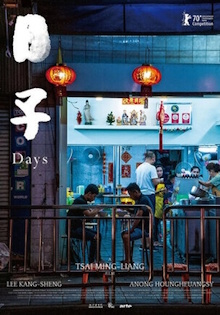
As a huge fan of Tsai Ming-Liang, I was compelled to seek out his latest film which took some doing given its very limited distribution. It stars once again his usual muse Lee Kang-Sheng and opens ominously with the disclaimer that there are no subtitles by design. Indeed there is no more than incidental dialogue and the very long shots with nothing much happening calls for patience. Unfortunately in this instance, one’s patience is not rewarded. Whereas his earlier work was often obscure in meaning, Days is very literal and what it has to say is self-indulgent, simplistic in thought and frankly insulting to the audience.
The middle-aged Kang lives alone in a comfortable house but is afflicted by some indefinable malaise. He is seemingly unable to relax and while trying to exercise feels pain or discomfort in his neck. Meanwhile Non is a migrant in Thailand who lives in a run-down flat. He cooks for himself with a charcoal stove on the floor and runs a stall at a night market. Arriving in the city, Kang checks into a hotel room and undergoes a painful acupuncture treatment that doesn’t appear to help. The two eventually meet in Kang’s hotel room. After stripping the bed of its duvet, he lies utterly naked face down on the mattress. Soon enough Non arrives wearing only underwear and begins giving Kang an oiled massage than quickly turns sexual. Then and only then does Kang begin to relax and whatever ails him is cured.
If you didn’t already know Tsai and Lee are lovers beforehand, this film would be a pretty blatant clue. The film objectifies Lee’s body to a ridiculous extent and the camera lingers so long on his face you can tell how much the director is in love with him. That’s all very well and good for him but I’m not sure what the rest of us are meant to get out of it. It has plenty of shots of the body of the Laotian actor Anong Houngheuangsy who plays Non as well. At least in his case, we do also get authentic-looking scenes of how a migrant lives in Thailand. Tsai allows the shot of him cooking to play out for so long that even if we never get a direct look of the dish, those in the know can recognize that it is Thai papaya salad. To the director’s credit even when nothing of import is seemingly going on, his mastery of composition is such that we are never bored. There is so much that is left blank that our minds naturally grasp for whatever scraps of meaning we can discern.
What meaning that is present however is plain as day and so shallow as to be embarrassing. The loneliness and isolation of people is a recurrent theme in Tsai’s oeuvre so it’s not surprising that Days too is about two such individuals. What’s infuriating is that the sexual encounter between the two is presented as a respite from this isolation, a moment of human connection no matter how brief. This is in spite of it being a paid service. We are even shown Kang taking the precaution of putting aside the cash he intends to pay Non with and keeping the rest of his money in the room’s safe. That Kang also gifts him a simple music box after they’ve put their clothes back on is downright insulting. I suppose it is meant to cement emotional intimacy after the physical intimacy the two have just experienced. But this is done through dialogue and actually getting to know the other person. With that being impossible here by design the use of the music box as a shortcut is laughable. If the characters here were an older man and a young girl, this would be rightly condemned as being predatory. That the two here are both men does not make it better.
I’m aware that I could be wrong in that Tsai’s point of view is neutral and not an endorsement of Kang’s actions. Judging from the context, I don’t think so though. Non responds positively to the gift of the music box and appears to have some affection for it when by rights he should angrily dump the moment he gets away. By all appearances, Tsai imagines this as a sweetly romanticized encounter between the two men. It is not and cannot ever be so. As such this is an incredibly self-indulgent work by a director whose status as a grandmaster of cinema has seemingly placed him above all criticism. It’s unworthy of Tsai’s reputation and so awful that I’m inclined to retrospectively revise my opinion of his work downwards.