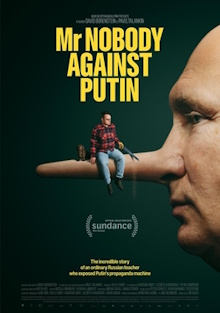
It beggars belief that Russia’s war against Ukraine has gone on for more than four years now with no end in sight. This documentary shows how the conflict has changed and damaged Russia itself, especially its children and youth. That this film is set in Karabash which its subject Pavel Talankin jokes is the most polluted place on Earth is fascinating. That the people who live in it still lead happy lives is amazing. But then Putin launches his war and the Ukrainians’ resistance is beyond what anyone expected and so Pavel watches as his students are subjected to propaganda and the entire school is militarized to support the war effort. I think David Borenstein chooses to put Talankin onscreen more often than is warranted but there is no question that the footage that he smuggled out of Russia offers an invaluable perspective.
Talankin or Pasha as he is known by his nickname, works as a videographer and events coordinator at Karabash Primary School #1, the same school he once attended as a child. Located in the industrial heartlands of Russia, it is mocked on the Internet for being heavily polluted, yet Pasha loves his home all the same and tries to make his office a welcoming space for the students. Things change after the invasion as the authorities amend the curriculum to justify and add requirements for displays of patriotism. As the videographer, Pasha is forced to film these lessons and extracurricular activities and upload the videos to a portal to prove compliance. Not willing to be a propagandist, he considers resigning but then makes contact with David Borenstein of the BBC. He is convinced to remain to document what is happening in Russia’s schools. At times, he mounts small acts of rebellion such as playing the US national anthem as sung by Lady Gaga in school. He is tolerated but is dismayed that only a minority of the residents dare to publicly oppose the war. The history teacher Pavel Abdulmanov in particular is strongly pro-Putin, praises Stalin’s enforces under the USSR and is rewarded with a new apartment. Eventually the school turns into something like a junior training camp as the children are exposed to weapons and participate in grenade throwing competitions while the bodies of those who go to war are sent back.
The draw here is that Talankin is an ordinary person, a Mr. Nobody as the film puts it, who is horrified by what is happening in Russia and feels powerless to do anything about it. Like many places where the government ratchets up the oppression, most people go along with the official line and are afraid to speak out. As the war drags on and Russia’s losses increase, we can see how the people grow more wary about speaking frankly with Pasha or even being associated with him. Even to someone who is relatively up to date on news developments, it is shocking to see the extent of the militarization among the children. It’s not just the flag-waving and marching, the students are told to write letters to soldiers on the front as homework. They are given official lines to speak on camera by the teachers. The school invites Wagner Group mercenaries who tell them stories about losing legs to landmines and getting your head blown off if you hold your helmet wrong. It’s easy for Talankin to get this kind of footage because Putin wants everyone to see how ready Russia is for a prolonged war. By contrast, the most affecting scene is when Pasha secretly records the audio of the funeral of a soldier who is his own class, judging it to be too risky to capture the full video. You can hear the soldier’s mother lamenting his death and that raw expression of grief is something Putin does not want to be seen or heard.
By its very nature, Talankin’s project has to be surreptitious so all of the subjects he filmed were unaware of his intentions. So it’s doubly problematic that many of them are children and those who speak out too severely against the ruling regime will be persecuted. I’m sure that Borenstein who is credited as the director here has been selective in deciding what footage does get included but these concerns still hang over the project like a cloud. I suspect this is also why Talankin himself appears before the camera so often. While he is undoubtedly courageous, the film frames him as more heroic a figure than his deeds warrant. We are shown him waxing lyrical at length over his love for his town and his homeland to prove that he is a true patriot. But there’s only so much that he can express on his own. Even his own mother seems resigned to Putin’s regime and Talankin doesn’t challenge her views directly. His farewell message to his students may be touching and is cleverly written to be ambiguous about his loyalties. But the overall picture is that the Russian populace is at best apathetic about the war and Talankin is able to do little to change their minds.
It is still heartening to know that there are some people like Talankin in Russia and any street-level perspective of what life is like now behind the new Iron Curtain is worth paying attention to. I do wish that the documentary were more about the world around Talankin rather than the man himself. Even additional footage of how ordinary people lived in Karabash would be more interesting.