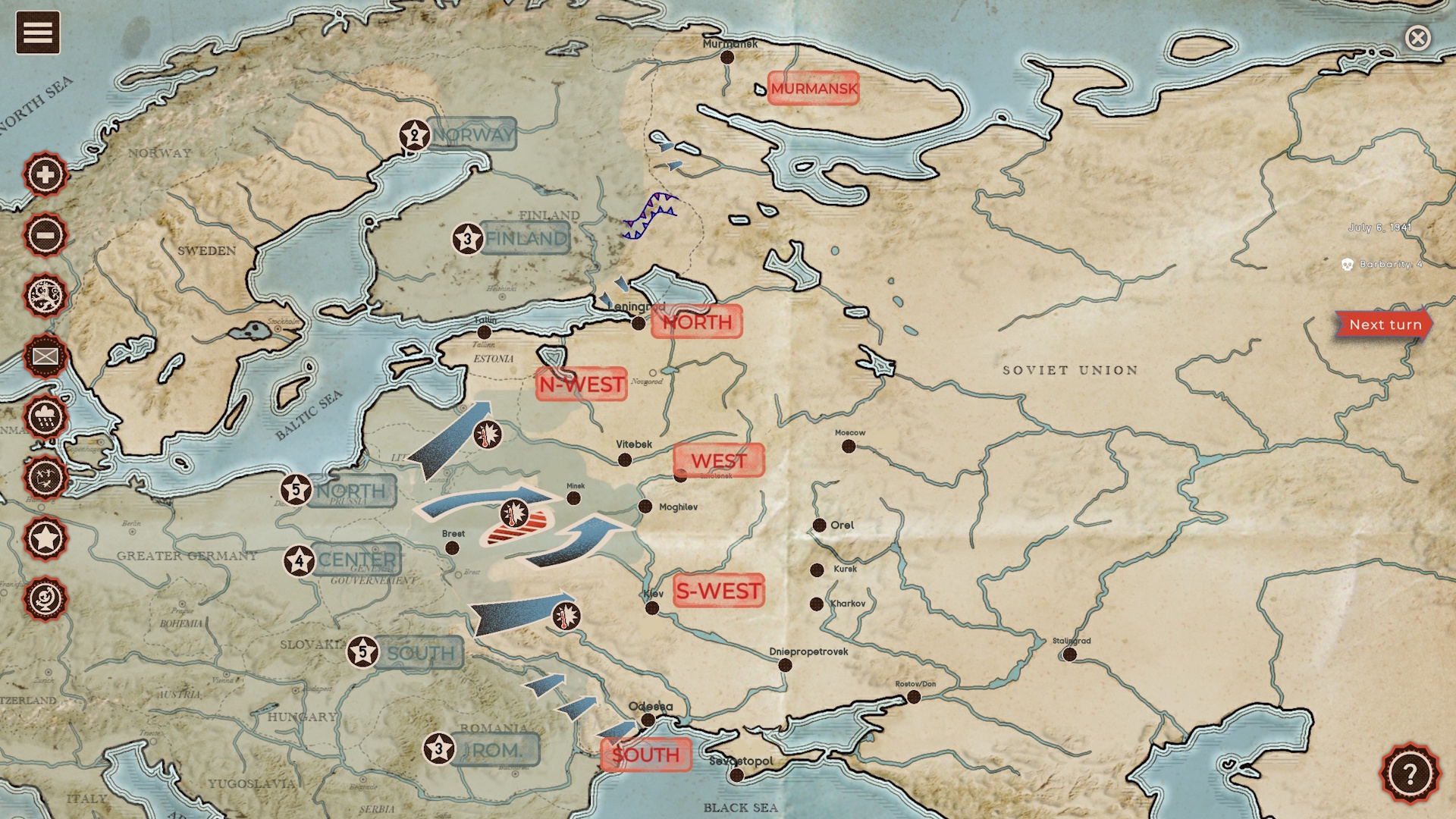
I’m still on decompression mode and so continuing with the smaller games that won’t take too much time to play. As you can tell from its title, its a World War 2 strategy game covering the Nazi Germany’s invasion of the Soviet Union. You can play as either side and a game is short enough that you should be done in a few hours. The user interface is simple so it’s deceptively easy to just click a few buttons and see things happen. But actually knowing what you’re doing and playing well is something else.
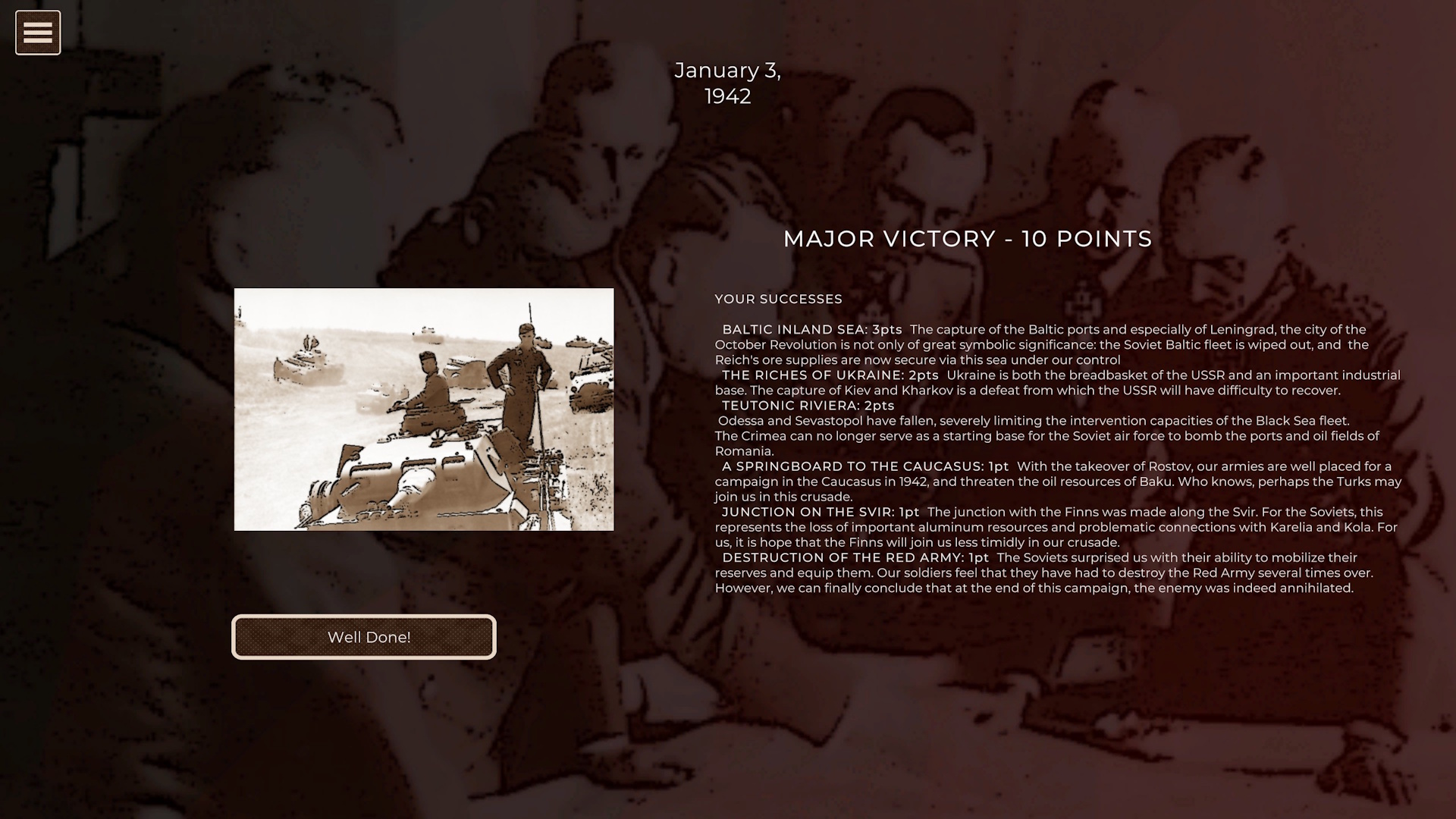
The game offers several scenarios with the main one being Operation Barbarossa itself running from June to December 1941. The smaller scenarios however are really just parts of the larger operation at specific points in history, so Operation Typhoon for example represents the German’s last ditch effort to take Moscow beginning in October 1941. Playing through the Winter Offensive scenario lets you simulate the end of the German offensive and the beginning of the Soviet counterattack. You score victory points by achieving different objectives. In Operation Barbarossa, the Nazis get points for taking Moscow and a host of other key cities like Odessa, Kiev and so on. The Soviets are the mirror opposite and score points by keeping these cities. As the game helpfully tells you, in real life the Nazis only succeeded in scoring 2 points. To win a minor victory here as the Nazis need to score 6 points. One option on the main menu is the Great Campaign but it requires a whopping 11 points to unlock which means taking Moscow. It includes all of the smaller scenarios extending the game up to early 1942 but the unlock requirements are too high for me to bother trying.
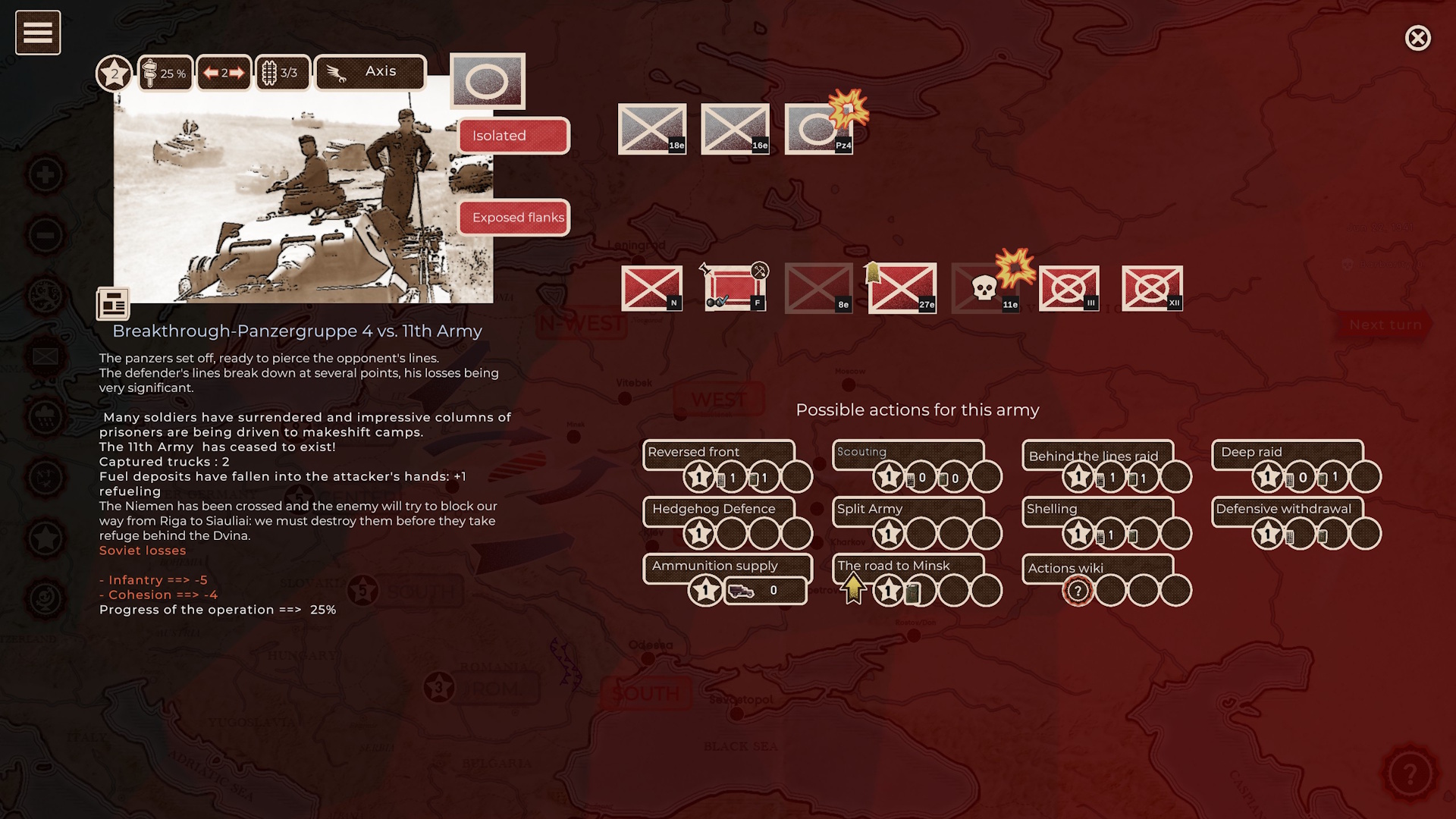
This is a turn-based game in which you move entire armies as units around the map. As the creators note, there are no hexes here. The game is organized around the military operations that historically existed. It measures your progress in achieving the goals of each operation and once it’s complete, you automatically move to the next operation. You have a number of separate army group and each group launches its own set of operations. So playing as the Nazis, the Heeresgruppe Nord controls the operations that is tasked with taking Leningrad. Each group has a certain number of command points each turn and you spend these points to take actions. This includes everything from ordering your aircraft to launch and try to achieve air superiority, to shelling the enemy with a unit or to try a direct assault with an army. The game calculates and reports the results of each action automatically. Once you run out of points, you can no longer do anything with that group for the turn.
You can see why this is easy to play. Click on an operation, select a unit and choose an action for it to perform. There is no building of new units and your armies can generally only move forward, though you can order a tactical withdrawal to trade progress for unit cohesion. In between turns, there might be narrative sections that tell you what is going on and ask you to make decisions, for example whether or not you should feed your prisoners. You successfully complete an objective when the associated operation reaches 100% progress. Playing well is a different matter. The game offers plenty of information such as the composition of each army, how many tanks, infantry and artillery are in it, the skill of its general, its cohesion and so on. But it also obscures information like how exhausted your army is or how well different units do under different conditions. Sometimes it’s common sense. Other times you just have to figure it out. As the Nazis, your Panzers can smash Soviet armies like they’re made out of tissue paper at the beginning. But later as the Soviets adapt and you’re bogged in the snow outside a heavily fortified Moscow, they’re pretty useless.
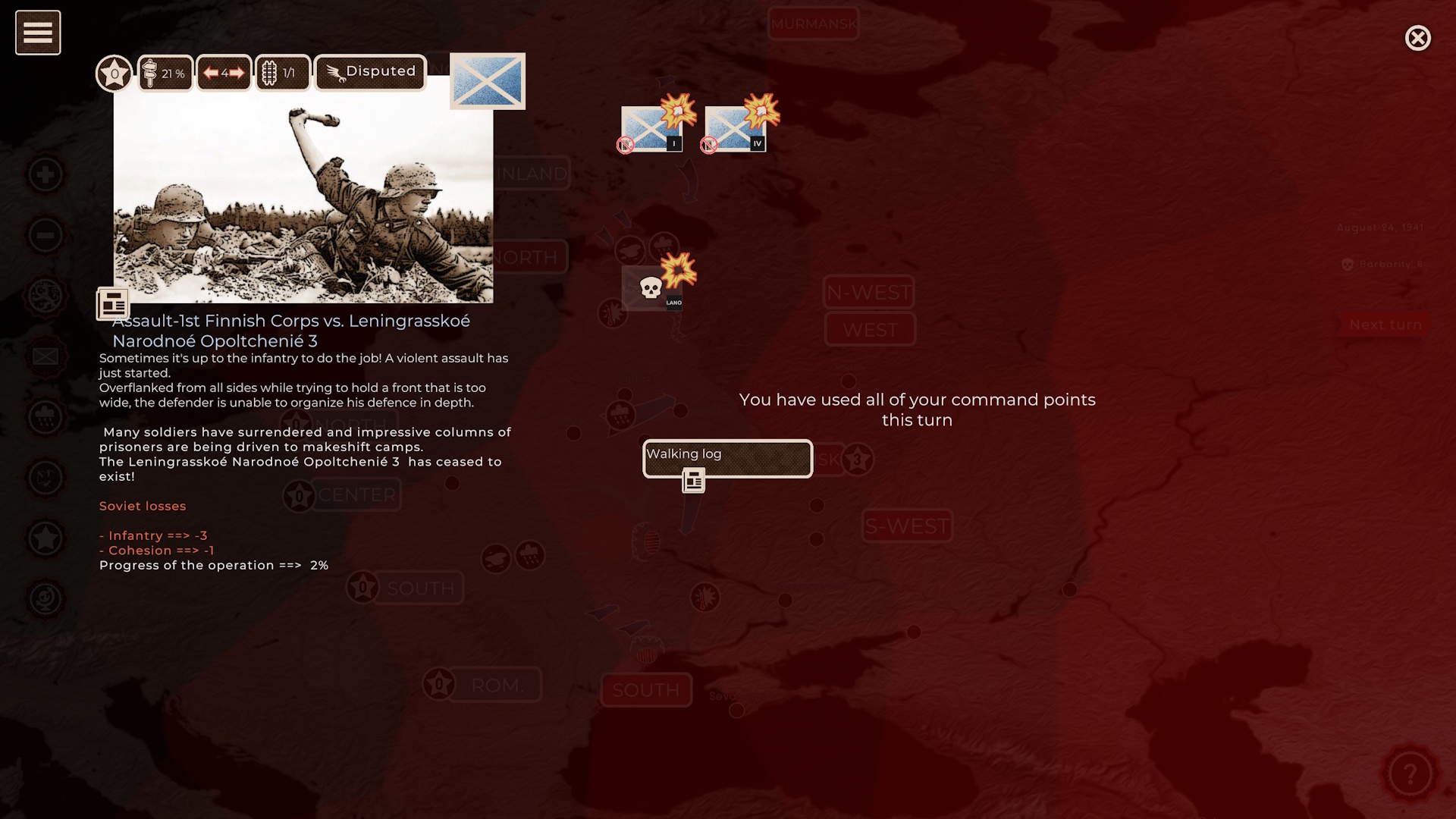
Not being a military historian, I can’t say how accurate all this is but I must presume that the creators know their stuff. I can certainly see how it must be very rewarding to those who are familiar with the historical events and would to simulate how things might turn out differently. I will say that since it simulates battles as operations, it feels like it’s on rails and it can be a matter of luck what kind of outcome your decisions yield. Some decisions seem forced, in that there’s no point in doing otherwise. For example on the first turn as the Nazis, you always want to bomb the Soviet airfields because you can catch a large number of their aircraft unawares. But after that, the option stays there but seems useless as you’re never catch them a second time. Similarly one operation in the far north aims to cut the Murmansk railway. I can’t see how that can ever be possible as it’s just impossible to get any supplies up there. The rules enforce historical realism but they also feel artificially constraining at times. You can send tons of units to Moscow but still be unable to take it because you can only use the command points of the center group there.
It’s fascinating that playing as the Soviets is a completely different experience as their units have different actions. You have large armies as the Soviets but they are rubbish and led by even worse generals. So you get actions like executing traitor generals and kicking the non-Russians out of your armies to try to improve them. No matter what you do, you’ll still be a punching bag for the Nazis so your only hope is to be able to slow them down. If you survive long enough however, the tides turn in your favor. Some mechanics seem odd from the Soviet side. Barbarity still exists but it seems determined by your actions instead of those of the AI-controlled Nazi player. Shooting traitor generals is a terrible action as you desperately need skilled generals but it does raise the barbarity which might be useful. But wait, in that case is the barbarity rating still measuring the same thing? It’s weird. The canned events also start to become irrelevant when you have ahistorical outcomes. The game seemingly doesn’t know quite what to do if you do too well as the Soviets and start counterattacking early.
I bought this mainly because I was curious about the novel way that the developer used to frame a strategic-level wargame. It’s certainly different from anything else I’ve seen, does a remarkable job at capturing the historicity of the scenario and plays reasonably quickly. It was well worth the cheap purchase price and the playing time spent for me. That said, I’m not enough of a fan of wargames to get the most out of it. I noticed that the developer offers a number of other titles that uses the same system, including one that covers the warlord era of China. That’s certainly different and I was intrigued. But again, I’m not enough of a history afficionado to have more than a superficial interest in the period so I’ll pass. But the developer certainly earns my admiration for successfully carving out a unique niche in the wargaming space.