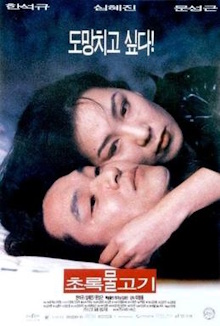
We’ve watched quite a few films by Lee Chan-dong so far but here we go all the way back to his very first one. It’s relatively simple but it may just be my favorite of his works. It’s very similar in tone to the Hong Kong gangster films of the late 1980s and early 1990s but unlike those, this has real pathos and depth. As with Pigs and Battleships, we get the life of a low-level gangster shorn of any glory or dignity and there is no happy ending to be had with the femme fatale of this story.
Returning home after being discharged from the army, Mak-dong notices a beautiful woman on the train and picks up a shawl she drops. He intervenes when she is hassled by a group of toughs and is beaten up. Arriving home at Ilsan, he finds that has changed with high-rise apartments springing up to replace the fields and the trees. His family is desperately poor, his mother works as a maid, his eldest brother is mentally disabled and his other siblings are also struggling. One day he receives a mysterious phone call and deduces that it must be the mysterious woman trying to return the belongings he left on the train. He tracks her down to a nightclub where she works as a singer and learns that her name is Mi-ae. When they meet in the street outside, a group of thugs try to force her into a car. Mak-dong once again tries to intervene and is beaten up. He realizes that Mi-ae is the girlfriend of a local gang boss Bae Tae-gon who also owns the nightclub. Mi-ae talks the boss into giving Mak-dong a job, starting as a car park attendant. After realizing that Mak-dong isn’t shy about violence, he assigns him riskier assignments. Meanwhile Mi-ae continuously flirts with him but he is too loyal to the boss to do anything about it.
As someone who grew up with the Hong Kong gangster flicks of the 1990s, it’s eerie how similar this even in its visual style and color tones. It has all of the common tropes like neon-lit nightclubs, fighting in the streets with bats and bottles, entertaining bosses in KTV lounges and so on. Yet where they go wrong and this one does right is that it doesn’t glamorize the gangster life in the least. Mak-dong keeps losing fights and he is notable to his boss because of his dumb loyalty and his willingness to both take and mete out violence. He is motivated by desperation, not a love of luxury or status, and his ambitions are commensurately modest. The scenes with his family appear irrelevant at first but they are needed to show who he is and what he has to lose. Even better, we that his boss Bae Tae-gon who seemingly has it all is also forced to grovel and humble himself in front of a bigger fish. He pimps Mi-ae out to officials to curry favor and has to endure endless humiliations until his own plans come to fruition. It’s obvious that Bae Tae-gon sees himself in Mak-dong decades ago when he was just starting out which might one reason why the young man rises so fast as his right-hand man. But as he survived only through grit and sheer ruthlessness, he isn’t held back by sentiment or morality, making Mak-dong a fool for being blindly loyal.
I’m also a huge fan of how this film handles the character of Mi-ae. She’s presented as the classic love interest of the protagonist, her shawl brushing across his face in the old-fashioned, cheesy way. She’s naturally a damsel in distress who is abused by her boyfriend. Mak-dong is poised to swoop in to save her, and she all but asks him to at one point. But he is unable to. This is real life, not a fairy tale. Brash and eager to fight as he is, Mak-dong is still just a dog who knows his place. Mi-ae’s contempt for his meek spinelessness is vicious, though it is overshadowed by her own self-hatred. The ending is superb as she understands perfectly well how her chance encounter with Mak-dong on the train changed his fate. This makes her in my opinion one of the best femme fatale characters ever put on screen.
All in all, I think this will probably rank among my favorite gangster films once I’ve had the time to process it a little more. Apparently Mak-dong phone booth scene is iconic but it was his dying scene with his eyeballs bulging in disbelief against the windshield of the car that made more of an impression on me. Its one failing might be that it’s a tad simplistic but its raw intensity wins out for me.