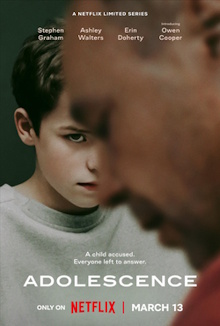
A British miniseries about adolescent male violence that is realistic enough to be shown in schools is a must-watch for us. What’s more, each of the four episodes were shot in a single take, lending it both a powerful sense of urgency and some added authenticity. Unlike other crime shows, there is no question of the perpetrator’s guilt and even details of how the murder itself was carried out aren’t that important. What matters is how the machinery of the state is activated in response to a crime like this and how everyone desperately searches to understand what could have driven a 13-year-old boy to kill.
The four episodes of this series detail the murder of Katie Leonard by her classmate Jamie Miller and its fallout. We see the police arresting Jamie at his home, booking him at the station and presenting the evidence that he was the culprit. Inspector Bascombe then visits the school to determine Jamie’s motive but has difficulty understanding the codes the students use to communicate among themselves. Months later a psychologist Briony Ariston has a session with Jamie who is now in a juvenile detention facility. Her job is to evaluate his mental state to assess if he is fit to stand trial. Finally as the date of Jamie’s trial approaches, we spend a day with his family. It is the birthday of Jamie’s father Eddie and the family is trying their best to make a day of it despite the stresses they are under. Eddie’s temper is pushed to its limit after he discovers that his van has been spray-painted with an insult overnight and their neighbors profess not to have seen anything. This is naturally the latest in a never-ending stream of abuse that the family has suffered since the murder such that Jamie’s mother Manda wants them to move.
There’s no mystery to solve and no real central cast of characters. Jamie doesn’t even appear at all in two of the four episodes. Instead by freely switching characters in and out, we get to see how a high-profile murder case realistically proceeds step by step across a period of months. The first episode in particular is astonishing in its detail as Jamie is arrested, read his rights and processed, with extra care given to the fact that he is a juvenile. Different people are involved at different stages and all contribute to a better understanding of why Jamie acted as he did. At this point, everyone should be aware that he was inspired by ideas from the so-called manosphere spread on the Internet. In a sense, he was bullied for being one of the unpopular boys in school and reacted violently. The show is careful however about delving too deeply into the details of the ideology, probably because it doesn’t want to be a vehicle for spreading these ideas itself. But it is a well-written show that has done its research and skillfully navigates the coded language used by the today’s youngsters and the virtual communities they inhabit.
The show is certainly a triumph of acting with the young Owen Cooper delivering an outstanding performance as Jamie Miller. He is at once far too young, being pitifully ignorant of the true richness of human interactions, and yet also far too old in deriving enjoyment from others being fearful of him. I love the final episode which presents a very ordinary story of how his own parents fell in love with each other to contrast against his own misguided conception of romance. No other commentary is needed. I’m not that big a fan of the continuous single take. Even though it adds urgency, it also locks the episode to a specific time and place, restricting what can be shown in what is already a very short series. I badly wanted to see more from the perspectives of the other students, Katie’s friend Jade for example, or the two other boys who were with Jamie.
In general I suppose the biggest disappointment here might be that there isn’t enough of it. One choice the show makes is to depict everything from the perspective of the adults. Yet Jamie lies both to himself and his father. Despite his best efforts to be approachable, Bascombe is unable to connect with any of the kids except his own son. Ariston must work for months to extract the smallest of confessions from Jamie. This accurately represents how monumentally difficult it is for adults and authority figures to understand what is really going on inside the heads and the lives of the youths. It could be completely different if we got to see the kids talking and interacting with each other in the absence of the adults. The producers are apparently in talks to make a second season and this would be a great approach to take. In any case, this is a great series that truly is every bit as good as everyone says it is. Highly recommended.