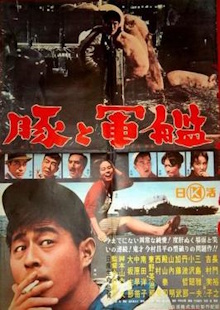
Continuing the string of films that show the darker side of Japan, especially under US occupation, here’s one by Shōhei Imamura. The title sounds ridiculous but makes complete sense given the context and even earns its comedic tone. At its heart is a rather old-fashioned love story between a girl and a bad boy but the incisive message about cultural imperialism elevates it above the usual fare. It’s rather cleverer and more multifaceted than it initially appears even if the moralizing is a tad obvious.
In the 1960s, the city of Yokosuka is the home port of the US Navy’s Seventh Fleet. Driven by poverty, the local Japanese have adapted by catering to the Americans, selling sex, smuggling supplies or a host of other criminal activities. Haruko is one such girl who regularly goes out with American sailors, egged on by her mother who insists that it is a viable path to wealth and security. Her Japanese boyfriend Kinta is jealous and warns her to stay away from them. He is a junior member of the local Yakuza who run a protection racket and act as pimps. They have a long-term plan to develop a pig farm and cultivate a connection with a Japanese-American Sakiyama to get scraps from the US base to cheaply feed the pigs. Kinta hopes that his share of the money from the scheme will be enough for him to marry Haruko. Naturally nothing goes according to plan. A former gang member gets out of jail, hears about the plan and wants his cut. The gang decides to kill him and Kinta has to help dispose of the body. They persuade him to take the fall for the boss in case the murder is discovered. Sakiyama keeps changing the terms of their deal, asking for more money. Meanwhile Tetsuji, Kinta’s immediate supervisor, is ill, compromising his ability to keep the gang members in line.
I started liking this from the moment it opens with a refrain that sounds like the Star-Spangled Banner but quickly morphs into something else. You can tell that this is going to be something that is irreverently brilliant. When I first saw the scenes of the American sailors in what passes for a ridiculously cramped brothel being busted, I thought for sure that the pigs of the title referred to the police. That it means literal pigs, culminating in an entire herd of them barreling down the main street past all of the nightclubs and other gaudy entertainment outlets, is even better. There’s no need to explain what the battleships mean what with the throngs of Americans in the streets of Yokosuka. The Americans in here are non-characters and whatever English they speak is usually unintelligible babble, which makes them extra funny. At the same time, the film doesn’t hold back on the bleakness of the era. Haruko gets in over her head and is raped even as the sailors drunkenly sing a ditty. One of mechanics who the gangsters extort money from ends up committing suicide. Post-war civil society Japan is in terrible shape and we are meant to both laugh and cry at how low they have been brought to.
For all that the Americans are portrayed as dumb brutes here, this is not an anti-American film. It’s target is instead the Japanese who disgrace themselves and even betray one another in order to earn mere scraps off the tables of the Americans. One telling inclusion is the presence of Chinese gangsters also operating in Yokosuka. Unlike the Japanese, they have more dignity and sense than to turn on each other. I appreciate how Imamura doesn’t glorify the Yakuza in the least and explicitly show that their code of brotherhood are all lies. Only the immature Kinta is naive enough to buy into his compatriots’ promises of future benefits in exchange for present sacrifices and so perishes in the end in the most undignified way possible. This approach makes for a great counterpoint to fans of Martin Scorsese who argue that his work doesn’t glorify gangsters.
Watching this, I realized that there are still many worthy works in Imamura’s filmography that I have yet to watch. The post-war period was certainly traumatic for Japan and represents a rich trove of material for artists. A cursory search suggests to me that a curiously small number of films were set in this era and so I’m especially glad that this exists.
One thought on “Pigs and Battleships (1961)”