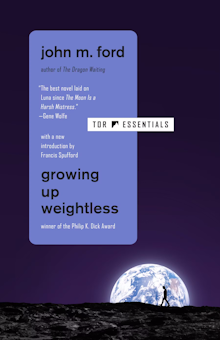
I’m continuing my deep dive into great science-fiction books that I missed out on back in the day so here’s one that was first published in 1993. It’s another book that is difficult to read because it’s full of slang words whose meaning you’re expected to infer from the context, there are no chapter breaks and it freely segues between the perspectives of different characters. Working one’s way through it is well worth your while however as it is simultaneously a very science-fiction novel, being a very detailed account of ordinary life on the surface of the Moon and a very mainstream one as it is an old-fashioned coming-of-age story.
Matthias Ronay is a 13-year-old boy who was born and has lived his entire life on Luna. He is perhaps unusually intelligent and self-aware for his age and together with his gang of friends have completed their studies and must decide what to do with their lives. While hanging out, they play a sort of virtual reality role-playing game inspired by stories of Robin Hood, disparage the tourists from Earth and tiptoe around adolescent emotions. Matthias in particular enjoys hanging around the spaceport and dreams of joining the crew of a starship but more realistically has to choose between committing to a theatre troupe and a job in transportation. As a small act of rebellion, his gang of friends plan a trip without the knowledge of their parents. Matthias has a strained relationship with his father Albin who he believes is overly controlling. Meanwhile Albin understands more about what his son desires than he lets on and as chairman of the Water Board is charged with the responsibility of ensuring that the growing Luna has the water it needs while remaining free of Earth’s influence.
It’s hard getting into the book as it’s full of slang and it thrusts you directly into the bewildering world of ordinary on Luna with no setup. Even after you get into the stride of things, you expect something to come from the grand adventure of Matthias and his friends running away from hope and it’s actually endearing how underwhelming their token disobedience to parental authority is. Yet that is also why it feels so authentic. In his own mind, Matthias is edgy and cynical, taking great care with his online activities to avoid his father’s surveillance. But he’s too much of a good boy to do anything truly bad. His entire group of friends scrupulously follow the rules at every stop of their journey, dutifully save up to pay their own way and make friends along the way. Just as his father is one of the leading figures in the Lunar government, Matthias holds his friend group together. But he is also keenly aware that this may well be the last time that they will all be together.
Accompanying all this is a very detailed description of what it is like for humans to live on the Moon. Having grown up in the low-gravity environment, Matthias and his friends run, leap and twist in three-dimensional space while the tourists from Earth stumble about clumsily and crash into obstacles. Ford delves deep into the technical details, how the different settlements on the Lunar surface are laid out, what their buildings are made of, what they use for transport, the foods they eat, how surgery is performed, the plant network running through tunnels that recycles their water and air, and so much more. It’s almost as if you were there seeing everything with your own eyes. In doing so, Ford pulls off a wonderful literary trick. His account of life on the Moon is crammed so full of technical information and slang words and we know so little of the societal structures there that we’re constantly lost. Yet the moment Matthias and his friends enter the virtual world of their role-playing game, all is familiar to us again because it’s just Sherwood Forest. It’s a neat way of demonstrating how we take for granted the basic knowledge that we need to effectively function in the world around us.
As a true slice-of-life story, we don’t get answers to all of the questions raised here. We don’t know the full extent of the Earth’s corporations plans and how Albin is going to resolve their water issues. We don’t know what will become of Matthias and his friends. Yet such too is the nature of a coming-of-age film. Matthias is still growing into an adult. He will continue to make mistakes as he grows into his own and his father’s problems with the administration of Luna are no longer part of his story. I admit that it took a while for me to get into this book’s groove and I was annoyed by its structure. But I’ve come around to considering this to be a masterpiece and yes, it does make me want to read more mainstream literature.